Department of Prosthodontics, Stomatological Hospital and Dental School of Tongji University, Shanghai Engineering Research Center of Tooth Restoration and Regeneration, Shanghai, 200072, China.
Department of Orthodontics, Shanghai Ninth People's Hospital, College of Stomatology, Shanghai Key Laboratory of Stomatology & Shanghai Research Institute of Stomatology, Shanghai Jiao Tong University School of Medicine, National Clinical Research Center for Oral Diseases, Shanghai, 200125, China.
J Nanobiotechnology. 2022 Jul 26;20(1):342. doi: 10.1186/s12951-022-01549-9.
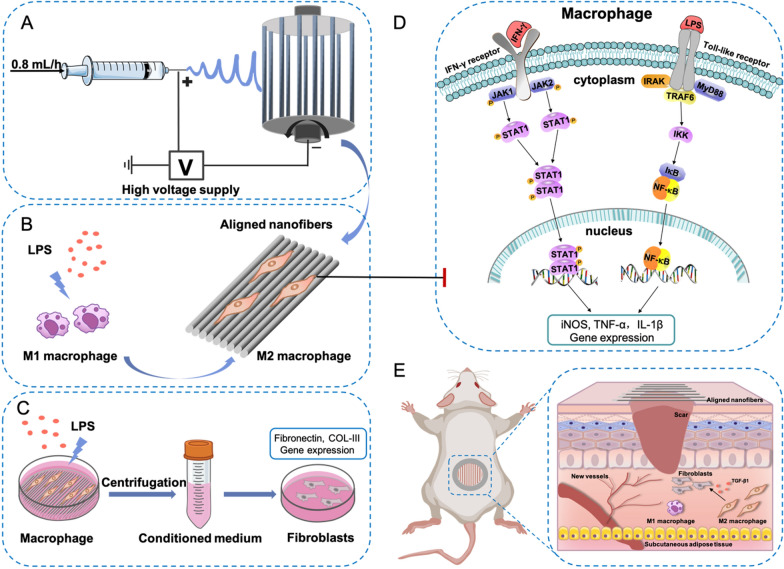
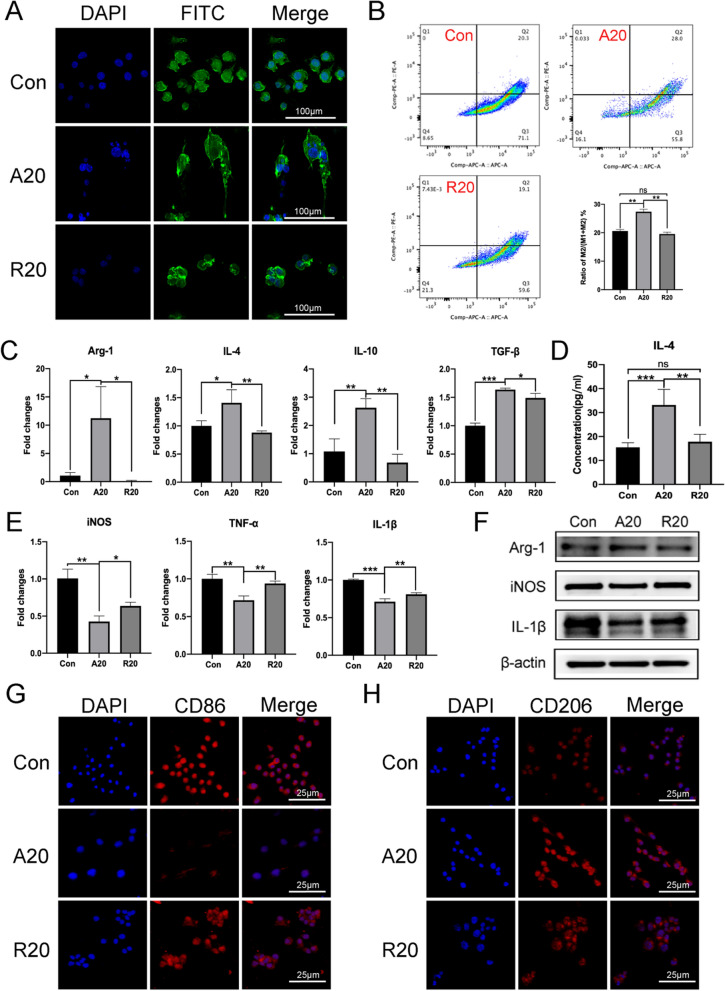
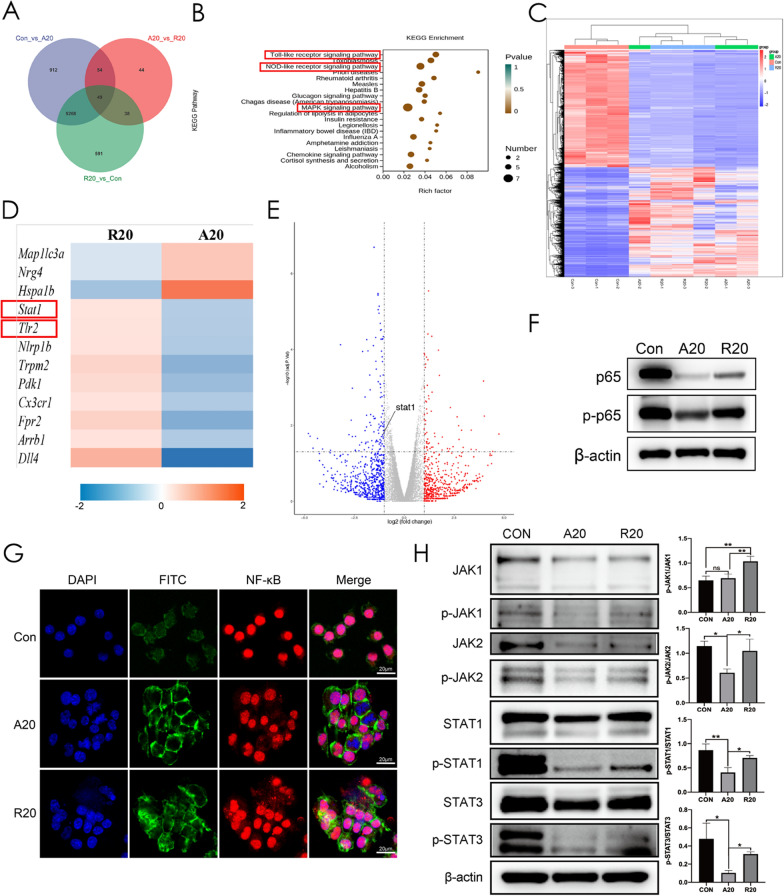
Delayed wound healing remains a challenge, and macrophages play an important role in the inflammatory process of wound healing. Morphological changes in macrophages can affect their phenotype, but little is known about the underlying mechanism. Aligned electrospun nanofibers have natural advantages in modulating cell morphology. Therefore, the current study constructed aligned electrospun nanofibers that could transform macrophages into elongated shapes. Our results demonstrated that aligned nanofibers without exogenous cytokines could downregulate the proinflammatory M1 phenotype and upregulate the prohealing M2 phenotype in an inflammatory environment. Importantly, our study revealed that aligned electrospun nanofibers could inhibit macrophage M1 polarization via the JAK-STAT and NF-κB pathways. Furthermore, the conditioned medium from macrophages cultured on aligned nanofibers could encourage fibroblast migration, proliferation and collagen secretion. In vivo, aligned nanofibers alleviated the inflammatory microenvironment, promoted angiogenesis and accelerated wound healing in mouse skin defects by modulating macrophage phenotypes. Collectively, aligned electrospun nanofibers can influence macrophage polarization via the JAK-STAT and NF-κB pathways and attenuate the local inflammatory response in skin wounds. This study provides a potential strategy to modulate macrophage polarization and promote wound healing by controlling the topology of biomaterials and offers a new perspective for the application of nanotechnology in wound healing.
延迟的伤口愈合仍然是一个挑战,巨噬细胞在伤口愈合的炎症过程中发挥着重要作用。巨噬细胞的形态变化可以影响其表型,但其中的潜在机制知之甚少。取向电纺纳米纤维在调节细胞形态方面具有天然优势。因此,本研究构建了能够将巨噬细胞转化为长形的取向电纺纳米纤维。我们的结果表明,在炎症环境中,没有外源性细胞因子的取向纳米纤维可以下调促炎的 M1 表型,并上调促愈合的 M2 表型。重要的是,我们的研究揭示了取向电纺纳米纤维可以通过 JAK-STAT 和 NF-κB 通路抑制巨噬细胞 M1 极化。此外,在取向纳米纤维上培养的巨噬细胞的条件培养基可以促进成纤维细胞的迁移、增殖和胶原蛋白分泌。在体内,通过调节巨噬细胞表型,取向纳米纤维减轻了皮肤缺损处的炎症微环境,促进了血管生成,并加速了伤口愈合。综上所述,取向电纺纳米纤维可以通过 JAK-STAT 和 NF-κB 通路影响巨噬细胞极化,并减轻皮肤伤口的局部炎症反应。该研究通过控制生物材料的拓扑结构为调节巨噬细胞极化和促进伤口愈合提供了一种潜在策略,并为纳米技术在伤口愈合中的应用提供了新的视角。