Department of Oral Implantology and State Key Laboratory of Oral Diseases and National Clinical Research Center for Oral Diseases, West China Hospital of Stomatology, Sichuan University, Chengdu, Sichuan 610041, China.
State Key Laboratory of Biotherapy, West China Hospital, Sichuan University, Collaborative Innovation Center for Biotherapy, Chengdu, Sichuan 610041, China.
Sci Adv. 2021 May 26;7(22). doi: 10.1126/sciadv.abf0787. Print 2021 May.
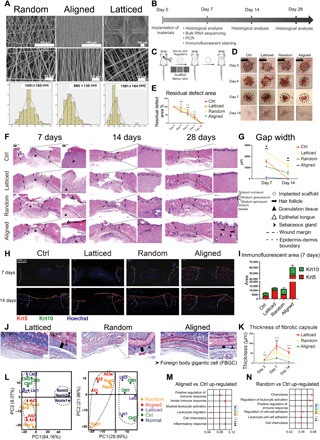
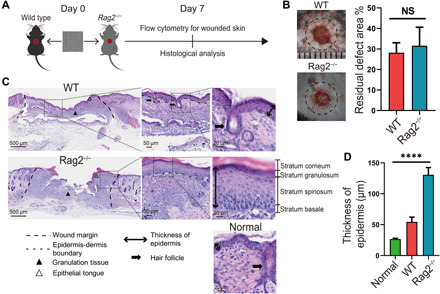
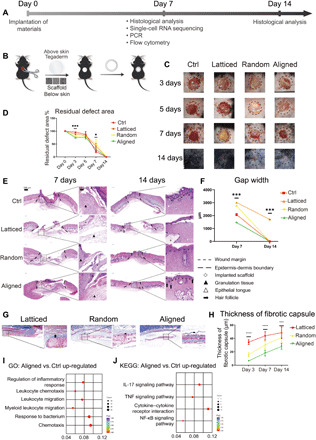
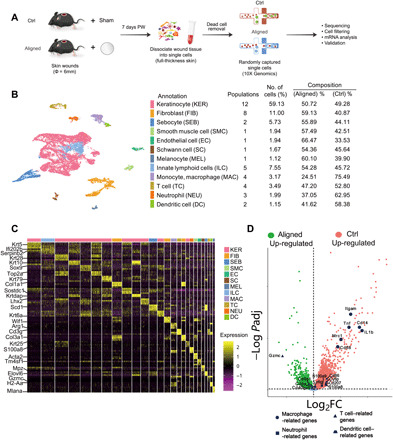
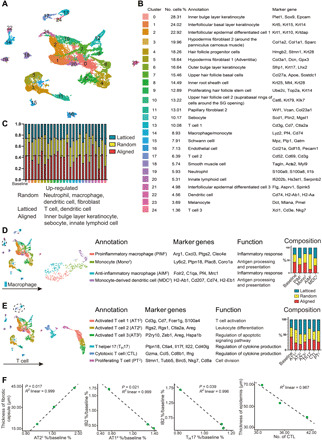
The structural properties of biomaterials play crucial roles in guiding cell behavior and influencing immune responses against the material. We fabricated electrospun membranes with three types of surface topography (random, aligned, and latticed), introduced them to dorsal skin excisional wounds in mice and rats, and evaluated their effects on wound healing and immunomodulatory properties. An overview of different immune cells in the microenvironment with the help of single-cell RNA sequencing revealed diverse cellular heterogeneity in vivo. The time course of immune response was advanced toward an adaptive immunity-dominant stage by the aligned scaffold. In mice without mature T lymphocytes, lack of wound-induced hair neogenesis indicated a regulatory role of T cells on hair follicle regeneration. The microenvironment around scaffolds involved an intricate interplay of immune and cutaneous cells.
生物材料的结构特性在指导细胞行为和影响机体对材料的免疫反应方面起着至关重要的作用。我们制备了具有三种表面形貌(随机、取向和格子)的静电纺丝膜,将其引入小鼠和大鼠的背部皮肤切除伤口中,并评估了它们对伤口愈合和免疫调节特性的影响。单细胞 RNA 测序技术帮助我们对微环境中的不同免疫细胞进行了概述,揭示了体内细胞的异质性。取向支架使免疫反应的时间进程向适应性免疫主导阶段推进。在没有成熟 T 淋巴细胞的小鼠中,缺乏伤口诱导的毛发新生表明 T 细胞在毛囊再生中起调节作用。支架周围的微环境涉及到免疫细胞和皮肤细胞的复杂相互作用。