Yi Youngseok, Baek Ji Yeon, Lee Eunju, Jung Hee-Won, Jang Il-Young
Division of Geriatrics, Department of Internal Medicine, Asan Medical Center, University of Ulsan College of Medicine, Seoul 05505, Korea.
Life (Basel). 2022 Jul 4;12(7):994. doi: 10.3390/life12070994.
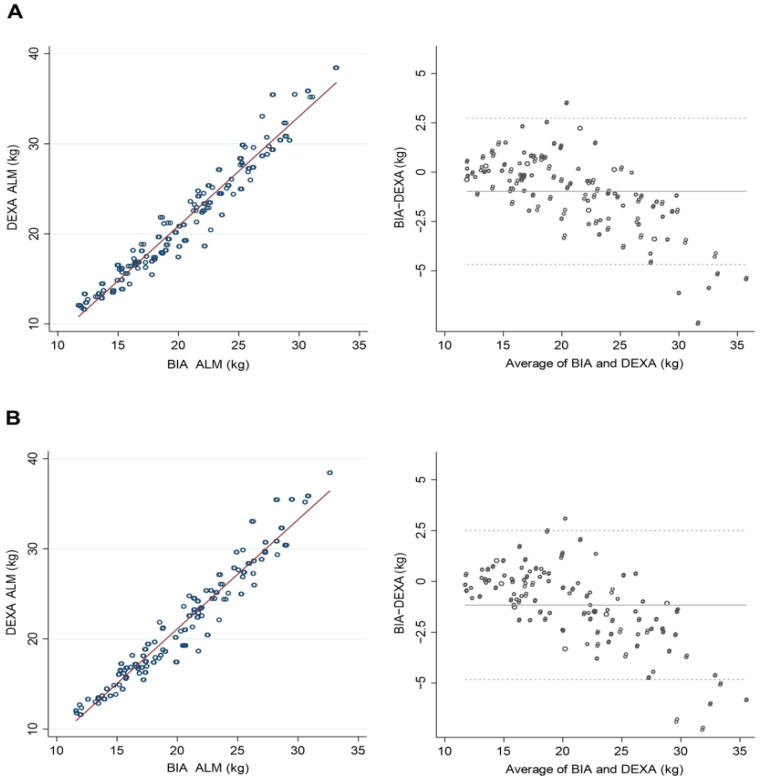
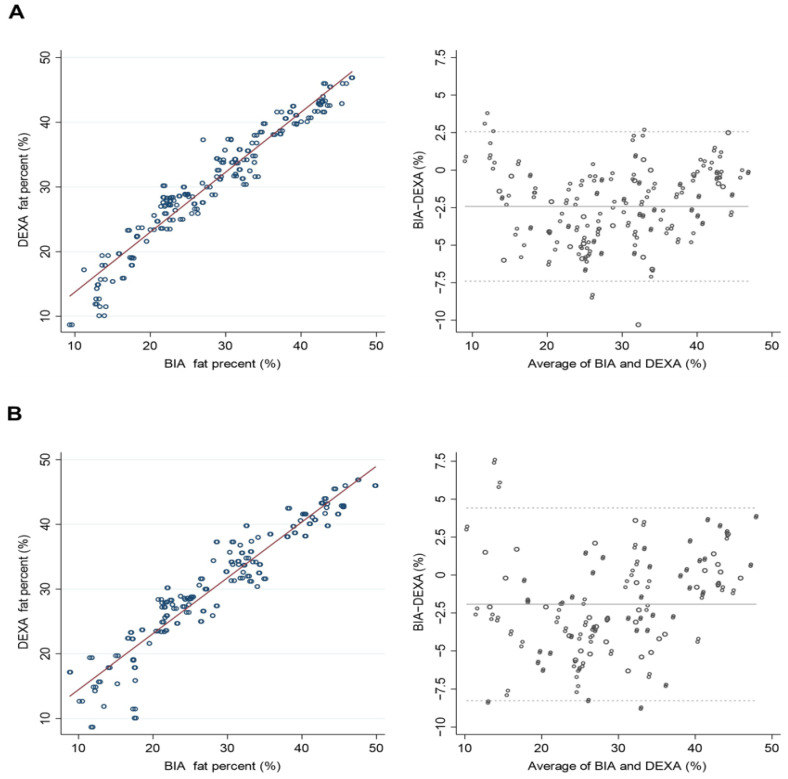
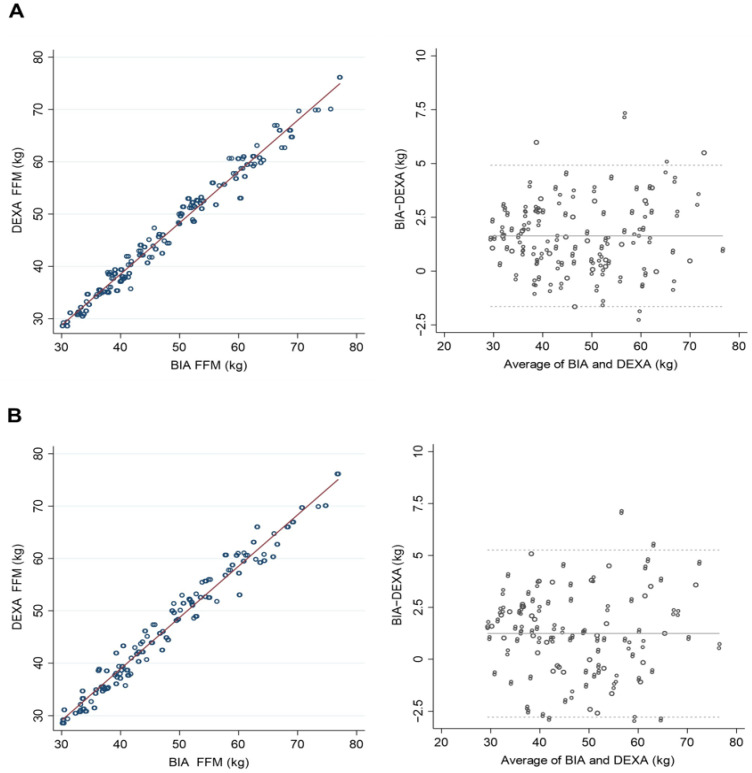
Though bioelectrical impedance analysis (BIA) is a favorable tool for assessing body composition to estimate nutritional status and physical fitness, such as sarcopenia, there are accuracy issues. Hence, high-frequency (HF) BIA equipment uses an additional frequency of 2 and 3 MHz and has been developed as a commercial model. However, there are no studies validating the accuracy and safety of HF-BIA. Therefore, this study aims to assess the validity of HF-BIA in analyzing body composition relative to dual-energy X-ray absorptiometry (DEXA). Appendicular lean mass (ALM), fat-free mass (FFM), and percentage of body fat (PBF) were assessed by HF-BIA and DEXA in 109 individuals; 50.5% ( = 55) were males. The average age and body mass index (BMI) were 43.4 ± 14.7 years and 25.5 ± 6.7 in males and 44.9 ± 14.1 years and 24.0 ± 6.4 in females, respectively. The HF-BIA results showed a high correlation with the DEXA results for assessing ALM (standard coefficient beta (β) ≥ 0.95), FFM (β ≥ 0.98, coefficient of determinations (R) ≥ 0.95), and PBF (β ≥ 0.94, R ≥ 0.89). Body composition measured by HF-BIA demonstrated good agreement with DEXA in Korean adults.
尽管生物电阻抗分析(BIA)是评估身体成分以估计营养状况和身体素质(如肌肉减少症)的有利工具,但仍存在准确性问题。因此,高频(HF)BIA设备使用了2和3兆赫的额外频率,并已开发出商业型号。然而,尚无研究验证HF-BIA的准确性和安全性。因此,本研究旨在评估HF-BIA在分析身体成分方面相对于双能X线吸收法(DEXA)的有效性。对109名个体采用HF-BIA和DEXA评估了上肢瘦体重(ALM)、去脂体重(FFM)和体脂百分比(PBF);其中50.5%(n = 55)为男性。男性的平均年龄和体重指数(BMI)分别为43.4±14.7岁和25.5±6.7,女性分别为44.9±14.1岁和24.0±6.4。HF-BIA结果显示,在评估ALM(标准系数β(β)≥0.95)、FFM(β≥0.98,决定系数(R)≥0.95)和PBF(β≥0.94,R≥0.89)方面,与DEXA结果高度相关。在韩国成年人中,通过HF-BIA测量的身体成分与DEXA显示出良好的一致性。