Alovisi Mario, Carossa Massimo, Mandras Narcisa, Roana Janira, Costalonga Massimo, Cavallo Lorenza, Pira Enrico, Putzu Maria Grazia, Bosio Davide, Roato Ilaria, Mussano Federico, Scotti Nicola
Department of Surgical Sciences, CIR Dental School, University of Turin, Via Nizza 230, 10126 Turin, Italy.
Department of Public Health and Pediatrics, University of Turin, 10126 Turin, Italy.
Materials (Basel). 2022 Jul 12;15(14):4850. doi: 10.3390/ma15144850.
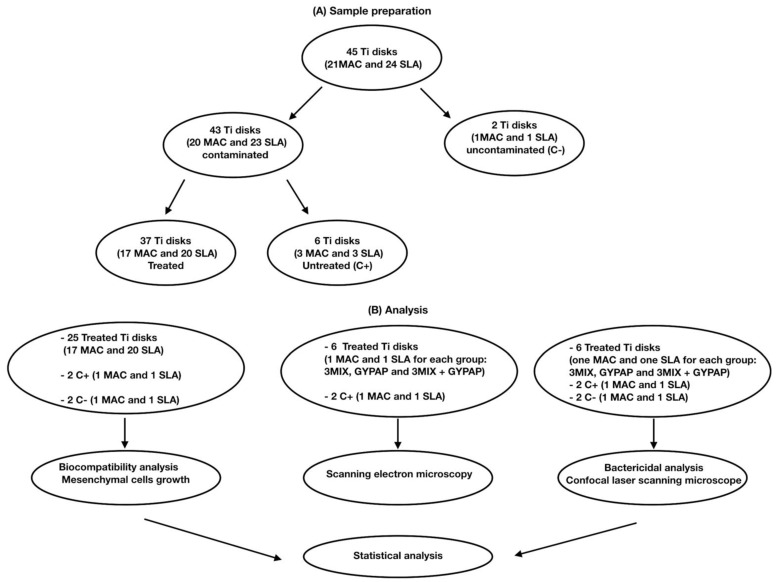
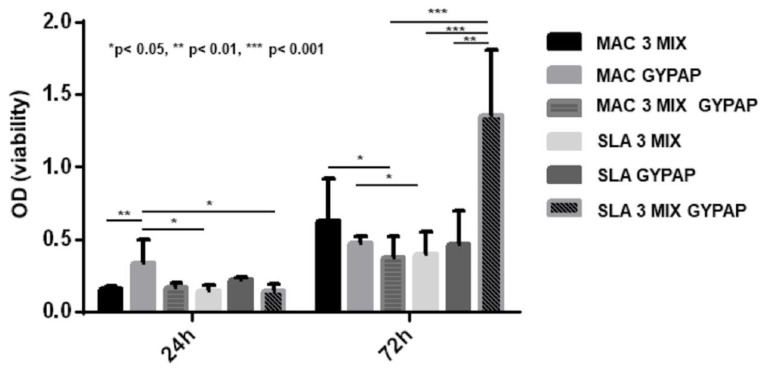
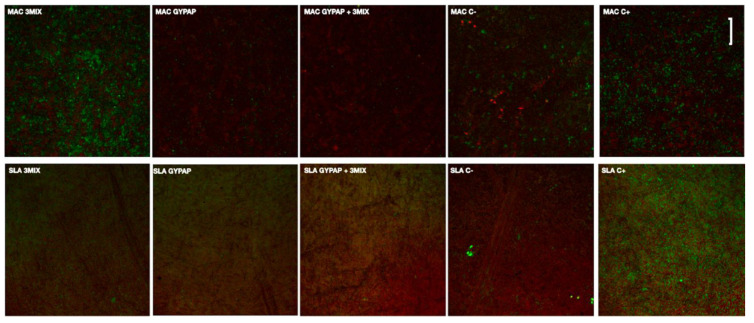
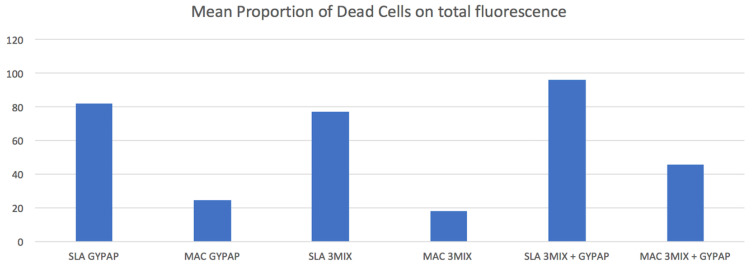
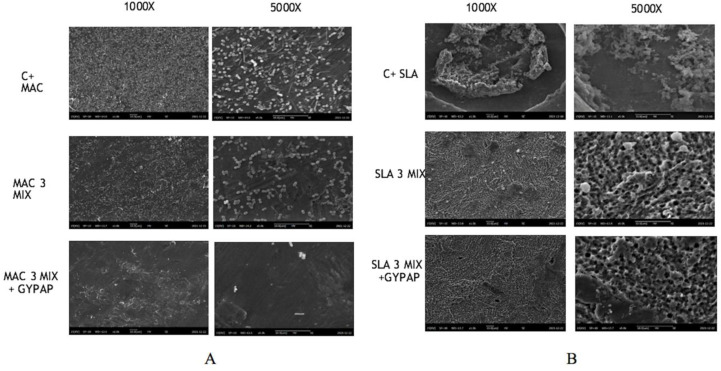
The aim of this in vitro study was to compare three disinfection protocols of biofilm-coated machined (MAC) and acid etched (SLA) commercial pure Grade 4 Titanium disks. Samples were infected with a vial of polymicrobial biofilm to simulate peri-implantitis in vitro. Seventeen MAC and twenty SLA titanium disks were randomly assigned to: (1) glycine powder air-flow (GYPAP) for 1 min; (2) a local delivered triple paste antibiotic composed by a gel mixture with ciprofloxacin, metronidazole, and clarithromycin (3MIX) for 1 h; and (3) a combination of both (GYPAP + 3MIX). Biocompatibility of the titanium disks after each treatment protocol was assessed by measurement of adhesion and growth of adipose-derived mesenchymal stem cells (ASCs) after 24 and 72 h. A confocal laser scanning microscope (CLSM) assessed the antibacterial effect of each treatment. Data of the antibacterial efficacy and cell viability were presented as mean with standard deviation and calculated by one-way ANOVA with multiple comparisons via Bonferroni tests. Results were considered significant with p < 0.05. The higher cell viability was achieved by the 3MIX and GYPAP combination on the SLA surfaces after 72 h. CLSM analysis showed a mean ratio of dead bacteria statistically higher in the 3MIX + GYPAP group compared with the GYPAP and 3MIX subgroups (p < 0.05). In conclusion, data showed that the combination of GYPAP and 3MIX could be preferred to the other protocols, especially in presence of SLA titanium surface.
本体外研究的目的是比较生物膜包被的机械加工(MAC)和酸蚀(SLA)商用纯4级钛盘的三种消毒方案。将样本用一瓶多微生物生物膜感染,以在体外模拟种植体周围炎。17个MAC钛盘和20个SLA钛盘被随机分为:(1)甘氨酸粉末气流(GYPAP)处理1分钟;(2)由环丙沙星、甲硝唑和克拉霉素凝胶混合物组成的局部递送三联糊剂抗生素(3MIX)处理1小时;(3)两者联合(GYPAP + 3MIX)。在每种处理方案后,通过测量脂肪来源间充质干细胞(ASC)在24小时和72小时后的黏附及生长情况,评估钛盘的生物相容性。共聚焦激光扫描显微镜(CLSM)评估每种处理的抗菌效果。抗菌功效和细胞活力数据以平均值和标准差表示,并通过单因素方差分析及Bonferroni检验进行多重比较计算。当p < 0.05时,结果被认为具有显著性。72小时后,3MIX和GYPAP联合处理在SLA表面实现了更高的细胞活力。CLSM分析显示,与GYPAP和3MIX亚组相比,3MIX + GYPAP组死菌的平均比例在统计学上更高(p < 0.05)。总之,数据表明,GYPAP和3MIX联合可能比其他方案更可取,尤其是在存在SLA钛表面的情况下。