Cheung Ka-Shing, Lam Lok-Ka, Zhang Ruiqi, Ooi Poh-Hwa, Tan Jing-Tong, To Wai-Pan, Hui Chun-Him, Chan Kwok-Hung, Seto Wai-Kay, Hung Ivan F N, Leung Wai K
Department of Medicine, Queen Mary Hospital, The University of Hong Kong, 102 Pokfulam Road, Hong Kong.
Department of Microbiology, Queen Mary Hospital, The University of Hong Kong, 102 Pokfulam Road, Hong Kong.
Vaccines (Basel). 2022 Jul 14;10(7):1122. doi: 10.3390/vaccines10071122.
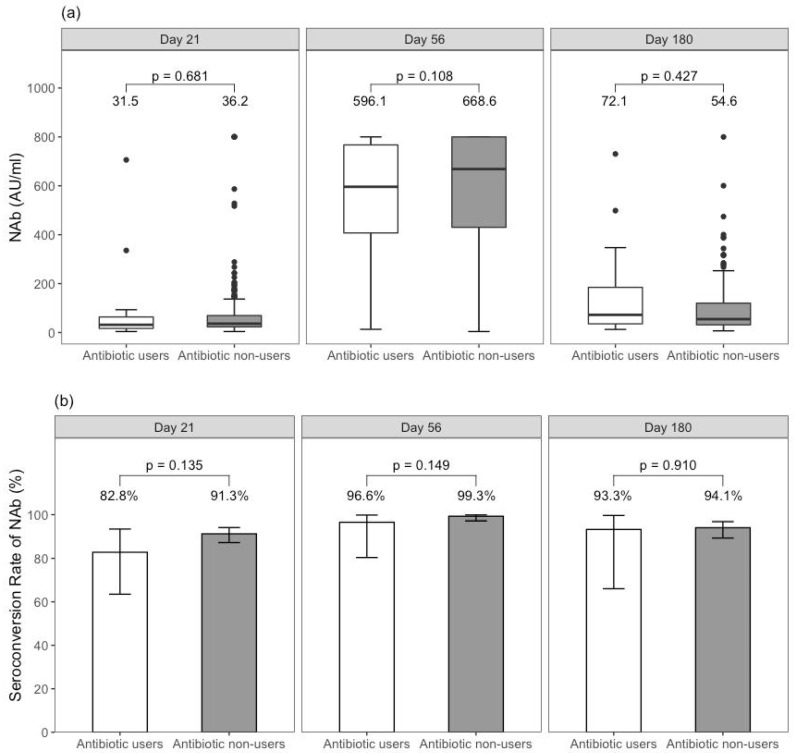
Gut microbiota can be associated with COVID-19 vaccine immunogenicity. We investigated whether recent antibiotic use influences BNT162b2 vaccine immunogenicity. BNT162b2 recipients from three centers were prospectively recruited. Outcomes of interest were seroconversion of neutralising antibody (NAb) at day 21, 56 and 180 after first dose. We calculated the adjusted odds ratio (aOR) of seroconversion with antibiotic usage (defined as ever use of any antibiotics within six months before first dose of vaccine) by adjusting for covariates including age, sex, smoking, alcohol, and comorbidities. Of 316 BNT162b2 recipients (100 [31.6%] male; median age: 50.1 [IQR: 40.0-57.0] years) recruited, 29 (9.2%) were antibiotic users. There was a trend of lower seroconversion rates in antibiotic users than non-users at day 21 (82.8% vs. 91.3%; = 0.14) and day 56 (96.6% vs. 99.3%; = 0.15), but not at day 180 (93.3% vs. 94.1%). A multivariate analysis showed that recent antibiotic usage was associated with a lower seroconversion rate at day 21 (aOR 0.26;95% CI: 0.08-0.96). Other factors associated with a lower seroconversion rate after first dose of the BNT162b2 vaccine included age ≥ 60 years (aOR: 0.34;95% CI: 0.13-0.95) and male sex (aOR: 0.14, 95% CI: 0.05-0.34). There were no significant factors associated with seroconversion after two doses of BNT16b2, including antibiotic use (aOR: 0.03;95% CI: 0.001-1.15). Recent antibiotic use may be associated with a lower seroconversion rate at day 21 (but not day 56 or 180) among BNT162b2 recipients. Further long-term follow-up data with a larger sample size is needed to reach a definite conclusion on how antibiotics influence immunogenicity and the durability of the vaccine response.
肠道微生物群可能与新冠疫苗的免疫原性相关。我们调查了近期使用抗生素是否会影响BNT162b2疫苗的免疫原性。前瞻性招募了来自三个中心的BNT162b2疫苗接种者。感兴趣的结果是在首剂接种后第21天、56天和180天的中和抗体(NAb)血清转化情况。我们通过对年龄、性别、吸烟、饮酒和合并症等协变量进行调整,计算了使用抗生素(定义为在首剂疫苗接种前六个月内曾使用过任何抗生素)情况下血清转化的调整优势比(aOR)。在招募的316名BNT162b2疫苗接种者中(100名[31.6%]为男性;中位年龄:50.1岁[四分位间距:40.0 - 57.0岁]),29名(9.2%)为抗生素使用者。在第21天(82.8%对91.3%;P = 0.14)和第56天(96.6%对99.3%;P = 0.15),抗生素使用者的血清转化率有低于非使用者的趋势,但在第180天(93.3%对94.1%)没有。多变量分析显示,近期使用抗生素与第21天较低的血清转化率相关(aOR 0.26;95%置信区间:0.08 - 0.96)。首剂BNT162b2疫苗后血清转化率较低的其他相关因素包括年龄≥60岁(aOR:0.34;95%置信区间:0.13 - 0.95)和男性(aOR:0.14,95%置信区间:0.05 - 0.34)。两剂BNT16b2疫苗接种后,没有与血清转化相关的显著因素,包括抗生素使用(aOR:0.03;95%置信区间:0.001 - 1.15)。近期使用抗生素可能与BNT162b2疫苗接种者在第21天(而非第56天或180天)较低的血清转化率相关。需要更多长期随访数据和更大样本量才能就抗生素如何影响免疫原性和疫苗反应的持久性得出明确结论。