Wu Rongjie, Li Haotao, Sun Chuanwei, Liu Jialin, Chen Duanyong, Yu Haiyang, Huang Zena, Lin Sien, Chen Yuanfeng, Zheng Qiujian
Department of Orthopedics, Guangdong Provincial People's Hospital, Guangdong Academy of Medical Sciences, Guangzhou, PR China.
Shantou University Medical College, Shantou, China.
J Orthop Translat. 2022 Jul 11;36:8-17. doi: 10.1016/j.jot.2022.05.009. eCollection 2022 Sep.
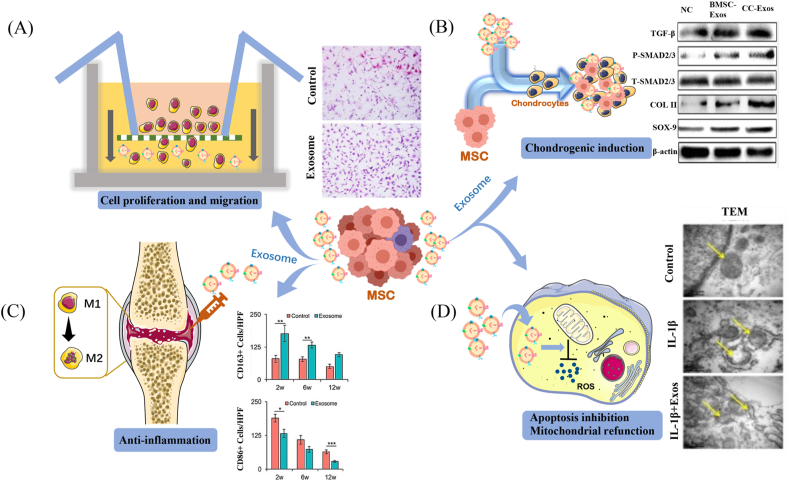
Degenerative diseases in orthopaedics have become a significant global public health issue with the aging of the population worldwide. The traditional medical interventions, including physical therapy, pharmacological therapy and even surgery, hardly work to modify degenerative progression. Stem cell-based therapy is widely accepted to treat degenerative orthopaedic disease effectively but possesses several limitations, such as the need for strict monitoring of production and storage and the potential risks of tumorigenicity and immune rejection in clinical translation. Furthermore, the ethical issues surrounding the acquisition of embryonic stem cells are also broadly concerned. Exosome-based therapy has rapidly grown in popularity in recent years and is regarded as an ideal alternative to stem cell-based therapy, offering a promise to achieve 'cell-free' tissue regeneration.
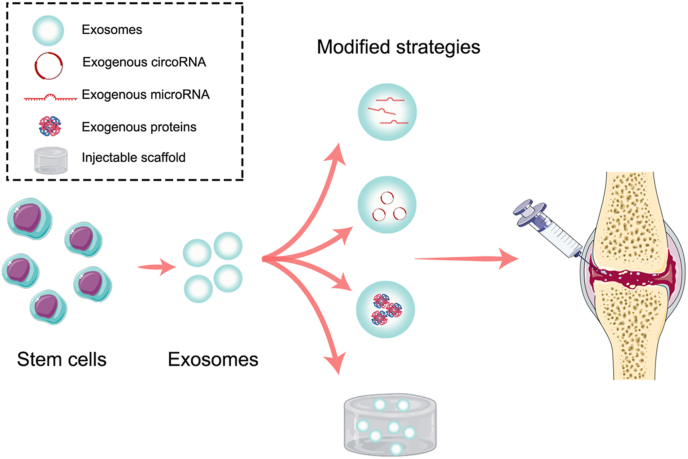
Traditionally, the native exosomes extracted from stem cells are directly injected into the injured site to promote tissue regeneration. Recently, several modified exosome-based strategies were developed to overcome the limitations of native exosomes, which include mainly exogenous molecule loading and exosome delivery through scaffolds. In this paper, a systematic review of the exosome-based strategy for degenerative disease in orthopaedics is presented.
Treatment strategies based on the native exosomes are effective but with several disadvantages such as rapid diffusion and insufficient and fluctuating functional contents. The modified exosome-based strategies can better match the requirements of the regeneration in some complex healing processes.
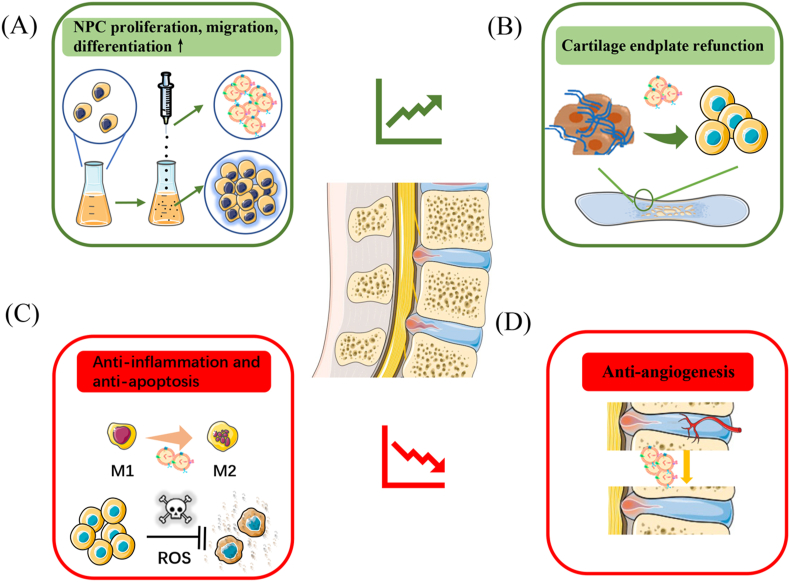
Exosome-based strategies hold promise to manage degenerative disease in orthopaedics prior to patients reaching the advanced stage of disease in the future. The timely summary and highlights offered herein could provide a research perspective to promote the development of exosome-based therapy, facilitating the clinical translation of exosomes in orthopaedics.
Exosome-based therapy is superior in anti-senescence and anti-inflammatory effects and possesses lower risks of tumorigenicity and immune rejection relative to stem cell-based therapy. Exosome-based therapy is regarded as an ideal alternative to stem cell-based therapy, offering a promise to achieve 'cell-free' tissue regeneration.
随着全球人口老龄化,骨科退行性疾病已成为一个重大的全球公共卫生问题。包括物理治疗、药物治疗甚至手术在内的传统医学干预措施,几乎无法改变退行性病变的进程。基于干细胞的疗法被广泛认为可有效治疗骨科退行性疾病,但存在一些局限性,例如需要严格监测生产和储存过程,以及在临床转化中存在致瘤性和免疫排斥的潜在风险。此外,围绕胚胎干细胞获取的伦理问题也备受广泛关注。近年来,基于外泌体的疗法迅速受到欢迎,被视为基于干细胞疗法的理想替代方案,有望实现“无细胞”组织再生。
传统上,从干细胞中提取的天然外泌体直接注射到损伤部位以促进组织再生。最近,人们开发了几种基于外泌体的改良策略来克服天然外泌体的局限性,主要包括外源性分子加载和通过支架递送外泌体。本文对基于外泌体的骨科退行性疾病治疗策略进行了系统综述。
基于天然外泌体的治疗策略是有效的,但存在一些缺点,如快速扩散以及功能成分不足和波动。基于外泌体的改良策略在某些复杂的愈合过程中能更好地满足再生需求。
基于外泌体的策略有望在未来患者病情发展到晚期之前管理骨科退行性疾病。本文及时的总结和重点内容可为促进基于外泌体疗法的发展提供研究视角,推动外泌体在骨科的临床转化。
基于外泌体的疗法在抗衰老和抗炎作用方面更具优势,相对于基于干细胞的疗法,具有更低的致瘤性和免疫排斥风险。基于外泌体的疗法被视为基于干细胞疗法的理想替代方案,有望实现“无细胞”组织再生。