Boyden Jackelyn Y, Hill Douglas L, LaRagione Gwenn, Wolfe Joanne, Feudtner Chris
Justin Michael Ingerman Center for Palliative Care, The Children's Hospital of Philadelphia, Philadelphia, PA 19104, USA.
Department of Psychosocial Oncology, Dana-Farber Cancer Institute, Boston, MA 02215, USA.
Children (Basel). 2022 Jul 26;9(8):1115. doi: 10.3390/children9081115.
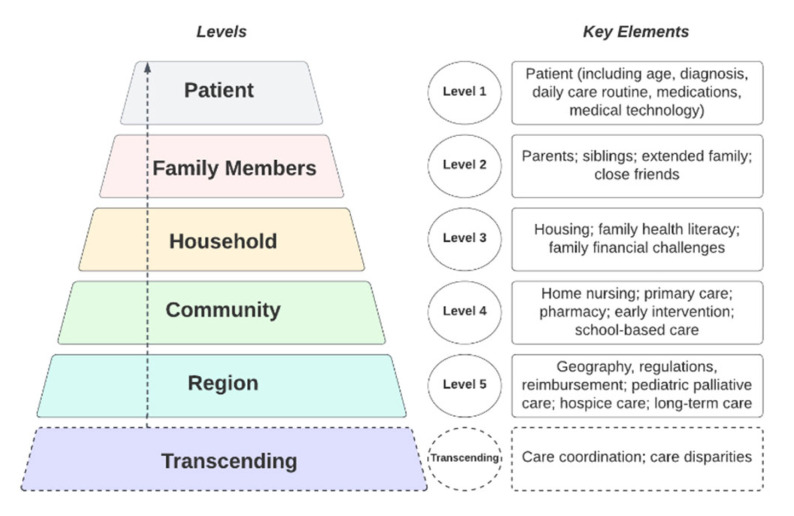
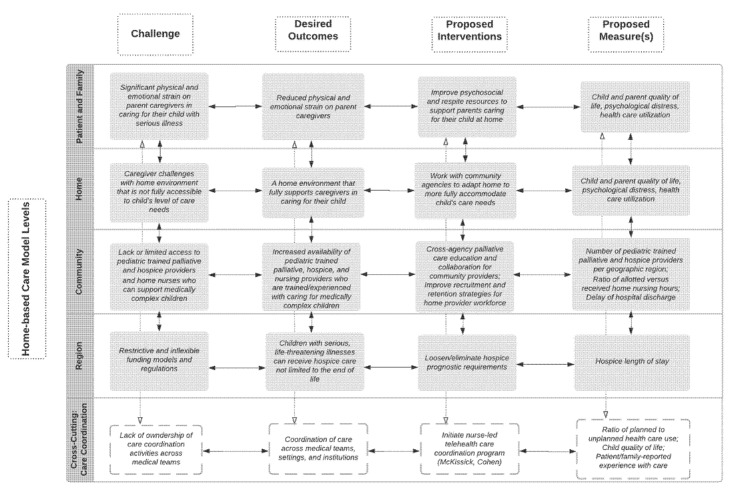
Care for U.S. children living with serious illness and their families at home is a complex and patchwork system. Improving home-based care for children and families requires a comprehensive, multilevel approach that accounts for and examines relationships across home environments, communities, and social contexts in which children and families live and receive care. We propose a multilevel conceptual framework, guided by Bronfenbrenner's ecological model, that conceptualizes the complex system of home-based care into five levels. Levels 1 and 2 contain patient and family characteristics. Level 3 contains factors that influence family health, well-being, and experience with care in the home. Level 4 includes the community, including community groups, schools, and providers. Level 5 includes the broader regional system of care that impacts the care of children and families across communities. Finally, care coordination and care disparities transcend levels, impacting care at each level. A multilevel ecological framework of home-based care for children with serious illness and families can be used in future multilevel research to describe and test hypotheses about aspects of this system of care, as well as to inform interventions across levels to improve patient and family outcomes.
在美国,为身患重病的儿童及其家庭提供居家护理是一个复杂且拼凑而成的体系。改善针对儿童及其家庭的居家护理需要采取一种全面的、多层次的方法,这种方法要考虑并审视儿童及其家庭生活和接受护理的家庭环境、社区及社会环境之间的关系。我们提出了一个以布朗芬布伦纳的生态模型为指导的多层次概念框架,该框架将复杂的居家护理系统概念化为五个层次。第一层和第二层包含患者及家庭特征。第三层包含影响家庭健康、幸福以及居家护理体验的因素。第四层包括社区,其中有社区团体、学校和护理提供者。第五层包括影响跨社区儿童及其家庭护理的更广泛的区域护理系统。最后,护理协调和护理差异贯穿各个层次,影响着每个层次的护理。针对身患重病的儿童及其家庭的居家护理多层次生态框架可用于未来的多层次研究,以描述和检验有关该护理系统各方面的假设,并为各层次的干预措施提供信息,从而改善患者和家庭的结局。