Clinical Hospital Center Split, School of Medicine, Department of Oncology, University of Split, 21 000 Split, Croatia.
Department of Health Studies, University of Split, 21 000 Split, Croatia.
Curr Oncol. 2022 Jul 23;29(8):5223-5237. doi: 10.3390/curroncol29080415.
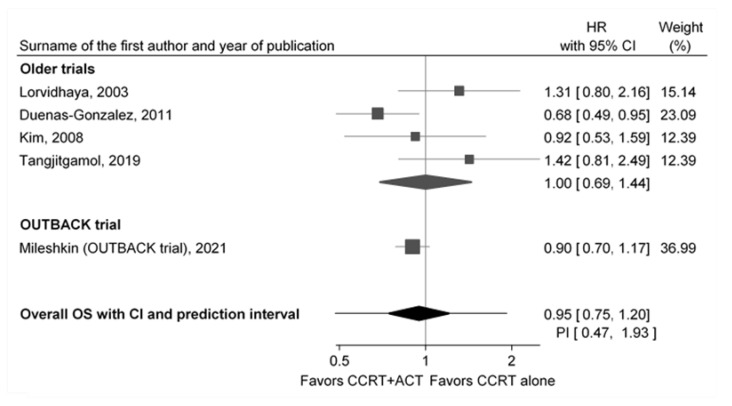
Findings on the efficacy of adjuvant chemotherapy (ACT) of locally advanced cervical cancer (LACC) after the concurrent chemoradiation (CCRT) therapy were inconsistent, and the OUTBACK trial was expected to shed some light regarding the topic. Its results on ACT in LACC were negative, with the conclusion of not to use it. The objective of this review was to present the inconsistencies of previous studies, along with the OUTBACK trial in more detail, and to rethink whether its results provide an unambiguous and definite answer to the optimal position of ACT in the treatment of LACC. To critically appraise the OUTBACK trial and understand the consequences of its results, we used only randomized controlled studies (RCTs) on ACT in LACC that have been included in high-quality systematic reviews and meta-analyses. We calculated the pooled prediction intervals using a random effects meta-analysis of all published randomized studies including the OUTBACK trial. After combining the OUTBACK trial with the results of four previous randomized trials, the pooled hazard ratio for overall survival benefit of CCRT + ACT was 0.95 (95% CI 0.75; 1.20). The pooled hazard ratio of the four previous trials was 1.00 (95% CI 0.69; 1.44). The OUTBACK trial improved the precision of the pooled estimate, but the clinical heterogeneity and the consequent prediction intervals are still very wide, and with 95% reliability, we can expect that if the new study, using a similar approach to the ACT, on a randomly selected patient population from the presented five trials is conducted, its hazard ratio for overall survival after ACT would be between 0.47 and 1.93. In conclusion, there is an absolute need for further research in order to optimally define the position of ACT in the treatment of LACC.
辅助化疗(ACT)在同期放化疗(CCRT)后对局部晚期宫颈癌(LACC)疗效的研究结果不一致,因此 OUTBACK 试验有望对此提供一些信息。该试验结果为 ACT 对 LACC 无效,结论为不应使用 ACT。本综述的目的是更详细地介绍先前研究的不一致之处以及 OUTBACK 试验,并重新思考其结果是否为 ACT 在治疗 LACC 中的最佳位置提供了明确和明确的答案。为了批判性地评价 OUTBACK 试验并了解其结果的后果,我们仅使用已包含在高质量系统评价和荟萃分析中的 ACT 治疗 LACC 的随机对照研究(RCT)。我们使用随机效应荟萃分析对包括 OUTBACK 试验在内的所有已发表的随机研究进行汇总预测区间计算。将 OUTBACK 试验与之前的四项随机试验的结果相结合后,CCRT+ACT 的总生存获益的汇总风险比为 0.95(95%CI 0.75; 1.20)。四项先前试验的汇总风险比为 1.00(95%CI 0.69; 1.44)。OUTBACK 试验提高了汇总估计的精度,但临床异质性和随之而来的预测区间仍然非常广泛,在 95%的可信度下,我们可以预期,如果使用类似 ACT 的方法对来自所呈现的五项试验的随机患者群体进行新的研究,其 ACT 后总生存的风险比将在 0.47 和 1.93 之间。总之,为了优化 ACT 在 LACC 治疗中的地位,绝对需要进一步的研究。