Biomedical Engineering Department, Boston University, MA, USA.
Biological Design Center, Boston University, Boston, MA, USA.
Lab Chip. 2022 Aug 9;22(16):2925-2937. doi: 10.1039/d2lc00254j.
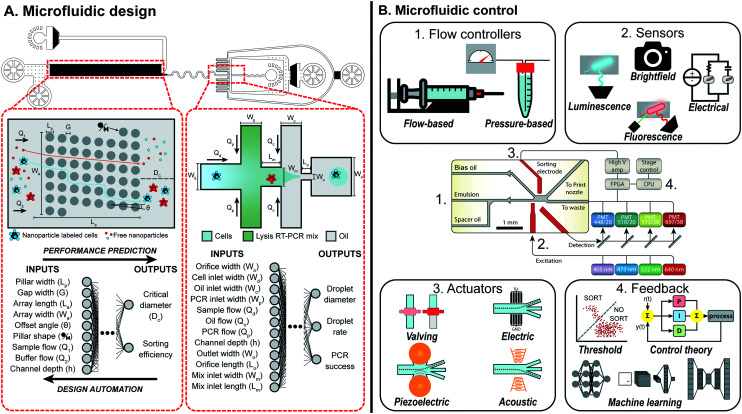
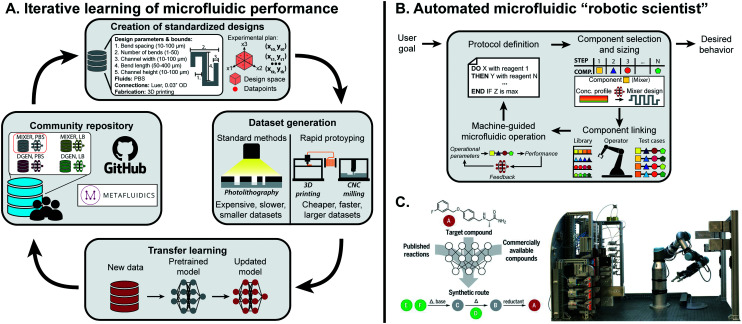
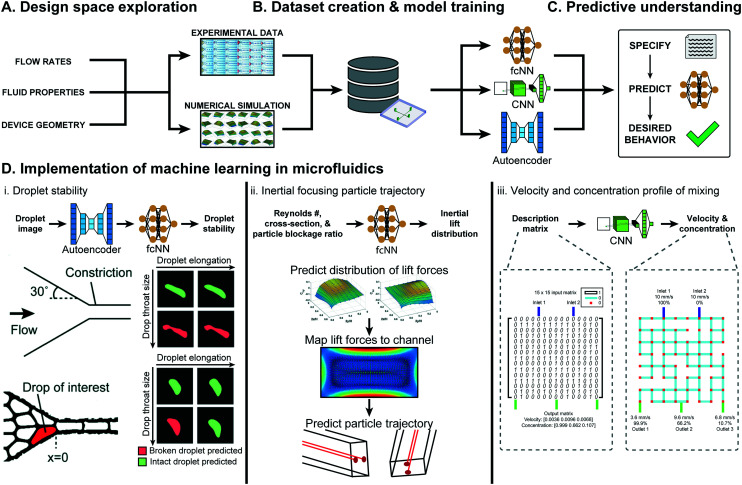
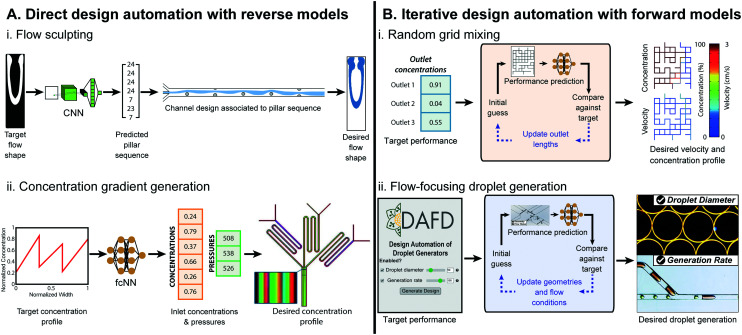
Microfluidics has developed into a mature field with applications across science and engineering, having particular commercial success in molecular diagnostics, next-generation sequencing, and bench-top analysis. Despite its ubiquity, the complexity of designing and controlling custom microfluidic devices present major barriers to adoption, requiring intuitive knowledge gained from years of experience. If these barriers were overcome, microfluidics could miniaturize biological and chemical research for non-experts through fully-automated platform development and operation. The intuition of microfluidic experts can be captured through machine learning, where complex statistical models are trained for pattern recognition and subsequently used for event prediction. Integration of machine learning with microfluidics could significantly expand its adoption and impact. Here, we present the current state of machine learning for the design and control of microfluidic devices, its possible applications, and current limitations.
微流控技术已经发展成为一个成熟的领域,其应用涵盖了科学和工程领域,在分子诊断、下一代测序和台式分析等方面取得了特别的商业成功。尽管它无处不在,但设计和控制定制微流控设备的复杂性给采用带来了重大障碍,需要从多年的经验中获得直观的知识。如果克服了这些障碍,微流控技术可以通过全自动平台的开发和操作,将生物和化学研究小型化,供非专业人士使用。微流控专家的直觉可以通过机器学习来捕捉,其中复杂的统计模型被用于模式识别,并随后用于事件预测。将机器学习与微流控技术集成,可以显著扩大其应用和影响。在这里,我们介绍了机器学习在微流控设备设计和控制方面的现状、可能的应用以及当前的局限性。