Wang Yue, Shen Xiao, Gong Longyuan, Zhao Yongchao, Xiong Xiufang
Cancer Institute of the Second Affiliated Hospital, Zhejiang University School of Medicine, Hangzhou, Zhejiang, People's Republic of China.
Institute of Translational Medicine, Zhejiang University School of Medicine, Hangzhou, Zhejiang, People's Republic of China.
Cell Death Discov. 2022 Jul 29;8(1):342. doi: 10.1038/s41420-022-01143-w.
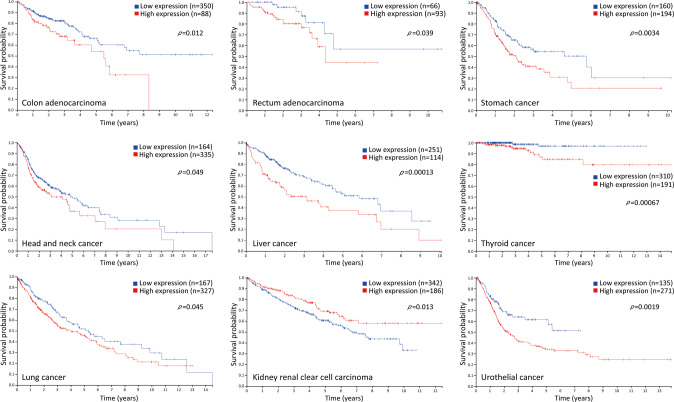
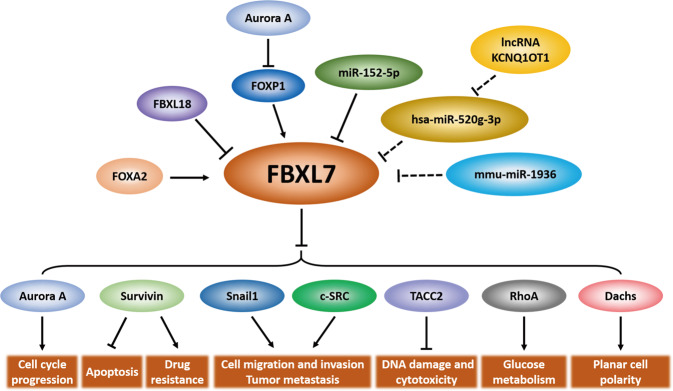
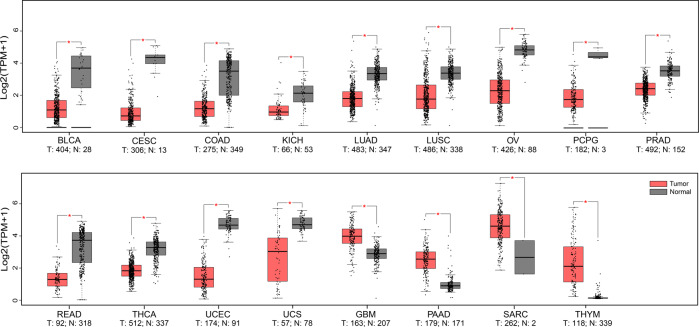
F-box and leucine-rich repeat protein 7 (FBXL7), an F-box protein responsible for substrate recognition by the SKP1-Cullin-1-F-box (SCF) ubiquitin ligases, plays an emerging role in the regulation of tumorigenesis and tumor progression. FBXL7 promotes polyubiquitylation and degradation of diverse substrates and is involved in many biological processes, including apoptosis, cell proliferation, cell migration and invasion, tumor metastasis, DNA damage, glucose metabolism, planar cell polarity, and drug resistance. In this review, we summarize the downstream substrates and upstream regulators of FBXL7. We then discuss its role in tumorigenesis and tumor progression as either an oncoprotein or a tumor suppressor, and further describe its aberrant expression and association with patient survival in human cancers. Finally, we provide future perspectives on validating FBXL7 as a cancer biomarker for diagnosis and prognosis and/or as a potential therapeutic target for anticancer treatment.
F盒和富含亮氨酸重复序列蛋白7(FBXL7)是一种F盒蛋白,负责通过SKP1- Cul1- F盒(SCF)泛素连接酶识别底物,在肿瘤发生和肿瘤进展的调控中发挥着越来越重要的作用。FBXL7促进多种底物的多聚泛素化和降解,并参与许多生物学过程,包括细胞凋亡、细胞增殖、细胞迁移和侵袭、肿瘤转移、DNA损伤、葡萄糖代谢、平面细胞极性和耐药性。在本综述中,我们总结了FBXL7的下游底物和上游调节因子。然后,我们讨论了它作为一种癌蛋白或肿瘤抑制因子在肿瘤发生和肿瘤进展中的作用,并进一步描述了它在人类癌症中的异常表达及其与患者生存的关系。最后,我们对验证FBXL7作为癌症诊断和预后的生物标志物和/或作为抗癌治疗的潜在靶点提供了未来展望。