Izadi Zara, Gianfrancesco Milena A, Schmajuk Gabriela, Jacobsohn Lindsay, Katz Patricia, Rush Stephanie, Ja Clairissa, Taylor Tiffany, Shidara Kie, Danila Maria I, Wysham Katherine D, Strangfeld Anja, Mateus Elsa F, Hyrich Kimme L, Gossec Laure, Carmona Loreto, Lawson-Tovey Saskia, Kearsley-Fleet Lianne, Schaefer Martin, Al-Emadi Samar, Sparks Jeffrey A, Hsu Tiffany Y-T, Patel Naomi J, Wise Leanna, Gilbert Emily, Duarte-García Alí, Valenzuela-Almada Maria O, Ugarte-Gil Manuel F, Ljung Lotta, Scirè Carlo A, Carrara Greta, Hachulla Eric, Richez Christophe, Cacoub Patrice, Thomas Thierry, Santos Maria J, Bernardes Miguel, Hasseli Rebecca, Regierer Anne, Schulze-Koops Hendrik, Müller-Ladner Ulf, Pons-Estel Guillermo, Tanten Romina, Nieto Romina E, Pisoni Cecilia N, Tissera Yohana S, Xavier Ricardo, Lopes Marques Claudia D, Pileggi Gecilmara C S, Robinson Philip C, Machado Pedro M, Sirotich Emily, Liew Jean W, Hausmann Jonathan S, Sufka Paul, Grainger Rebecca, Bhana Suleman, Gore-Massy Monique, Wallace Zachary S, Yazdany Jinoos
Division of Rheumatology, School of Medicine, University of California, San Francisco, CA, USA.
San Francisco VA Medical Center, San Francisco, CA, USA.
Lancet Rheumatol. 2022 Sep;4(9):e603-e613. doi: 10.1016/S2665-9913(22)00192-8. Epub 2022 Jul 25.
Differences in the distribution of individual-level clinical risk factors across regions do not fully explain the observed global disparities in COVID-19 outcomes. We aimed to investigate the associations between environmental and societal factors and country-level variations in mortality attributed to COVID-19 among people with rheumatic disease globally.
In this observational study, we derived individual-level data on adults (aged 18-99 years) with rheumatic disease and a confirmed status of their highest COVID-19 severity level from the COVID-19 Global Rheumatology Alliance (GRA) registry, collected between March 12, 2020, and Aug 27, 2021. Environmental and societal factors were obtained from publicly available sources. The primary endpoint was mortality attributed to COVID-19. We used a multivariable logistic regression to evaluate independent associations between environmental and societal factors and death, after controlling for individual-level risk factors. We used a series of nested mixed-effects models to establish whether environmental and societal factors sufficiently explained country-level variations in death.
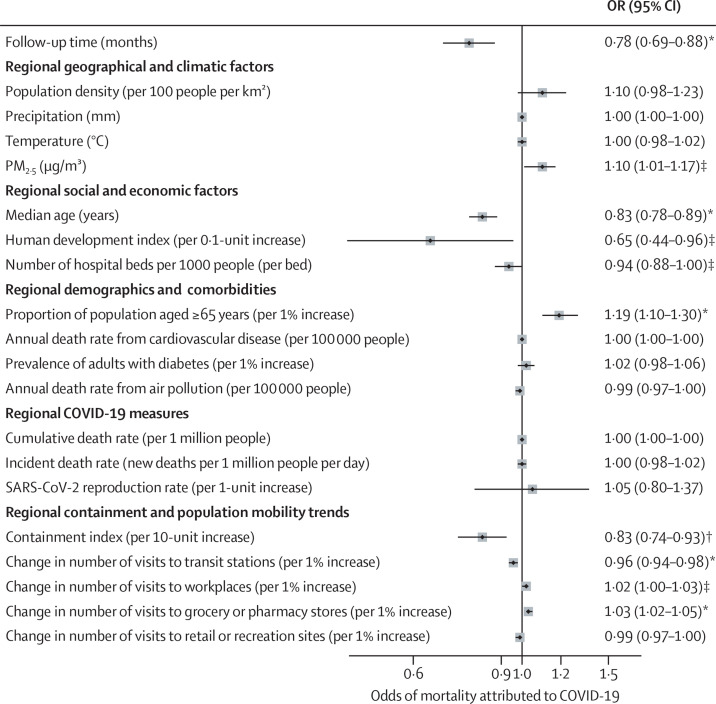
14 044 patients from 23 countries were included in the analyses. 10 178 (72·5%) individuals were female and 3866 (27·5%) were male, with a mean age of 54·4 years (SD 15·6). Air pollution (odds ratio 1·10 per 10 μg/m [95% CI 1·01-1·17]; p=0·0105), proportion of the population aged 65 years or older (1·19 per 1% increase [1·10-1·30]; p<0·0001), and population mobility (1·03 per 1% increase in number of visits to grocery and pharmacy stores [1·02-1·05]; p<0·0001 and 1·02 per 1% increase in number of visits to workplaces [1·00-1·03]; p=0·032) were independently associated with higher odds of mortality. Number of hospital beds (0·94 per 1-unit increase per 1000 people [0·88-1·00]; p=0·046), human development index (0·65 per 0·1-unit increase [0·44-0·96]; p=0·032), government response stringency (0·83 per 10-unit increase in containment index [0·74-0·93]; p=0·0018), as well as follow-up time (0·78 per month [0·69-0·88]; p<0·0001) were independently associated with lower odds of mortality. These factors sufficiently explained country-level variations in death attributable to COVID-19 (intraclass correlation coefficient 1·2% [0·1-9·5]; p=0·14).
Our findings highlight the importance of environmental and societal factors as potential explanations of the observed regional disparities in COVID-19 outcomes among people with rheumatic disease and lay foundation for a new research agenda to address these disparities.
American College of Rheumatology and European Alliance of Associations for Rheumatology.
个体层面临床风险因素在各地区的分布差异并不能完全解释观察到的全球新冠疫情结果的差异。我们旨在调查环境和社会因素与全球风湿性疾病患者中新冠病毒病所致死亡的国家层面差异之间的关联。
在这项观察性研究中,我们从新冠全球风湿病联盟(GRA)登记处获取了2020年3月12日至2021年8月27日期间收集的关于成年(18 - 99岁)风湿性疾病患者及其新冠病毒病最高严重程度确诊状态的个体层面数据。环境和社会因素来自公开可用的来源。主要终点是新冠病毒病所致死亡。在控制个体层面风险因素后,我们使用多变量逻辑回归来评估环境和社会因素与死亡之间的独立关联。我们使用一系列嵌套混合效应模型来确定环境和社会因素是否足以解释国家层面的死亡差异。
分析纳入了来自23个国家的14044例患者。10178例(72.5%)为女性,3866例(27.5%)为男性,平均年龄为54.4岁(标准差15.6)。空气污染(每10μg/m³比值比1.10 [95%置信区间1.01 - 1.17];p = 0.0105)、65岁及以上人口比例(每增加1%比值比1.19 [1.10 - 1.30];p < 0.0001)以及人口流动性(杂货店和药店访问次数每增加1%比值比1.03 [1.02 - 1.05];p < 0.0001,工作场所访问次数每增加1%比值比1.02 [1.00 - 1.03];p = 0.032)与较高死亡几率独立相关。每1000人医院病床数量增加1个单位(比值比0.94 [0.88 - 1.00];p = 0.046)、人类发展指数每增加0.1个单位(比值比0.65 [0.44 - 0.96];p = 0.032)、政府应对严格程度(遏制指数每增加10个单位比值比0.83 [0.74 - 0.93];p = 0.0018)以及随访时间(每月比值比0.78 [0.69 - 0.88];p < 0.0001)与较低死亡几率独立相关。这些因素足以解释国家层面新冠病毒病所致死亡差异(组内相关系数1.2% [0.1 - 9.5];p = 0.14)。
我们的研究结果突出了环境和社会因素作为观察到的风湿性疾病患者新冠疫情结果区域差异潜在解释的重要性,并为解决这些差异的新研究议程奠定了基础。
美国风湿病学会和欧洲风湿病协会联盟。