Zimiao Chen, Dongdong Luo, Shuoping Chen, Peng Zhou, Fan Zheng, Rujun Chen, Xiaohua Gong
Department of Endocrinology and Metabolism, The First Affiliated Hospital of Wenzhou Medical University, Wenzhou, China.
Department of Endocrinology and Metabolism, The Second Affiliated Hospital of Dalian Medical University, Dalian Medical University, Dalian, China.
Front Nutr. 2022 Jul 13;9:911860. doi: 10.3389/fnut.2022.911860. eCollection 2022.
Our study aimed to investigate the association between iron metabolism and body composition in patients with type 2 diabetes mellitus (T2DM).
A total of 824 patients with T2DM were enrolled. Measurements of body composition were obtained by dual-energy X-ray absorptiometry. Patients were stratified into three groups according to their sex-specific ferritin levels. Basic information, laboratory results, and body composition were collected.
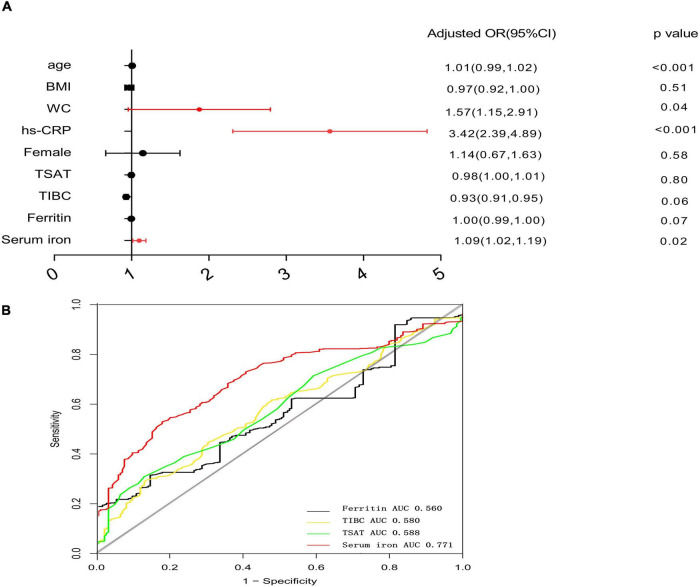
Serum iron and transferrin saturation (TSAT) were increased significantly with increased serum ferritin (all < 0.05). Total iron-binding capacity (TIBC) was decreased significantly with increased serum ferritin ( < 0.05). Visceral fat mass (VF), android fat/total body fat mass, android-to-gynoid fat ratio (A/G ratio), and high-sensitivity C-reactive protein were all increased significantly with increased serum ferritin (all < 0.05). Patients with a high A/G ratio (A/G ratio ≧ 1) had significantly higher serum iron, ferritin, and TSAT, but significantly lower TIBC. In the model adjusted for age and gender, higher ferritin levels were associated with a higher VF (all < 0.05). Serum iron was positively correlated with the occurrence of a high A/G ratio (A/G ratio ≧ 1) after the adjustment of confounding factors [an odds ratio (OR = 1.09, 95% CI, 1.02-1.19, = 0.02)]. With receiver operating curve analysis, the cutoff value of serum iron for a high A/G ratio was 18.56, and the area under the curve was 0.771 (sensitivity 88.9%and specificity 63.9%, = 0.01).
Higher serum iron and ferritin concentrations were positively associated with a higher VF. Higher serum iron concentrations were positively correlated with a high A/G ratio. This study indicates the potential relationship between iron overload and the body composition in patients with T2DM.
我们的研究旨在调查2型糖尿病(T2DM)患者铁代谢与身体成分之间的关联。
共纳入824例T2DM患者。通过双能X线吸收法测量身体成分。根据性别特异性铁蛋白水平将患者分为三组。收集基本信息、实验室检查结果和身体成分数据。
血清铁和转铁蛋白饱和度(TSAT)随血清铁蛋白升高而显著增加(均P<0.05)。总铁结合力(TIBC)随血清铁蛋白升高而显著降低(P<0.05)。内脏脂肪量(VF)、男性脂肪/总体脂肪量、男性与女性脂肪比例(A/G比例)和高敏C反应蛋白均随血清铁蛋白升高而显著增加(均P<0.05)。A/G比例高(A/G比例≧1)的患者血清铁、铁蛋白和TSAT显著更高,但TIBC显著更低。在调整年龄和性别后的模型中,较高的铁蛋白水平与较高的VF相关(均P<0.05)。调整混杂因素后,血清铁与高A/G比例(A/G比例≧1)的发生呈正相关[比值比(OR)=1.09,95%置信区间(CI),1.02-1.19,P=0.02]。通过受试者工作特征曲线分析,高A/G比例时血清铁的截断值为18.56,曲线下面积为0.