Santoro Jonathan D, Patel Lina, Kammeyer Ryan, Filipink Robyn A, Gombolay Grace Y, Cardinale Kathleen M, Real de Asua Diego, Zaman Shahid, Santoro Stephanie L, Marzouk Sammer M, Khoshnood Mellad, Vogel Benjamin N, Tanna Runi, Pagarkar Dania, Dhanani Sofia, Ortega Maria Del Carmen, Partridge Rebecca, Stanley Maria A, Sanders Jessica S, Christy Alison, Sannar Elise M, Brown Ruth, McCormick Andrew A, Van Mater Heather, Franklin Cathy, Worley Gordon, Quinn Eileen A, Capone George T, Chicoine Brian, Skotko Brian G, Rafii Michael S
Department of Pediatrics, Children's Hospital Los Angeles, Los Angeles, CA, United States.
Department of Neurology, Keck School of Medicine at USC, Los Angeles, CA, United States.
Front Neurol. 2022 Jul 15;13:940175. doi: 10.3389/fneur.2022.940175. eCollection 2022.
To develop standardization for nomenclature, diagnostic work up and diagnostic criteria for cases of neurocognitive regression in Down syndrome.
There are no consensus criteria for the evaluation or diagnosis of neurocognitive regression in persons with Down syndrome. As such, previously published data on this condition is relegated to smaller case series with heterogenous data sets. Lack of standardized assessment tools has slowed research in this clinical area.
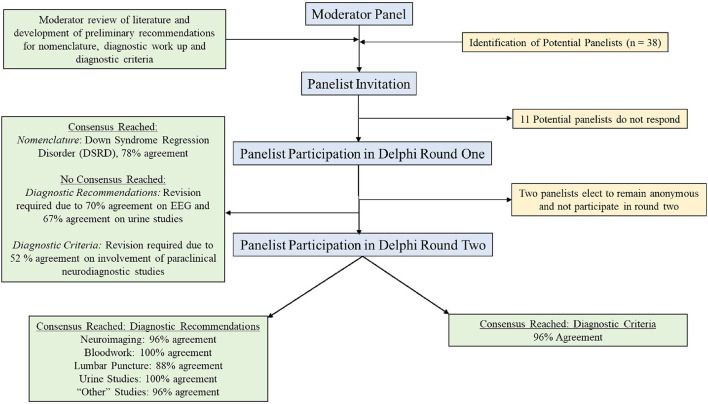
The authors performed a two-round traditional Delphi method survey of an international group of clinicians with experience in treating Down syndrome to develop a standardized approach to clinical care and research in this area. Thirty-eight potential panelists who had either previously published on neurocognitive regression in Down syndrome or were involved in national or international working groups on this condition were invited to participate. In total, 27 panelists (71%) represented nine medical specialties and six different countries reached agreement on preliminary standards in this disease area. Moderators developed a proposed nomenclature, diagnostic work up and diagnostic criteria based on previously published reports of regression in persons with Down syndrome.
During the first round of survey, agreement on nomenclature for the condition was reached with 78% of panelists agreeing to use the term Down Syndrome Regression Disorder (DSRD). Agreement on diagnostic work up and diagnostic criteria was not reach on the first round due to low agreement amongst panelists with regards to the need for neurodiagnostic testing. Following incorporation of panelist feedback, diagnostic criteria were agreed upon (96% agreement on neuroimaging, 100% agreement on bloodwork, 88% agreement on lumbar puncture, 100% agreement on urine studies, and 96% agreement on "other" studies) as were diagnostic criteria (96% agreement).
The authors present international consensus agreement on the nomenclature, diagnostic work up, and diagnostic criteria for DSRD, providing an initial practical framework that can advance both research and clinical practices for this condition.
制定唐氏综合征神经认知衰退病例的命名、诊断检查及诊断标准的规范化方案。
对于唐氏综合征患者神经认知衰退的评估或诊断,目前尚无共识性标准。因此,此前发表的关于该病症的数据仅限于较小的病例系列且数据集各异。缺乏标准化的评估工具减缓了这一临床领域的研究进展。
作者对一组具有唐氏综合征治疗经验的国际临床医生进行了两轮传统德尔菲法调查,以制定该领域临床护理和研究的标准化方法。邀请了38位潜在专家组成员参与,这些专家要么此前发表过关于唐氏综合征神经认知衰退的文章,要么参与了有关该病症的国家或国际工作组。共有27位专家组成员(占71%),代表九个医学专业和六个不同国家,就该疾病领域的初步标准达成了一致。主持人根据此前发表的唐氏综合征患者衰退报告,制定了一份拟议的命名、诊断检查及诊断标准。
在第一轮调查中,78%的专家组成员同意使用“唐氏综合征衰退障碍”(DSRD)这一术语来命名该病症。由于专家组成员在神经诊断测试必要性方面的共识较低,第一轮调查未就诊断检查和诊断标准达成一致。纳入专家组成员的反馈意见后,诊断标准达成了一致(神经影像学方面96%的共识、血液检查方面100%的共识、腰椎穿刺方面88%的共识、尿液检查方面100%的共识以及“其他”检查方面96%的共识),诊断标准方面也达成了96%的共识。
作者提出了关于DSRD的命名、诊断检查及诊断标准的国际共识协议,提供了一个初步实用框架,可推动针对该病症的研究和临床实践。