Monash University Accident Research Centre, Clayton, Victoria, Australia.
Cairnmillar Institute, Melbourne, Victoria, Australia.
PLoS One. 2022 Aug 1;17(8):e0272422. doi: 10.1371/journal.pone.0272422. eCollection 2022.
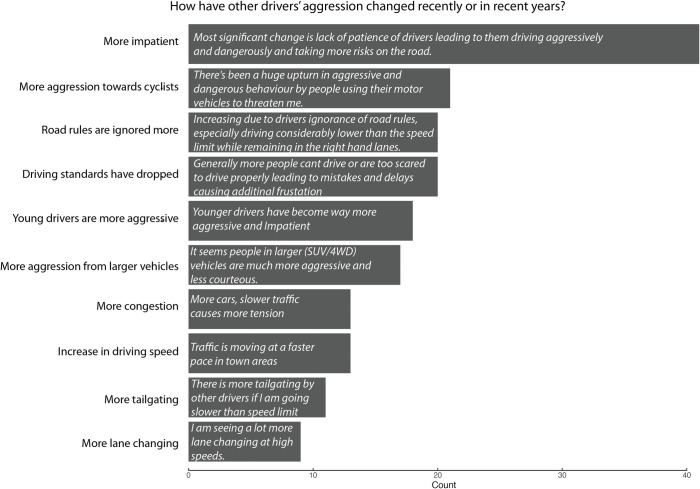
Aggressive driving is a significant road safety problem and is likely to get worse as the situations that provoke aggression become more prevalent in the road network (e.g. as traffic volumes and density increase and the grey fleet expands). In addition, driver frustration and stress, also recognised as triggers for aggression, are likely to stay high because of the COVID-19 pandemic and associated burdens, leading to increased aggression. However, although drivers report that other drivers are becoming more aggressive, self-report data suggests that the prevalence of aggression has not changed over time. This may be due to the methods used to define and measure aggression. This study sought to clarify whether self-reported aggression has increased over a five-year period and across three different types of aggression: verbal aggression, aggressive use of the vehicle and personal physical aggression. The influence of COVID-19 lockdowns on own and others' driving styles was also investigated. A total of 774 drivers (males = 66.5%, mean age = 48.7; SD = 13.9) who had been licensed for at least five years (M = 30.6, SD = 14.3), responded to an online survey and provided retrospective frequencies for their current aggression (considered pre-COVID-19 lockdowns) and five years prior. Two open ended questions were included to understand perceived changes in driving styles (own and others) during the COVID-19 pandemic. One third (33%) of drivers believed they were more aggressive now than five years ago but 61% of the sample believed other drivers were more aggressive now than five years ago. Logistic regression analyses on changes in self-reported aggression (same or decreased vs increased) showed the main factor associated with increases in aggressive driving was the perception that other drivers' aggression had increased. Further, almost half the sample (47%) reported that other drivers had become riskier and more dangerous during, and soon after, the COVID-19 lockdowns. These results show that the driving environment is seen as becoming more aggressive, both gradually and as a direct result of COVID-19 lockdowns. The data indicate that this perceived increase in aggression is likely to provoke higher levels of aggression in some drivers. Campaigns to reduce aggression on the roads need to focus on changing road culture and improving interactions, or perceived interactions, among road users.
攻击性驾驶是一个严重的道路安全问题,随着引发攻击性的情况在道路网络中变得更加普遍(例如,随着交通量和密度的增加以及灰色车队的扩大),这种情况可能会变得更糟。此外,由于 COVID-19 大流行及其相关负担,司机的挫败感和压力也被认为是攻击性的触发因素,这可能会导致攻击性增加。然而,尽管司机报告说其他司机变得更加咄咄逼人,但自我报告的数据表明,攻击性的普遍性并没有随着时间的推移而改变。这可能是由于用于定义和衡量攻击性的方法。本研究旨在澄清在五年期间和三种不同类型的攻击性(言语攻击性、车辆攻击性和人身攻击性)方面,自我报告的攻击性是否有所增加。还研究了 COVID-19 封锁对自己和他人驾驶风格的影响。共有 774 名驾驶员(男性=66.5%,平均年龄=48.7;SD=13.9),至少有五年的驾驶执照(M=30.6,SD=14.3),他们对在线调查做出了回应,并提供了他们当前攻击性的回溯频率(考虑到 COVID-19 封锁之前)和五年前的回溯频率。包括两个开放式问题,以了解在 COVID-19 大流行期间对驾驶风格(自己和他人)的看法变化。三分之一(33%)的司机认为他们现在比五年前更具攻击性,但 61%的样本认为现在其他司机比五年前更具攻击性。关于自我报告攻击性(相同或减少与增加)变化的逻辑回归分析表明,与攻击性驾驶增加相关的主要因素是认为其他司机的攻击性有所增加。此外,近一半的样本(47%)报告说,在 COVID-19 封锁期间和之后,其他司机变得更加危险和冒险。这些结果表明,驾驶环境被视为变得更加具有攻击性,无论是逐渐的还是 COVID-19 封锁的直接结果。数据表明,这种对攻击性的感知增加可能会引发一些司机更高水平的攻击性。减少道路攻击性的运动需要集中精力改变道路文化,改善道路使用者之间的互动或感知互动。