Graduate School of Natural Science, Konan University, Kobe 658-8501, Japan.
Faculty of Science and Engineering, Konan University, Kobe 658-8501, Japan.
Proc Natl Acad Sci U S A. 2022 Aug 9;119(32):e2203121119. doi: 10.1073/pnas.2203121119. Epub 2022 Aug 1.
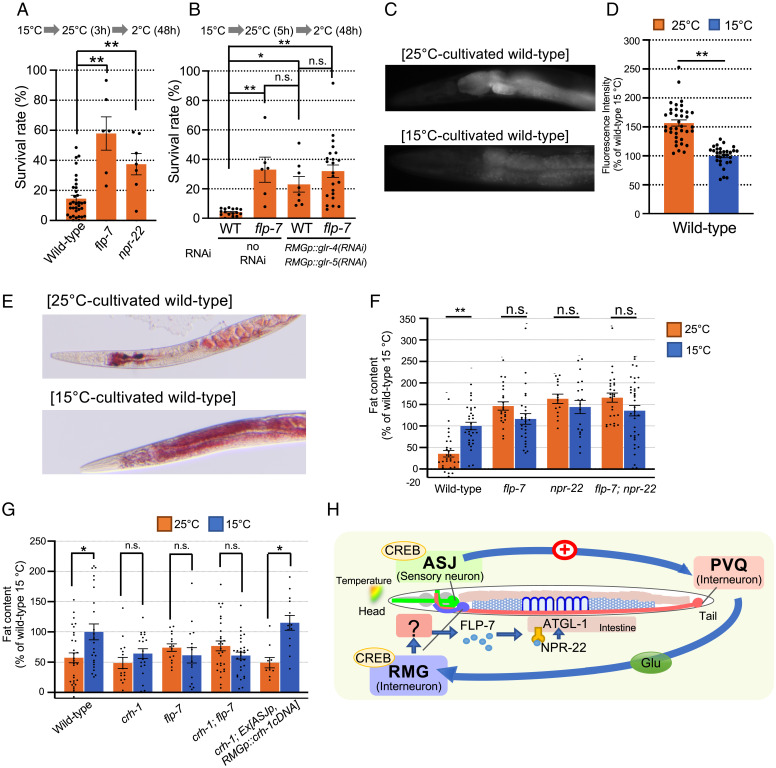
Animals maintain the ability to survive and reproduce by acclimating to environmental temperatures. We showed here that exhibited temperature acclimation plasticity, which was regulated by a head-tail-head neural circuitry coupled with gut fat storage. After experiencing cold, individuals memorized the experience and were prepared against subsequent cold stimuli. The cyclic adenosine monophosphate (cAMP) response element-binding protein (CREB) regulated temperature acclimation in the ASJ thermosensory neurons and RMG head interneurons, where it modulated ASJ thermosensitivity in response to past cultivation temperature. The PVQ tail interneurons mediated the communication between ASJ and RMG via glutamatergic signaling. Temperature acclimation occurred via gut fat storage regulation by the triglyceride lipase ATGL-1, which was activated by a neuropeptide, FLP-7, downstream of CREB. Thus, a head-tail-head neural circuit coordinated with gut fat influenced experience-dependent temperature acclimation.
动物通过适应环境温度来维持生存和繁殖的能力。我们在这里表明,表现出温度适应可塑性,这是由一个头尾头的神经回路与肠道脂肪储存相耦合调节的。在经历寒冷后,个体记住了这种经历,并为随后的寒冷刺激做好了准备。环腺苷酸(cAMP)反应元件结合蛋白(CREB)调节 ASJ 热敏神经元和 RMG 头间神经元中的温度适应,调节 ASJ 对过去培养温度的热敏性。PVQ 尾间神经元通过谷氨酸能信号介导 ASJ 和 RMG 之间的通讯。通过甘油三酯脂肪酶 ATGL-1 调节肠道脂肪储存来实现温度适应,该酶被 CREB 下游的神经肽 FLP-7 激活。因此,一个头尾头的神经回路与肠道脂肪一起影响经验依赖性的温度适应。