McCall Terika, Asuzu Kammarauche, Oladele Carol R, Leung Tiffany I, Wang Karen H
Division of Health Informatics, Department of Biostatistics, Yale School of Public Health, New Haven, CT, United States.
Center for Medical Informatics, Yale School of Medicine, New Haven, CT, United States.
Front Digit Health. 2022 Jul 18;4:897250. doi: 10.3389/fdgth.2022.897250. eCollection 2022.
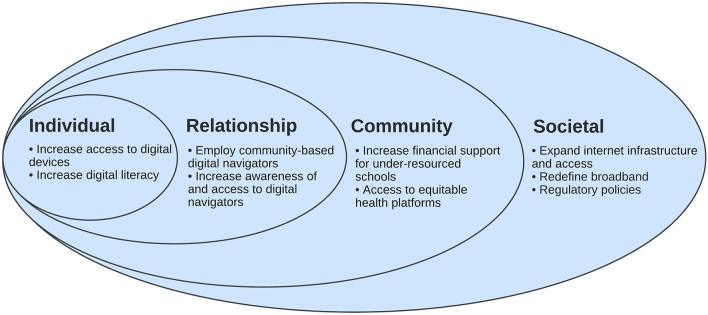
Physical distancing requirements due to the coronavirus (COVID-19) pandemic has increased the need for broadband internet access. The World Health Organization defines social determinants of health as non-medical factors that impact health outcomes by affecting the conditions in which people are born, grow, work, live, and age. By this definition broadband internet access is a social determinant of health. Digital redlining-the systematic process by which specific groups are deprived of equal access to digital tools such as the internet-creates inequities in access to educational and employment opportunities, as well as healthcare and health information. Although it is known that internet service providers systematically exclude low-income communities from broadband service, little has been done to stop this discriminatory practice. In this paper, we seek to amplify the call to action against the practice of digital redlining in the United States, describe how it contributes to health disparities broadly and within the context of the COVID-19 pandemic, and use a socio-ecological framework to propose short- and long-term actions to address this inequity.
由于冠状病毒(COVID-19)大流行而实施的物理距离要求增加了对宽带互联网接入的需求。世界卫生组织将健康的社会决定因素定义为通过影响人们出生、成长、工作、生活和衰老的条件来影响健康结果的非医学因素。根据这一定义,宽带互联网接入是健康的一个社会决定因素。数字红线划定——特定群体被系统地剥夺平等使用互联网等数字工具的机会的过程——在获得教育和就业机会以及医疗保健和健康信息方面造成了不平等。尽管已知互联网服务提供商系统性地将低收入社区排除在宽带服务之外,但在阻止这种歧视性做法方面几乎没有采取什么行动。在本文中,我们试图加大在美国反对数字红线划定做法的行动呼吁力度,描述它如何在广泛范围内以及在COVID-19大流行背景下导致健康差距,并使用社会生态框架提出解决这种不平等的短期和长期行动。