Department of Health Care Policy, Harvard Medical School, Boston, MA, USA.
Department of Psychology, The Pennsylvania State University, State College, PA, USA.
Psychol Med. 2023 Aug;53(11):5267-5278. doi: 10.1017/S003329172200232X. Epub 2022 Aug 4.
Vulnerability theories propose that suboptimal levels of lipid markers and proinflammatory proteins predict future heightened depression. Scar models posit the reverse association. However, most studies that tested relationships between non-specific immune/endocrine markers and depression did not separate temporal inferences between people and within-person and how different immunometabolism markers related to unique depression symptoms. We thus used cross-lagged prospective network analyses (CLPN) to investigate this topic.
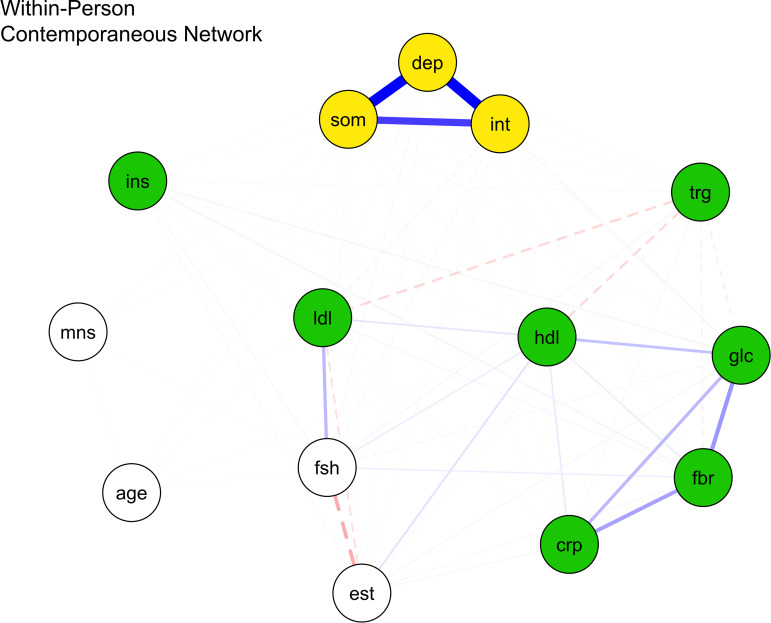
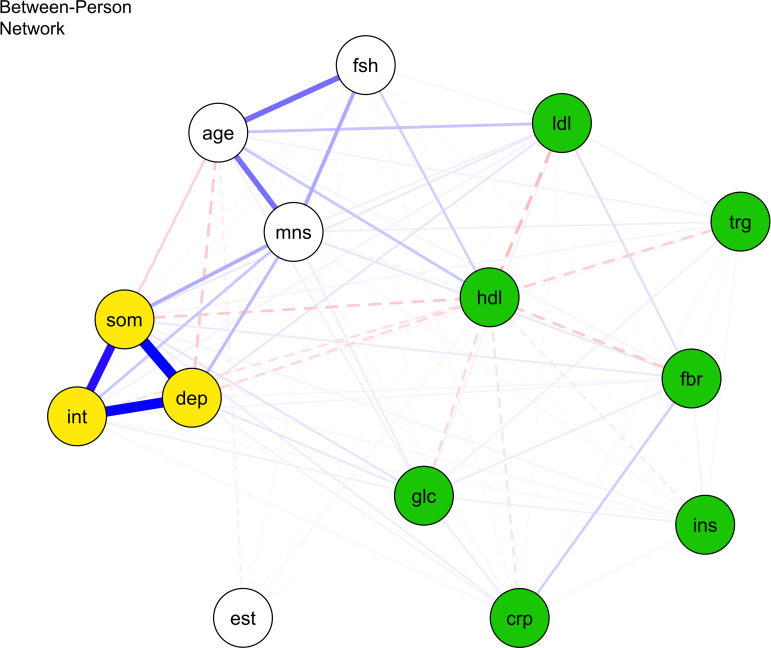
Community midlife women ( = 2224) completed the Center for Epidemiologic Studies-Depression scale and provided biomarker samples across five time-points spanning 9 years. CLPN identified significant relations () among components () of depression (depressed mood, somatic symptoms, interpersonal issues), lipid markers [insulin, fasting glucose, triglycerides, low-density lipoprotein-cholesterol (LDL), high-density lipoprotein-cholesterol (HDL)], and proinflammatory proteins [C-reactive protein (CRP), fibrinogen], within and across time-points. All models adjusted for age, estradiol, follicle-stimulating hormone, and menopausal status.
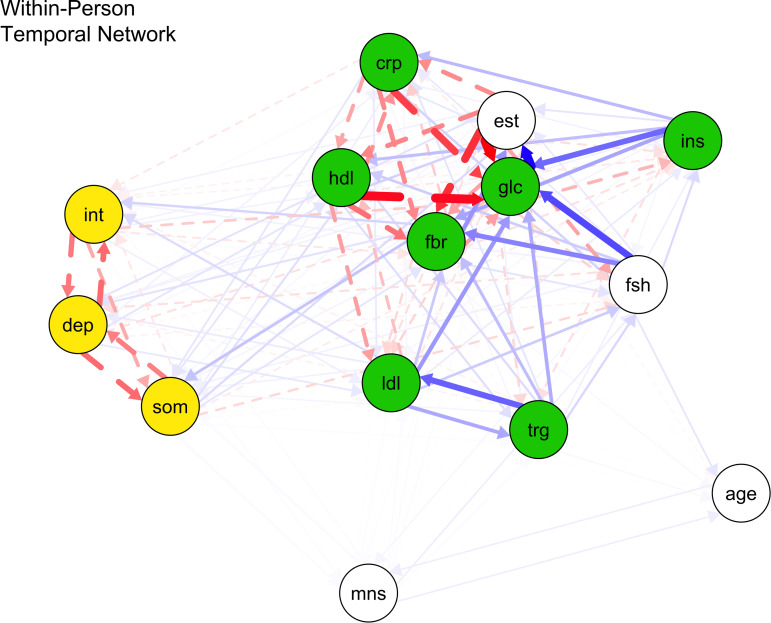
In within-person temporal networks, higher CRP and HDL predicted all three depression components ( = 0.131-2.112). Increased LDL preceded higher depressed mood and interpersonal issues ( somatic symptoms) ( = 0.251-0.327). Elevated triglycerides predicted more somatic symptoms ( depressed mood and interpersonal problems) ( = 0.131). More interpersonal problems forecasted elevated fibrinogen and LDL levels ( = 0.129-0.331), and stronger somatic symptoms preceded higher fibrinogen levels ( = 0.188).
Results supported both vulnerability and scar models. Long-term dysregulated immunometabolism systems, social disengagement, and related patterns are possible mechanistic accounts. Cognitive-behavioral therapies that optimize nutrition and physical activity may effectively target depression.
脆弱性理论提出,脂质标志物和促炎蛋白水平不理想预示着未来抑郁程度加剧。疤痕模型则提出了相反的关联。然而,大多数测试非特异性免疫/内分泌标志物与抑郁之间关系的研究并未区分人与人之间以及个体内部的时间推断,以及不同的免疫代谢标志物与独特的抑郁症状之间的关系。因此,我们使用交叉滞后前瞻性网络分析(CLPN)来研究这个问题。
社区中年女性(n=2224)完成了《流行病学研究中心抑郁量表》,并在 9 年的时间里完成了 5 次生物标志物样本采集。CLPN 确定了抑郁(情绪低落、躯体症状、人际关系问题)、脂质标志物[胰岛素、空腹血糖、甘油三酯、低密度脂蛋白胆固醇(LDL)、高密度脂蛋白胆固醇(HDL)]和促炎蛋白[C 反应蛋白(CRP)、纤维蛋白原]之间在时间点内和时间点之间的显著关系()。所有模型均调整了年龄、雌二醇、卵泡刺激素和绝经状态。
在个体内部的时间网络中,较高的 CRP 和 HDL 预测了所有三个抑郁成分( = 0.131-2.112)。升高的 LDL 先于更高的情绪低落和人际关系问题(躯体症状)( = 0.251-0.327)。升高的甘油三酯预测更多的躯体症状(情绪低落和人际关系问题)( = 0.131)。更多的人际关系问题预测了更高的纤维蛋白原和 LDL 水平( = 0.129-0.331),而更强的躯体症状先于更高的纤维蛋白原水平( = 0.188)。
结果支持脆弱性和疤痕模型。长期失调的免疫代谢系统、社会脱节以及相关模式可能是可能的机制解释。优化营养和体育活动的认知行为疗法可能会有效地针对抑郁。