Department of Psychiatry, National Clinical Research Center for Mental Disorders, The Second Xiangya Hospital of Central South University, Changsha, Hunan, China.
Department of Psychiatry, First Hospital of Shanxi Medical University, Taiyuan, China.
Front Endocrinol (Lausanne). 2023 Feb 28;14:1138233. doi: 10.3389/fendo.2023.1138233. eCollection 2023.
Thyroid dysfunction and metabolic disturbances are common in major depressive disorder (MDD) patients. We aimed to assess the relationship between thyroid dysfunction, metabolic disturbances, and clinical symptoms in Chinese first-episode, drug-naïve (FEDN) MDD patients using undirected and Bayesian network methods.
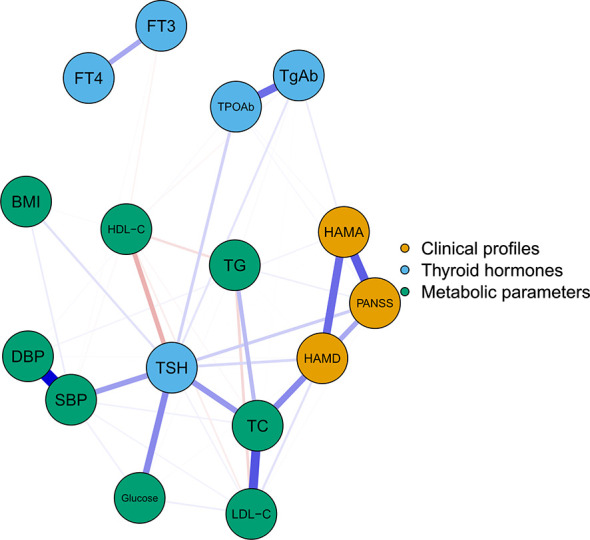
1718 FEDN MDD patients were recruited. Serum levels of free triiodothyronine (FT3), free thyroxine (FT4), thyroid stimulating hormone (TSH), anti-thyroglobulin (TgAb), thyroid peroxidases antibody (TPOAb), total cholesterol (TC), total triglycerides (TG), high-density lipoprotein (HDL-C), low-density lipoprotein (LDL-C), and glucose were assessed. Blood pressure and body mass index were measured. Hamilton Rating Scale for Depression (HAMD), Hamilton Rating Scale for Anxiety, and positive subscale of Positive And Negative Syndrome Scales were used to detect clinical symptoms. An undirected network with EBICglasso default and a directed acyclic graph (DAG) using the Bayesian network approach was conducted.
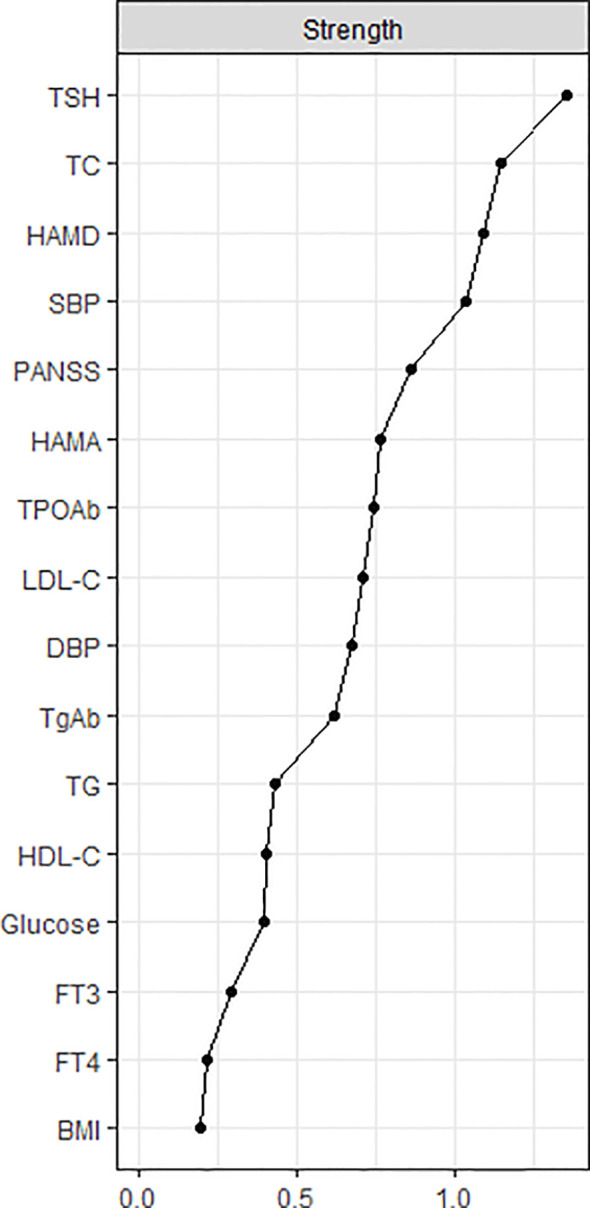
The prevalence rates of clinical symptoms, thyroid dysfunction, and metabolic dysfunction were as follows: anxiety (n=894, 52%), psychotic symptoms (171, 10%), subclinical hypothyroidism (SCH, n=1041, 61%), abnormal TgAb (n=297, 17%), abnormal TPOAb (n=438, 25%), hyperthyroidism (n=5, 0.3%), hypothyroidism (n=3, 0.2%), hyperglycemia (n=241, 14%), hypertriglyceridemia (n=668, 39%), low HDL-C (n=429, 25%), hypercholesterolemia (421, 25%), abnormal TC (357, 21%), abnormal LDL-C (185, 11%). overweight or obesity (n=1026, 60%), and hypertension (n=92, 5.4%). Both networks demonstrated serum TSH and TC levels and the severity of depression played an important role in the pathophysiology of MDD.
MDD patients may have thyroid and metabolic dysfunction in the early stage. Targeting hypercholesterolemia, depressive symptoms, and SCH in MDD patients may hold promise in reducing clinical symptoms, metabolic disturbances, and thyroid dysfunction.
甲状腺功能障碍和代谢紊乱在重度抑郁症(MDD)患者中很常见。我们旨在使用无向和贝叶斯网络方法评估中国首发、未用药(FEDN)MDD 患者甲状腺功能障碍、代谢紊乱和临床症状之间的关系。
招募了 1718 名 FEDN MDD 患者。评估了游离三碘甲状腺原氨酸(FT3)、游离甲状腺素(FT4)、促甲状腺激素(TSH)、抗甲状腺球蛋白(TgAb)、甲状腺过氧化物酶抗体(TPOAb)、总胆固醇(TC)、总甘油三酯(TG)、高密度脂蛋白胆固醇(HDL-C)、低密度脂蛋白胆固醇(LDL-C)和血糖水平。测量了血压和体重指数。使用汉密尔顿抑郁量表(HAMD)、汉密尔顿焦虑量表和阳性与阴性综合征量表的阳性子量表来检测临床症状。使用 EBICglasso 默认的无向网络和贝叶斯网络方法的有向无环图(DAG)进行了分析。
临床症状、甲状腺功能障碍和代谢功能障碍的患病率如下:焦虑(n=894,52%)、精神病症状(n=171,10%)、亚临床甲状腺功能减退症(SCH,n=1041,61%)、TgAb 异常(n=297,17%)、TPOAb 异常(n=438,25%)、甲状腺功能亢进(n=5,0.3%)、甲状腺功能减退(n=3,0.2%)、高血糖(n=241,14%)、高甘油三酯血症(n=668,39%)、低 HDL-C(n=429,25%)、高胆固醇血症(n=421,25%)、TC 异常(n=357,21%)、LDL-C 异常(n=185,11%)、超重或肥胖(n=1026,60%)和高血压(n=92,5.4%)。两个网络均显示血清 TSH 和 TC 水平,抑郁严重程度在 MDD 的病理生理学中起着重要作用。
MDD 患者在早期可能存在甲状腺和代谢功能障碍。针对 MDD 患者的高胆固醇血症、抑郁症状和 SCH 可能有助于降低临床症状、代谢紊乱和甲状腺功能障碍。