Department of Rehabilitation, Shenzhen Dapeng New District Nan'ao People's Hospital, No. 6, Renmin Road, Dapeng New District, Shenzhen, 518000, Guangdong, China.
Department of Nephrology, The First Affiliated Hospital of Shenzhen University, Shenzhen, 518000, Guangdong, China.
Sci Rep. 2022 Aug 4;12(1):13445. doi: 10.1038/s41598-022-17837-1.
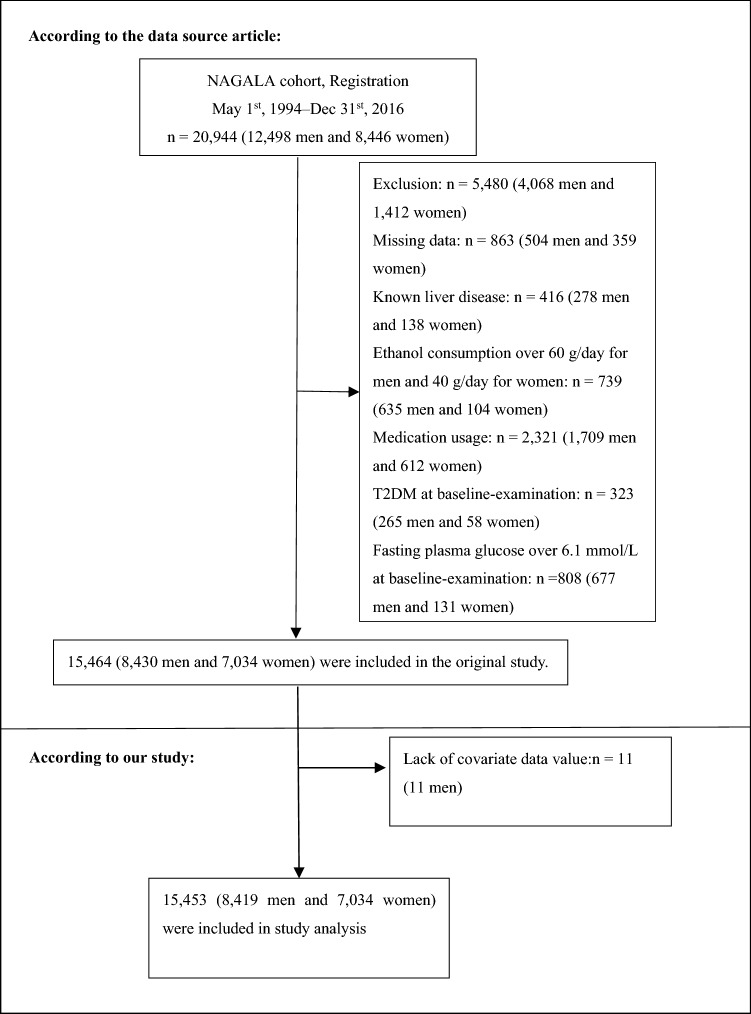
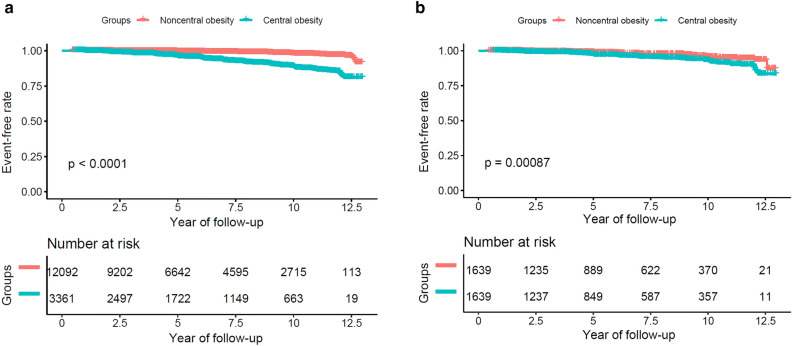
Previous evidence revealed that central obesity played a vital role in the development of diabetes mellitus (DM). However, because of imbalanced confounding variables, some studies have not wholly established the association between central obesity and diabetes. Propensity score matching (PSM) analysis can minimize the impact of potential confounding variables. Therefore, the aim of the present study was to explore the relationship between central obesity and diabetes in the Japanese population by using PSM analysis. This retrospective cohort study included 15,453 Japanese adults who were free of diabetes at baseline between 2004 and 2015, which provided all medical records for individuals participating in the physical exam. Central obesity at baseline was an independent variable, and incident diabetes during follow-up was an outcome variable. Using a 1:1 PSM analysis, the present retrospective cohort study included 1639 adults with and without central obesity. Additionally, we employed a doubly robust estimation method to identify the association between central obesity and diabetes. Subjects with central obesity were 92% more likely to develop DM (HR = 1.65, 95%CI 1.12, 2.41). After adjusting for covariates, subjects with central obesity had a 72% increased risk of developing DM compared with subjects with non-central obesity in the PSM cohort (HR = 1.72, 95% CI 1.16, 2.56). Central obesity individuals had a 91% higher risk of DM than non-central obesity individuals, after adjustment for propensity score (HR = 1.91, 95% CI 1.29, 2.81). In sensitivity analysis, the central obesity group had a 44% (HR = 1.44, 95% CI 1.09, 1.90) and 59% (HR = 1.59, 95% CI1.35, 1.88) higher risk of DM than the non-central obesity group in the original and weighted cohorts after adjusting for confounding variables, respectively. Central obesity was independently associated with an increased risk of developing diabetes. After adjustment for confounding covariates, central obesity participants had a 72% higher risk of development of diabetes than non-central obesity individuals in the PSM cohort.
先前的证据表明,中心性肥胖在糖尿病(DM)的发展中起着至关重要的作用。然而,由于混杂变量的不平衡,一些研究并未完全确定中心性肥胖与糖尿病之间的关联。倾向评分匹配(PSM)分析可以最大程度地减少潜在混杂变量的影响。因此,本研究旨在通过 PSM 分析探讨日本人群中心性肥胖与糖尿病之间的关系。这项回顾性队列研究纳入了 2004 年至 2015 年间基线时无糖尿病的 15453 名日本成年人,这些人提供了参与体检的个体的所有医疗记录。基线时的中心性肥胖是一个自变量,随访期间发生的糖尿病是一个因变量。使用 1:1 PSM 分析,本回顾性队列研究纳入了 1639 名患有和不患有中心性肥胖的成年人。此外,我们采用双重稳健估计方法来确定中心性肥胖与糖尿病之间的关联。患有中心性肥胖的受试者发生 DM 的可能性高 92%(HR=1.65,95%CI 1.12,2.41)。在校正协变量后,PSM 队列中患有中心性肥胖的受试者发生 DM 的风险比非中心性肥胖的受试者高 72%(HR=1.72,95%CI 1.16,2.56)。在调整倾向得分后,中心性肥胖个体发生 DM 的风险比非中心性肥胖个体高 91%(HR=1.91,95%CI 1.29,2.81)。在敏感性分析中,在调整混杂变量后,原始队列和加权队列中,中心性肥胖组发生 DM 的风险分别比非中心性肥胖组高 44%(HR=1.44,95%CI 1.09,1.90)和 59%(HR=1.59,95%CI1.35,1.88)。中心性肥胖与发生糖尿病的风险增加独立相关。在校正混杂协变量后,PSM 队列中中心性肥胖参与者发生糖尿病的风险比非中心性肥胖个体高 72%。