Department of Cancer Genetics, Institute for Cancer Research, Oslo University Hospital, Oslo, Norway.
Department of Preclinical Sciences and Pathology, Faculty of Veterinary Medicine, Norwegian University of Life Sciences, Ås, Norway.
J Mammary Gland Biol Neoplasia. 2022 Jun;27(2):171-183. doi: 10.1007/s10911-022-09523-9. Epub 2022 Aug 6.
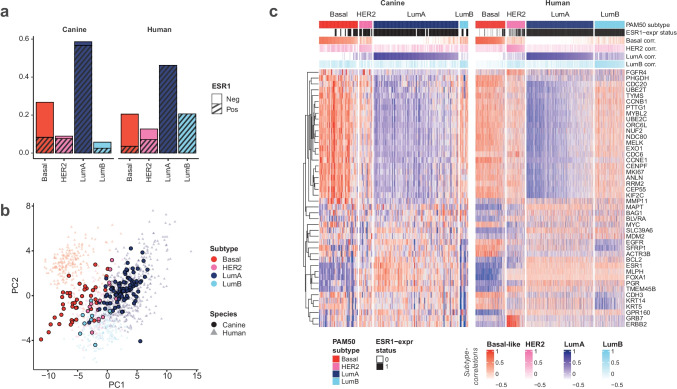
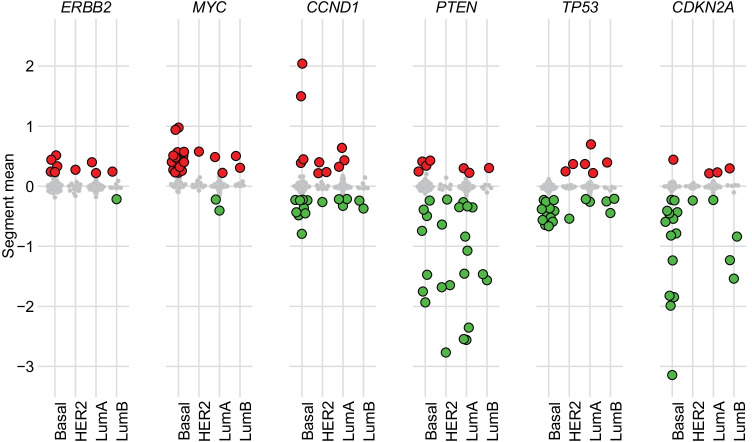
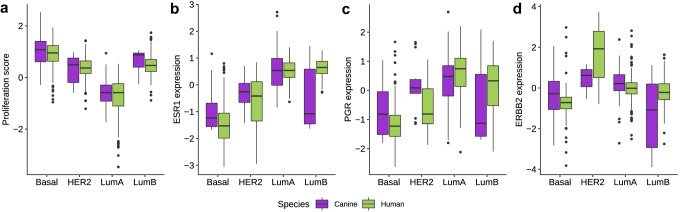
Breast cancers in humans belong to one of several intrinsic molecular subtypes each with different tumor biology and different clinical impact. Mammary gland tumors in dogs are proposed as a relevant comparative model for human breast cancer; however, it is still unclear whether the intrinsic molecular subtypes have the same significance in dogs and humans. Using publicly available data, we analyzed gene expression and whole-exome sequencing data from 158 canine mammary gland tumors. We performed molecular subtyping using the PAM50 method followed by subtype-specific comparisons of gene expression characteristics, mutation patterns and copy number profiles between canine tumors and human breast tumors from The Cancer Genome Atlas (TCGA) breast cancer cohort (n = 1097). We found that luminal A canine tumors greatly resemble luminal A human tumors both in gene expression characteristics, mutations and copy number profiles. Also, the basal-like canine and human tumors were relatively similar, with low expression of luminal epithelial markers and high expression of genes involved in cell proliferation. There were, however, distinct differences in immune-related gene expression patterns in basal-like tumors between the two species. Characteristic HER2-enriched and luminal B subtypes were not present in the canine cohort, and we found no tumors with high-level ERBB2 amplifications. Benign and malignant canine tumors displayed similar PAM50 subtype characteristics. Our findings indicate that deeper understanding of the different molecular subtypes in canine mammary gland tumors will further improve the value of canines as comparative models for human breast cancer.
人类乳腺癌属于几种固有分子亚型之一,每种亚型具有不同的肿瘤生物学特性和不同的临床影响。犬乳腺肿瘤被认为是人类乳腺癌的相关比较模型;然而,内在分子亚型在犬和人类中的意义是否相同尚不清楚。我们使用公开可用的数据,分析了 158 例犬乳腺肿瘤的基因表达和全外显子测序数据。我们使用 PAM50 方法进行分子分型,然后比较犬肿瘤和癌症基因组图谱 (TCGA) 乳腺癌队列中 1097 例人类乳腺癌肿瘤的基因表达特征、突变模式和拷贝数图谱的亚型特异性。我们发现,在基因表达特征、突变和拷贝数图谱方面,犬乳腺的 luminal A 肿瘤与人类 luminal A 肿瘤非常相似。此外,基底样犬和人肿瘤相对相似,luminal 上皮标志物表达水平低,参与细胞增殖的基因表达水平高。然而,在两种物种的基底样肿瘤中,免疫相关基因表达模式存在明显差异。在犬群中没有特征性的 HER2 富集和 luminal B 亚型,我们也没有发现高水平 ERBB2 扩增的肿瘤。良性和恶性犬肿瘤显示出相似的 PAM50 亚型特征。我们的研究结果表明,深入了解犬乳腺肿瘤的不同分子亚型将进一步提高犬作为人类乳腺癌比较模型的价值。