Byrne Micheal B, Thapa Ganesh, Doohan FIona M, Burke James I
School of Agriculture and Food Science, University College Dublin, Dublin, Ireland.
School of Biology and Environmental Science, University College Dublin, Dublin, Ireland.
Front Microbiol. 2022 Jul 22;13:912632. doi: 10.3389/fmicb.2022.912632. eCollection 2022.
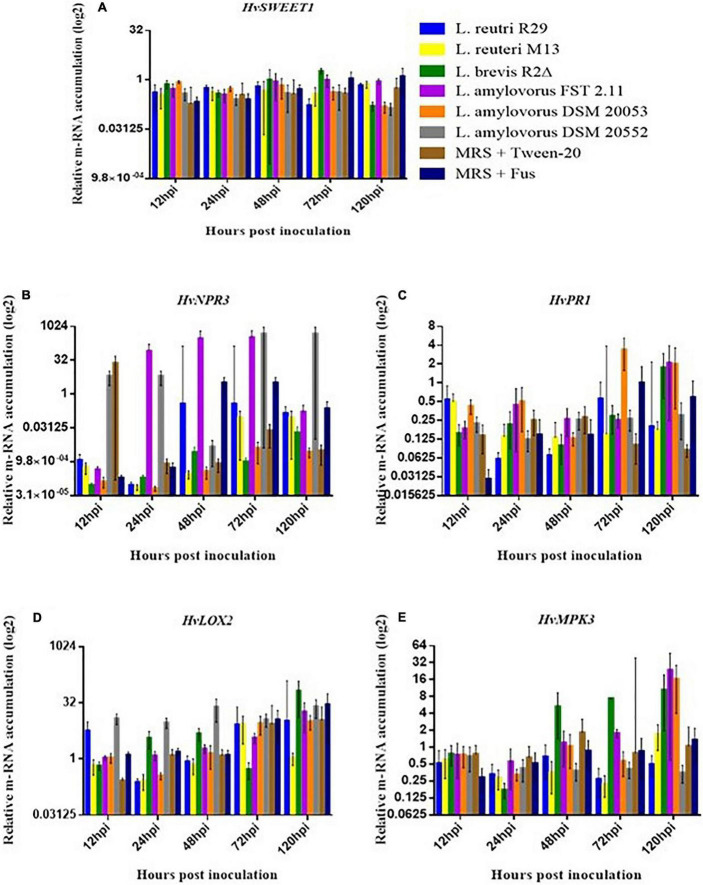
Fusarium head blight (FHB) is a devastating disease encountered by spring-grown barley. Traditionally, synthetic chemicals have been used to control this disease on small grain cereals. A move toward biological control agents as part of sustainable agriculture is pertinent due to the evolutionary mechanisms employed by fungal diseases to circumvent current protection strategies. This study evaluated the effect of six lactic acid bacteria isolates on the development of FHB under and glasshouse conditions. The relative expression of marker genes and transcription factors under infection was examined. Dual-culture assays observed inhibition zones of up to 10 and 17% of total plate area for FST 2.11 and R2Δ, respectively. Detached leaf assays validated the antifungal activity and showed the potential of all test isolates to significantly inhibit sporulation of and strains. Spray inoculation of lactic acid bacteria to barley spikelets prior to spore application significantly reduced disease severity for five candidates ( < 0.05) under glasshouse conditions. Mycotoxin analysis revealed the ability of DSM20552 to significantly reduce deoxynivalenol content in spikelets ( < 0.05). A preliminary gene expression study showed the positive influence of lactic acid bacteria on the expression of important defense-related marker genes and transcription factors upon FHB. These results indicate the potential of lactic acid bacteria to be included as part of an integrated pest management strategy for the management of FHB disease. This strategy will reduce FHB severity and deoxynivalenol (DON) contamination of spring barley, leading to high acceptance in the grain market.
赤霉病是春大麦面临的一种毁灭性病害。传统上,合成化学药剂被用于防治小粒谷物上的这种病害。由于真菌病害采用进化机制来规避当前的保护策略,因此采用生物防治剂作为可持续农业的一部分是很有必要的。本研究评估了六种乳酸菌分离株在田间和温室条件下对赤霉病发展的影响。检测了在禾谷镰刀菌感染下标记基因和转录因子的相对表达。双培养试验观察到,对于FST 2.11和R2Δ,抑制区分别达到平板总面积的10%和17%。离体叶片试验验证了抗真菌活性,并表明所有测试分离株都有显著抑制禾谷镰刀菌和黄色镰刀菌菌株产孢的潜力。在接种禾谷镰刀菌孢子之前向大麦小穗喷雾接种乳酸菌,在温室条件下,五种候选菌株的病情严重程度显著降低(P<0.05)。霉菌毒素分析表明,DSM20552能够显著降低小穗中的脱氧雪腐镰刀菌烯醇含量(P<0.05)。一项初步的基因表达研究表明,乳酸菌对赤霉病发生时重要的防御相关标记基因和转录因子的表达有积极影响。这些结果表明,乳酸菌有潜力作为赤霉病综合虫害管理策略的一部分。该策略将降低春大麦的赤霉病严重程度和脱氧雪腐镰刀菌烯醇(DON)污染,从而在谷物市场上获得较高的认可度。