Kinnunen Paula M, Matomäki Alisa, Verkola Marie, Heikinheimo Annamari, Vapalahti Olli, Kallio-Kokko Hannimari, Virtala Anna-Maija, Jokelainen Pikka
Department of Veterinary Biosciences, Faculty of Veterinary Medicine, University of Helsinki, Finland.
Division of Health and Social Services, Legality and Licensing, Regional State Administrative Agency of Northern Finland, Finland.
Saf Health Work. 2022 Mar;13(1):78-85. doi: 10.1016/j.shaw.2021.10.008. Epub 2021 Nov 9.
Veterinarians may encounter a variety of zoonotic pathogens in their work.
We conducted two cross-sectional questionnaire studies among veterinarians in Finland. Participants were recruited during two Annual Veterinary Congresses. In 2009, 306 veterinarians participated in an extensive questionnaire study, and in 2016, 262 veterinarians participated in a more focused study that included two same questions.
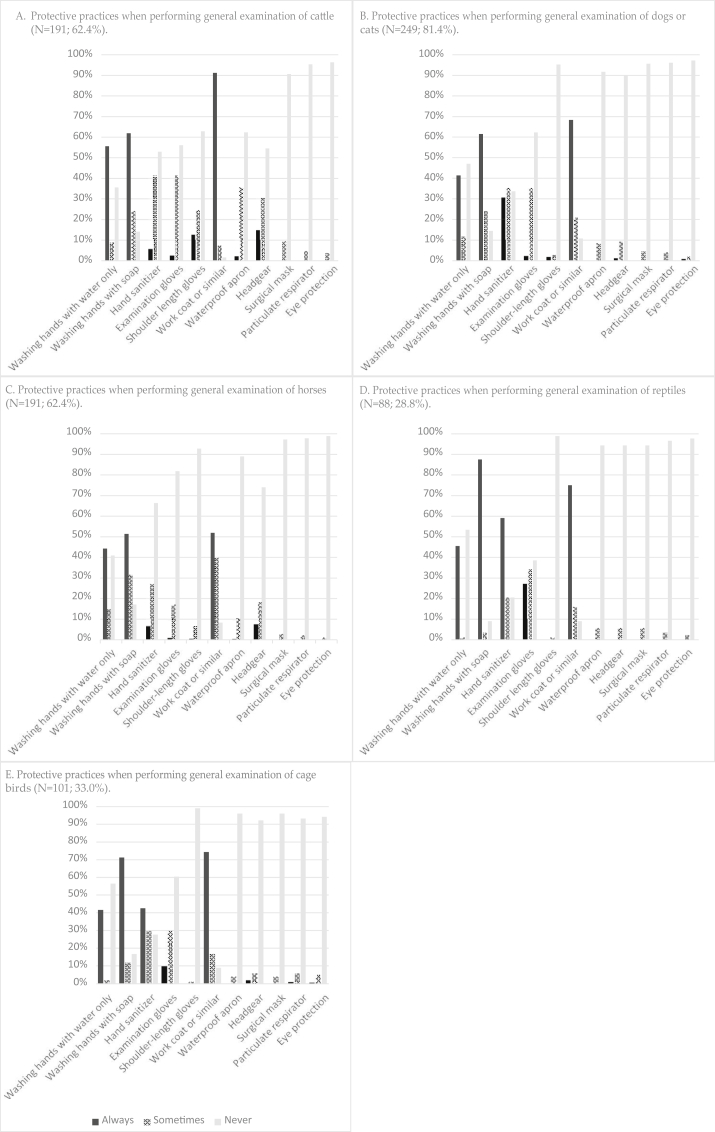
In 2009, the majority (90.9%) of the participating veterinarians reported having been occupationally exposed to zoonotic pathogens. Zoonotic infections (15.0%), needle stick incidents (78.8%), bites (85.0%), as well as infected skin lesions (24.2%) were reported. In 2009, 8.2% of the participants fully agreed with the statement "I have good knowledge of zoonoses and their prevention"; in 2016, the proportion was 10.3%. The reported use of protective practices and personal protective equipment in connection with specific veterinary procedures indicated that there was room for improvement, particularly in protection from pathogens that are transmissible via inhalation and mucous membranes.
The results confirm that veterinarians are commonly occupationally exposed to zoonotic pathogens. Education should aim to improve and maintain the knowledge of zoonoses and their prevention. Use of protective practices should be advocated.
兽医在工作中可能会遇到多种人畜共患病原体。
我们在芬兰的兽医中开展了两项横断面问卷调查研究。参与者是在两次年度兽医大会期间招募的。2009年,306名兽医参与了一项广泛的问卷调查研究,2016年,262名兽医参与了一项更具针对性的研究,该研究包含两个相同的问题。
2009年,大多数(90.9%)参与调查的兽医报告称曾在职业中接触过人畜共患病原体。报告了人畜共患感染(15.0%)、针刺事件(78.8%)、咬伤(85.0%)以及感染性皮肤损伤(24.2%)。2009年,8.2%的参与者完全同意“我对人畜共患病及其预防有充分了解”这一说法;2016年,这一比例为10.3%。报告的与特定兽医程序相关的防护措施和个人防护设备的使用情况表明仍有改进空间,尤其是在预防通过吸入和粘膜传播的病原体方面。
结果证实兽医在职业中普遍接触人畜共患病原体。教育应旨在提高和维持对人畜共患病及其预防的认识。应提倡使用防护措施。