Davitt Cassandra, Traub Rebecca, Batsukh Basan, Battur Banzragch, Pfeffer Martin, Wiethoelter Anke K
Faculty of Veterinary and Agricultural Sciences, University of Melbourne, Parkville, VIC 3052, Australia.
Mongolian Veterinary Medical Association, 11 Khoroo, Khan-Uul District, Ulaanbaatar 17024, Mongolia.
One Health. 2022 Nov 14;15:100458. doi: 10.1016/j.onehlt.2022.100458. eCollection 2022 Dec.
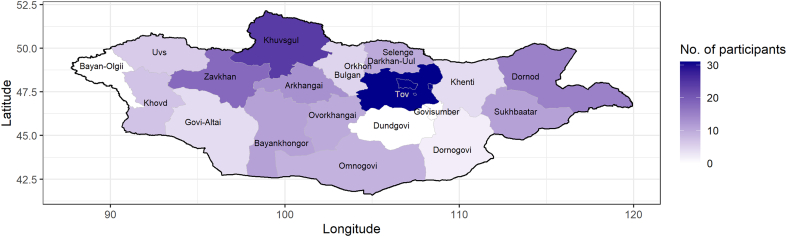
Mongolia is an expansive nation, dominated by agriculture with livestock under nomadic herder care contributing significantly to the economy. Mongolian veterinarians service these herder's livestock and dogs, and are often the first point of contact for animal health advice, including ectoparasite prophylaxis. Dogs are competent reservoir and sentinel hosts for several zoonotic vector-borne diseases (VBD). These diseases in dogs can be dependent on the presence of other sylvatic or domestic reservoir hosts, the abundance of competent vectors and supporting environmental and climatic conditions. Therefore, VBD present a true One Health challenge. The direct and close association of nomadic herders with livestock and livestock protection dogs coupled with frequent relocation (associated with nomadic lifestyles) places all three host groups (herders, livestock and livestock protection dogs) at risk of acquiring VBD. Our study set out to investigate the overall knowledge, perceptions and practices of Mongolian veterinarians towards canine vector-borne diseases (CVBD). A hardcopy questionnaire was delivered through the Mongolian Veterinary Medical Association to a cohort of veterinarians representing 39% of Mongolia's total veterinary workforce with a 53% response rate. A total of 297 participants were included in the final study. The bulk of participants were livestock veterinarians, followed by mixed animal veterinarians. Overall Mongolian veterinarians' knowledge of CVBD were scored as low (58%; 0-3 points) or medium (32%; 4-6 points) on a ten-point scale. There was a significant discrepancy between self-rated and actual knowledge. Females had 1.7 (95% CI 1.1, 2.8) times higher knowledge compared with males and those veterinarians who had 3-5 canine consultations per day were also found to have higher knowledge (odds ratio 1.4, 95% CI 0.4, 4.5). Most veterinarians utilised two or less resources to source information on CVBD over the previous 12 months. The potential of climate-induced emergence of vector populations and their associated pathogens makes it imperative that veterinarians in Mongolia have the necessary resources and knowledge to be on the forefront of CVBD preparedness and mitigation. This study identifies the knowledge gaps and addresses the need for further resources for Mongolian veterinarians to effectively engage in a One Health approach for negating CVBD in animals and humans.
蒙古国是一个幅员辽阔的国家,以农业为主,游牧民饲养的牲畜对经济贡献显著。蒙古兽医为这些牧民的牲畜和犬只提供服务,并且往往是动物健康咨询的第一接触点,包括体外寄生虫预防。犬是多种人畜共患媒介传播疾病(VBD)的有效储存宿主和哨兵宿主。犬身上的这些疾病可能取决于其他野生或家养储存宿主的存在、有效媒介的数量以及支持性的环境和气候条件。因此,媒介传播疾病带来了真正的“同一健康”挑战。游牧民与牲畜及牲畜保护犬直接且密切的联系,再加上频繁搬迁(与游牧生活方式相关),使得所有三个宿主群体(牧民、牲畜和牲畜保护犬)都有感染媒介传播疾病的风险。我们的研究旨在调查蒙古兽医对犬类媒介传播疾病(CVBD)的总体知识、认知和实践。通过蒙古兽医协会向一组兽医发放了纸质问卷,这些兽医占蒙古国兽医总劳动力的39%,回复率为53%。最终研究共纳入297名参与者。大部分参与者是家畜兽医,其次是混合动物兽医。总体而言,蒙古兽医对CVBD的知识在十分制中得分较低(58%;0 - 3分)或中等(32%;4 - 6分)。自我评估的知识与实际知识之间存在显著差异。女性的知识水平是男性的1.7倍(95%置信区间1.1, 2.8),并且发现每天进行3 - 5次犬类咨询的兽医知识水平也更高(优势比1.4, 95%置信区间0.4, 4.5)。在过去12个月中,大多数兽医利用两种或更少的资源来获取关于CVBD的信息。气候导致媒介种群及其相关病原体出现的可能性使得蒙古国的兽医必须拥有必要的资源和知识,以便在CVBD的防范和缓解方面走在前列。本研究确定了知识差距,并指出需要为蒙古兽医提供更多资源,以便他们有效地采用“同一健康”方法来消除动物和人类中的CVBD。