School of Pharmacy, Chengdu University, Chengdu, China.
College of Animal Science and Technology, Sichuan Agricultural University, Chengdu, China.
Microbiol Spectr. 2022 Aug 31;10(4):e0100522. doi: 10.1128/spectrum.01005-22. Epub 2022 Aug 11.
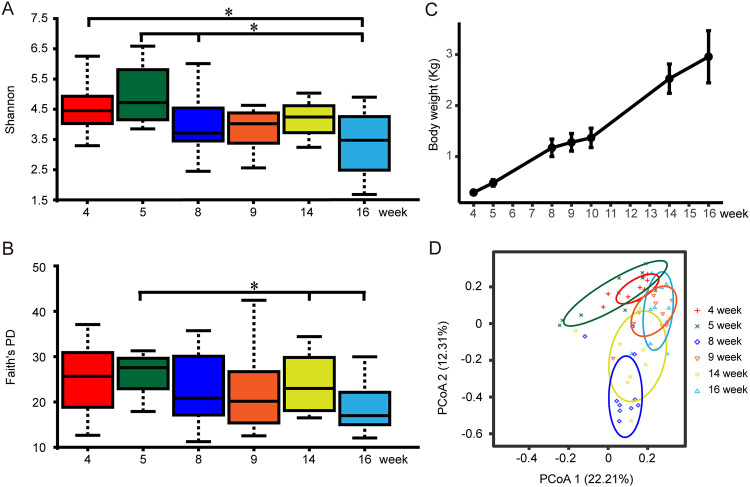
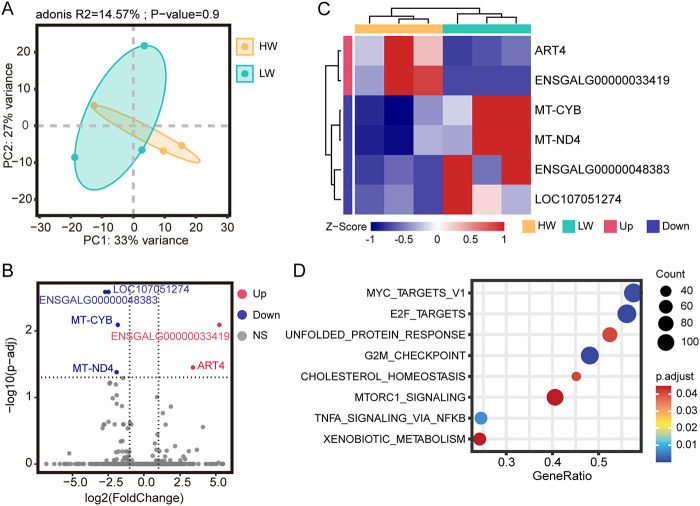
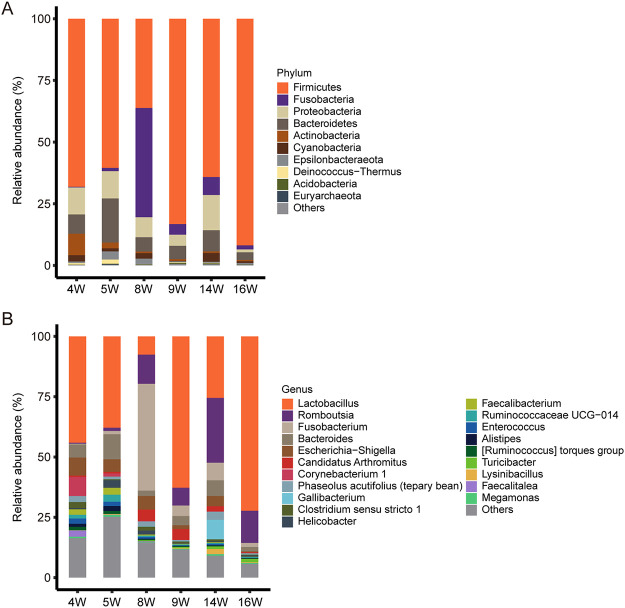
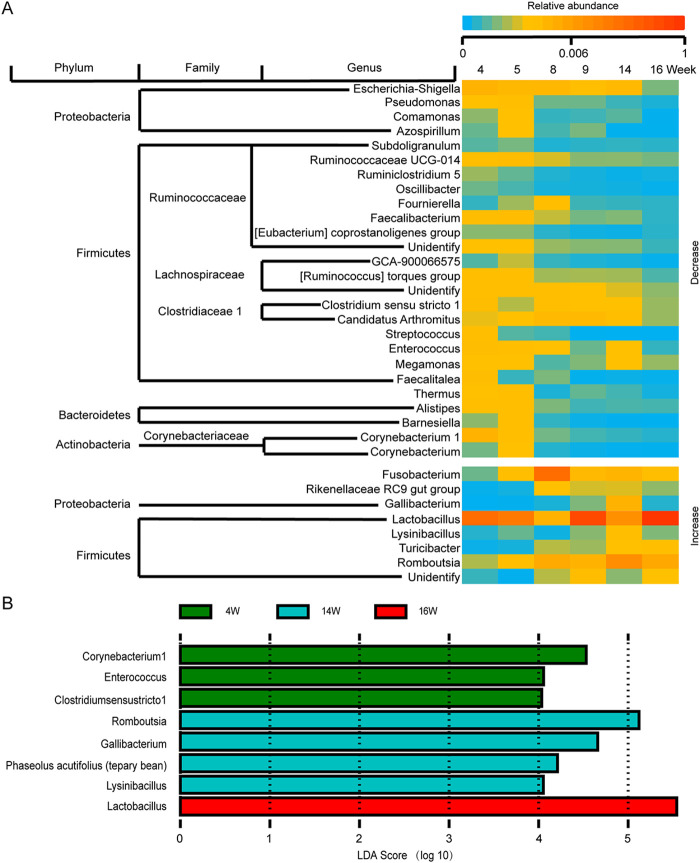
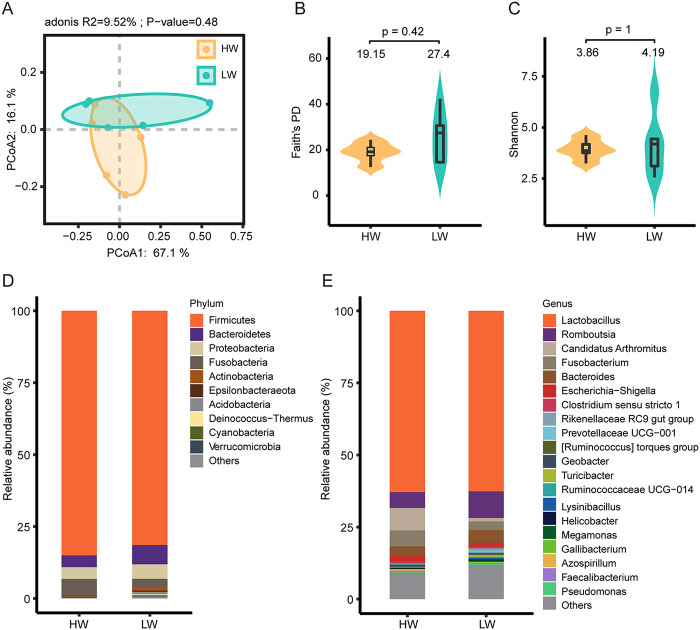
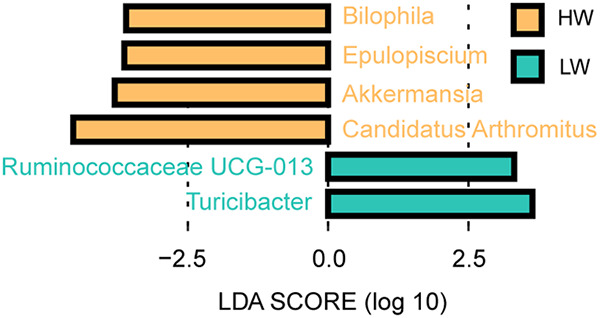
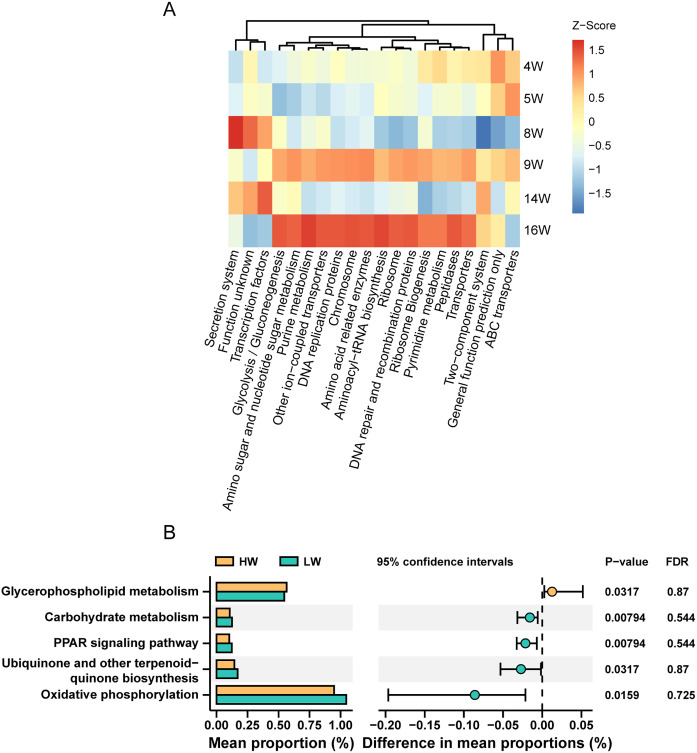
During the entire growth process, gut microbiota continues to change and has a certain impact on the performance of broilers. Here, we used 16S rRNA gene sequencing to explore the dynamic changes in the fecal bacterial communities and functions in 120 broilers from 4 to 16 weeks of age. We found that the main phyla (, , , and ) accounted for more than 93.5% of the total bacteria in the feces. The alpha diversity of the fecal microbiota showed a downward trend with time, and the beta diversity showed significant differences at various time points. Then, the study on the differences of microbiota between high-weight (HW) and low-weight (LW) broilers showed that there were differences in the diversity and composition of microbiota between high- and low-weight broilers. Furthermore, we identified 22 genera that may be related to the weight change of broilers. The analysis of flora function reveals their changes in metabolism, genetic information processing, and environmental information processing. Finally, combined with microbial function and cecal transcriptome results, we speculated that microorganisms may affect the immune level and energy metabolism level of broilers through their own carbohydrate metabolism and lipid metabolism and then affect body weight (BW). Our results will help to expand our understanding of intestinal microbiota and provide guidance for the production of high-quality broilers. The intestinal microbiota has a certain impact on the performance of broilers. However, the change of intestinal microbiota after 4 weeks of age is not clear, and the mechanism of the effect of microorganisms on the weight change of broilers needs more exploration. After 4 weeks of age, the alpha diversity of microorganisms in broiler feces decreased, and the dominant bacteria were , , , and . There were differences in microbiota diversity and composition between high- and low-weight broilers. Intestinal microorganisms may affect the immune level and energy metabolism level of broilers through their own carbohydrate metabolism and lipid metabolism and then affect the body weight. The results are helpful to increase the understanding of intestinal microbiota and provide reference for the production of high-quality broilers.
在整个生长过程中,肠道微生物群继续变化,并对肉鸡的性能产生一定的影响。在这里,我们使用 16S rRNA 基因测序来探索 4 至 16 周龄的 120 只肉鸡粪便中细菌群落和功能的动态变化。我们发现,主要的门(、、、和)占粪便中总细菌的 93.5%以上。粪便微生物群的 alpha 多样性随时间呈下降趋势,beta 多样性在不同时间点有显著差异。然后,对高体重(HW)和低体重(LW)肉鸡之间微生物群差异的研究表明,高体重和低体重肉鸡之间的微生物群多样性和组成存在差异。此外,我们鉴定出 22 个可能与肉鸡体重变化相关的属。菌群功能分析揭示了它们在代谢、遗传信息处理和环境信息处理方面的变化。最后,结合微生物功能和盲肠转录组结果,我们推测微生物可能通过自身的碳水化合物代谢和脂质代谢影响肉鸡的免疫水平和能量代谢水平,从而影响体重(BW)。我们的研究结果将有助于扩展我们对肠道微生物群的理解,并为生产高质量肉鸡提供指导。肠道微生物群对肉鸡的性能有一定的影响。然而,4 周龄后肠道微生物群的变化尚不清楚,微生物对肉鸡体重变化的影响机制需要更多的探索。4 周龄后,肉鸡粪便中微生物的 alpha 多样性下降,优势菌为、、、和。高体重和低体重肉鸡之间的微生物群多样性和组成存在差异。肠道微生物可能通过自身的碳水化合物代谢和脂质代谢影响肉鸡的免疫水平和能量代谢水平,从而影响体重。研究结果有助于增加对肠道微生物群的理解,并为生产高质量肉鸡提供参考。