Bergen Addiction Research, Department of Addiction Medicine, Haukeland University Hospital, Post Box 1400, 5021, Bergen, Norway.
Department of Global Public Health and Primary Care, Faculty of Medicine, University of Bergen, Bergen, Norway.
Sci Rep. 2022 Aug 11;12(1):13695. doi: 10.1038/s41598-022-17804-w.
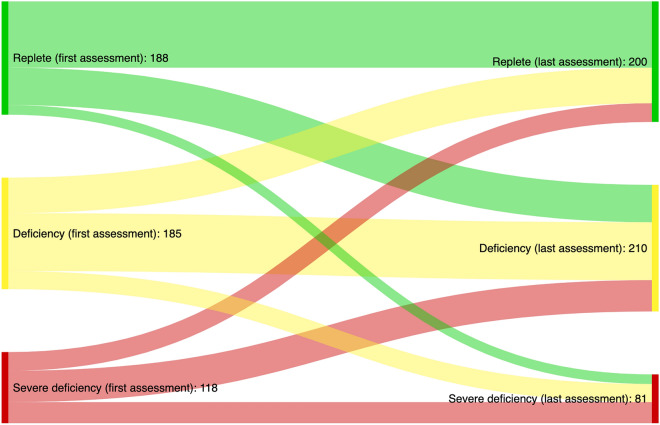
Chronic and harmful substance use is associated with a cluster of harms to health, including micronutrient deficiencies. Maintaining adequate levels of vitamin D is important for musculoskeletal and other aspects of health. In this prospective longitudinal cohort study, 666 participants drawn from outpatient opioid agonist therapy (OAT) clinics and community care clinics for substance use disorder in Western Norway were assessed annually for determination of serum 25-hydroxyvitamin D [s-25(OH)D] levels. Fifty-seven percent were deficient at baseline (s-25(OH)D < 50 nmol/l), and 19% were severely deficient (s-25(OH)D < 25 nmol/l). Among those deficient/severely deficient at baseline, 70% remained deficient/severely deficient at the last measurement (mean duration 714 days). Substance use patterns and dosage of opioids for OAT were not associated with vitamin D levels. One exception was found for cannabis, where consumption on a minimum weekly basis was associated with lower levels at baseline (mean difference: -5.2 nmol/l, 95% confidence interval [CI]: -9.1, - 1.3), but without clear time trends (mean change per year: 1.4 nmol/l, CI: - 0.86, 3.7). The high prevalence of sustained vitamin D deficiency in this cohort highlights the need for targeted monitoring and supplementation for this and similar at-risk populations.
慢性和有害物质的使用与一系列健康危害有关,包括微量营养素缺乏。维持足够的维生素 D 水平对骨骼肌肉和其他健康方面都很重要。在这项前瞻性纵向队列研究中,从挪威西部的门诊阿片类药物激动剂治疗(OAT)诊所和物质使用障碍社区护理诊所中抽取了 666 名参与者,每年评估一次血清 25-羟维生素 D [s-25(OH)D] 水平。基线时 57%的人缺乏(s-25(OH)D<50 nmol/l),19%的人严重缺乏(s-25(OH)D<25 nmol/l)。在基线时缺乏/严重缺乏的人群中,70%的人在最后一次测量时仍然缺乏/严重缺乏(平均持续时间 714 天)。物质使用模式和 OAT 的阿片类药物剂量与维生素 D 水平无关。只有大麻的一个例外,每周最低摄入量与基线时较低的水平有关(平均差异:-5.2 nmol/l,95%置信区间 [CI]:-9.1,-1.3),但没有明显的时间趋势(每年平均变化:1.4 nmol/l,CI:-0.86,3.7)。该队列中持续存在的维生素 D 缺乏的高患病率突出表明,需要对这一人群和类似的高危人群进行有针对性的监测和补充。