Jefferson Health Design Lab, 925 Chestnut Street Basement Level, Philadelphia, PA, 19107, USA.
Sidney Kimmel Medical College of Thomas Jefferson University, 1025 Walnut Street, College Building, Suite 100, Philadelphia, PA, 19107, USA.
BMC Med Educ. 2022 Aug 12;22(1):614. doi: 10.1186/s12909-022-03581-7.
3D printed models are becoming increasingly popular in healthcare as visual and tactile tools to enhance understanding of anatomy and pathology in medical trainee education, provide procedural simulation training, and guide surgical procedures. Patient-specific 3D models are currently being used preoperatively for trainee medical education in planning surgical approaches and intraoperatively to guide decision-making in several specialties. Our study group utilized a modified Delphi process to create a standardized assessment for trainees using patient-specific 3D models as a tool in medical education during pre-surgical planning.
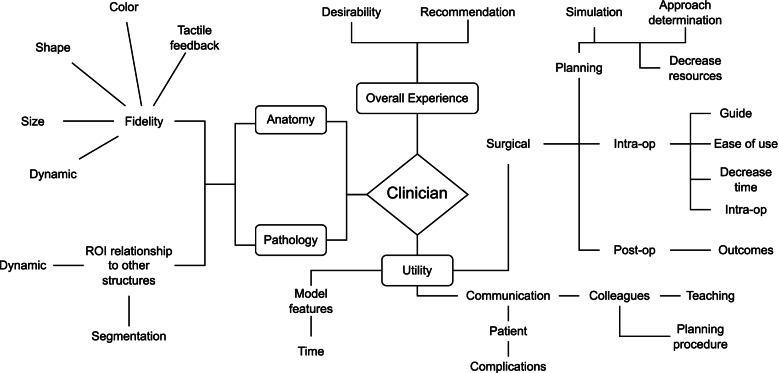
A literature review was conducted to identify survey questions administered to clinicians in published surgical planning studies regarding the use of patient-specific 3D models. A core study team reviewed these questions, removed duplicates, categorized them, mapped them to overarching themes, and, where applicable, modified individual questions into a form generalizable across surgical specialties. The core study panel included a physician, physician-scientist, social scientist, engineer/medical student, and 3D printing lab manager. A modified Delphi process was then used to solicit feedback on the clarity and relevance of the individual questions from an expert panel consisting of 12 physicians from specialties including anesthesiology, emergency medicine, radiology, urology, otolaryngology, and obstetrics/gynecology. When the Radiological Society of North America (RSNA)/American College of Radiology (ACR) 3D Printing Registry Data Dictionary was released, additional survey questions were reviewed. A final cross-disciplinary survey of the utility of 3D printed models in surgical planning medical education was developed.
The literature review identified 100 questions previously published in surveys assessing patient-specific 3D models for surgical planning. Following the review, generalization, and mapping of survey questions from these studies, a list of 24 questions was generated for review by the expert study team. Five additional questions were identified in the RSNA/ACR 3D Printing Registry Data Dictionary and included for review. A final questionnaire consisting of 20 questions was developed.
As 3D printed models become more common in medical education, the need for standardized assessment is increasingly essential. The standardized questionnaire developed in this study reflects the interests of a variety of stakeholders in patient-specific 3D models across disciplines.
3D 打印模型作为增强医学生教育中解剖学和病理学理解的视觉和触觉工具、提供程序模拟训练以及指导手术过程的工具,在医疗保健领域越来越受欢迎。目前,在术前,患者特定的 3D 模型正被用于医学生教育中的手术入路规划,并在术中用于指导多个专业的决策。我们的研究小组利用改良 Delphi 流程,为使用患者特定 3D 模型作为术前手术规划中医学教育工具的医学生创建了标准化评估。
我们进行了文献综述,以确定发表的外科手术计划研究中针对临床医生使用患者特定 3D 模型的调查问题。核心研究小组审查了这些问题,删除了重复项,对其进行了分类,将其映射到总体主题,并在适用的情况下,将个别问题修改为适用于多个外科专业的形式。核心研究小组包括一名医生、医生科学家、社会科学家、工程师/医学生和 3D 打印实验室经理。然后,使用改良 Delphi 流程,从包括麻醉学、急诊医学、放射学、泌尿科、耳鼻喉科和妇产科/妇科在内的 12 名专家组成的专家小组中征求对个别问题的清晰度和相关性的反馈。当放射学学会(RSNA)/美国放射学会(ACR)3D 打印注册数据字典发布时,审查了额外的调查问题。最后,开发了一项跨学科调查,以评估 3D 打印模型在外科手术规划医学教育中的效用。
文献综述确定了之前发表的 100 项评估患者特定 3D 模型用于手术规划的调查问题。在对这些研究中的调查问题进行审查、概括和映射之后,生成了一份 24 个问题清单,供专家研究小组审查。在 RSNA/ACR 3D 打印注册数据字典中还确定了另外 5 个问题,并包括在内进行审查。最终开发了一份包含 20 个问题的问卷。
随着 3D 打印模型在医学教育中越来越普遍,对标准化评估的需求变得越来越重要。本研究中开发的标准化问卷反映了不同学科对患者特定 3D 模型的各种利益相关者的兴趣。