Montesano Vincenzo, Negro Donatella, Sonnante Gabriella, Laghetti Gaetano, Urbano Marcella
URT-ALSIA, Institute for Sustainable Plant Protection (IPSP), National Research Council (CNR), S.S. 106 Km 448,000, 75012 Bernalda, Italy.
Institute of Biosciences and BioResources (IBBR), National Research Council (CNR), Via Amendola, 165/A, 70126 Bari, Italy.
Plants (Basel). 2022 Aug 8;11(15):2067. doi: 10.3390/plants11152067.
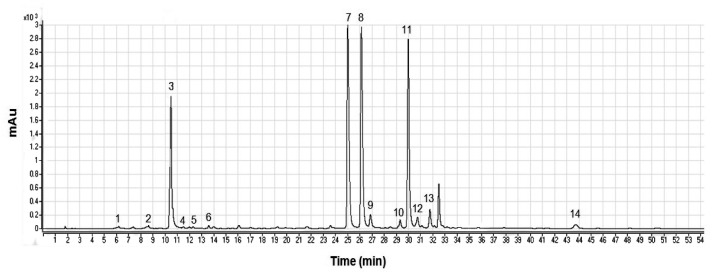
Globe artichoke is an ancient herbaceous plant native to the Mediterranean Basin. The edible part of the plant is limited to the fleshy leaves (bracts) and receptacle of a large immature inflorescence (head) that has been shown to be a rich source of bioactive compounds. Nutritional and pharmacological properties of artichoke heads and leaves are attributed mainly to polyphenolic compounds and inulin present at high concentration. In this study, polyphenols were investigated in two artichoke cultivars (Opal and Madrigal) in response to four nitrogen rates and foliar applications of biostimulating products under drip irrigation. Field experiments were carried out over two growing seasons (2015-2016, 2016-2017) in Policoro (MT), Southern Italy, on a deep clay soil in sub-humid climate conditions. Phenolic compounds were isolated and characterized by means of high-performance liquid chromatography with photodiode array detection and electrospray ionization/mass spectrometry (HPLC-DAD-MS/MS) analysis. In both cultivars, caffeoylquinic acids were more abundant when a dose of 100 kg ha of ammonium nitrate was provided, whereas apigenins were not affected by nitrogen fertilization. Luteolins increased in cv Opal and decreased in cv Madrigal following N fertilization. The application of biostimulants (3 L ha) favored the accumulation of polyphenols, in particular of caffeoylquinic acids and apigenin, in artichoke heads in both cultivars. The results obtained highlight some positive aspects related to the synergistic effect of nitrogen fertilization and biostimulant foliar application.
洋蓟是一种原产于地中海盆地的古老草本植物。该植物的可食用部分仅限于大型未成熟花序(花球)的肉质叶片(苞片)和花托,这些部位已被证明富含生物活性化合物。洋蓟花球和叶片的营养及药理特性主要归因于高浓度存在的多酚类化合物和菊粉。在本研究中,对两个洋蓟品种(蛋白石和马德里加尔)在滴灌条件下,针对四种氮肥施用量以及叶面喷施生物刺激产品的情况进行了多酚类物质的研究。在意大利南部波利科罗(MT),于2015 - 2016年、2016 - 2017年两个生长季,在亚湿润气候条件下的深厚粘土土壤上开展了田间试验。通过配备光电二极管阵列检测和电喷雾电离/质谱(HPLC - DAD - MS/MS)分析的高效液相色谱法对酚类化合物进行分离和表征。在两个品种中,当提供100 kg/ha硝酸铵剂量时,咖啡酰奎宁酸含量更为丰富,而芹菜素不受氮肥影响。施氮后,蛋白石品种中的木犀草素增加,马德里加尔品种中的木犀草素减少。生物刺激剂(3 L/ha)的施用有利于两个品种洋蓟花球中多酚类物质的积累,尤其是咖啡酰奎宁酸和芹菜素。所得结果突出了氮肥施用和叶面喷施生物刺激剂协同效应的一些积极方面。