Department of Chemistry, University of Bari, Campus Universitario, Via Orabona, 4, 70126 Bari, Italy.
Interuniversity Consortium on Chemical Reactivity and Catalysis-CIRCC, Via C. Ulpiani, 27, 70126 Bari, Italy.
Molecules. 2022 Aug 2;27(15):4913. doi: 10.3390/molecules27154913.
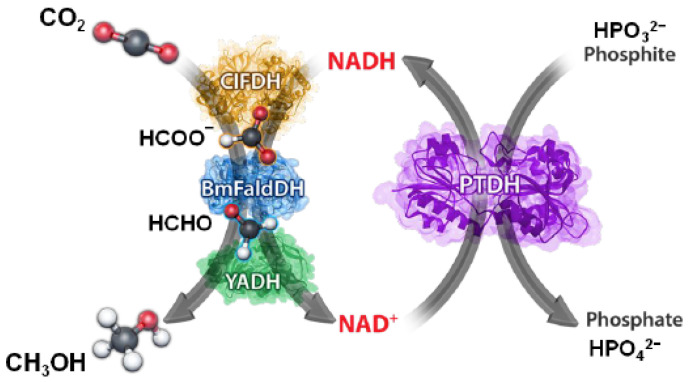
The need to decrease the concentration of CO in the atmosphere has led to the search for strategies to reuse such molecule as a building block for chemicals and materials or a source of carbon for fuels. The enzymatic cascade of reactions that produce the reduction of CO to methanol seems to be a very attractive way of reusing CO; however, it is still far away from a potential industrial application. In this review, a summary was made of all the advances that have been made in research on such a process, particularly on two salient points: enzyme immobilization and cofactor regeneration. A brief overview of the process is initially given, with a focus on the enzymes and the cofactor, followed by a discussion of all the advances that have been made in research, on the two salient points reported above. In particular, the enzymatic regeneration of NADH is compared to the chemical, electrochemical, and photochemical conversion of NAD into NADH. The enzymatic regeneration, while being the most used, has several drawbacks in the cost and life of enzymes that suggest attempting alternative solutions. The reduction in the amount of NADH used (by converting CO electrochemically into formate) or even the substitution of NADH with less expensive mimetic molecules is discussed in the text. Such an approach is part of the attempt made to take stock of the situation and identify the points on which work still needs to be conducted to reach an exploitation level of the entire process.
减少大气中 CO 浓度的需求促使人们寻找策略,以将这种分子作为化学品和材料的构建块或燃料的碳源来加以再利用。生产 CO 还原为甲醇的酶级联反应似乎是一种非常有吸引力的 CO 再利用方法;然而,它距离潜在的工业应用还很远。在这篇综述中,总结了在该过程研究方面取得的所有进展,特别是在两个突出的方面:酶固定化和辅助因子再生。首先简要概述了该过程,重点介绍了酶和辅助因子,然后讨论了在上述两个突出方面报告的所有研究进展。特别是,比较了 NADH 的酶再生与 NAD 向 NADH 的化学、电化学和光化学转化。酶再生虽然应用最广泛,但在酶的成本和寿命方面存在一些缺点,这表明需要尝试替代解决方案。文中讨论了减少使用的 NADH 量(通过将 CO 电化学转化为甲酸盐),甚至用更便宜的模拟分子替代 NADH。这种方法是试图评估现状并确定仍需要开展工作的要点,以达到整个过程的开发水平的一部分。