Chen Rongping, Zhu Dan, Yang Rui, Wu Zezhen, Xu Ningning, Chen Fengwu, Zhang Shuo, Chen Hong, Li Ming, Hou Kaijian
School of Laboratory Medical and Biotechnology, Southern Medical University, Guangzhou, China.
Department of Endocrine and Metabolic Diseases, Longhu Hospital, The First Affiliated Hospital of Shantou University Medical College, Shantou, China.
Ann Transl Med. 2022 Jul;10(13):750. doi: 10.21037/atm-22-2926.
Diabetic kidney disease (DKD) is the most common cause of end-stage renal disease (ESRD), but the mechanism between DKD and ESRD remains unclear. Some experts have put forward the "microbial-centered ESRD development theory", believing that the bacterial load caused by gut microecological imbalance and uremia toxin transfer are the core pathogenic links. The purpose of this study was to analyze the genomic characteristics of gut microbiota in patients with ESRD, specifically DKD or non-diabetic kidney disease (NDKD).
In this cross-sectional study, patients with ESRD were recruited in a community, including 22 DKD patients and 22 NDKD patients matched using gender and age. Fecal samples of patients were collected for 16S rDNA sequencing and gut microbiota analysis. The distribution structure, diversity, and abundance of microflora in DKD patients were analyzed by constructing species evolutionary trees and analyzing alpha diversity, beta diversity, and linear discriminant analysis effect size (LEfSe).
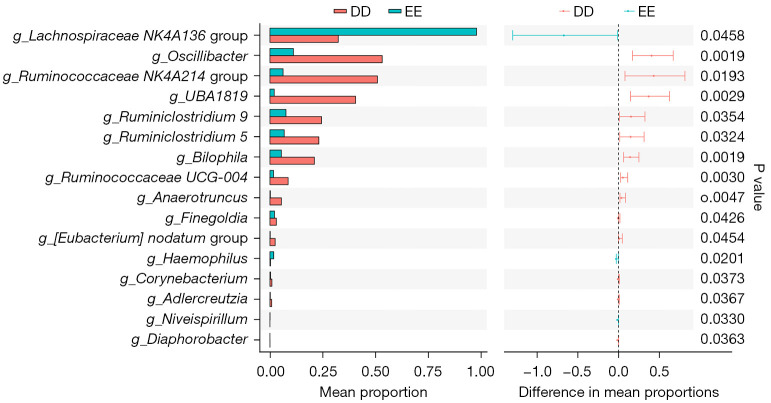
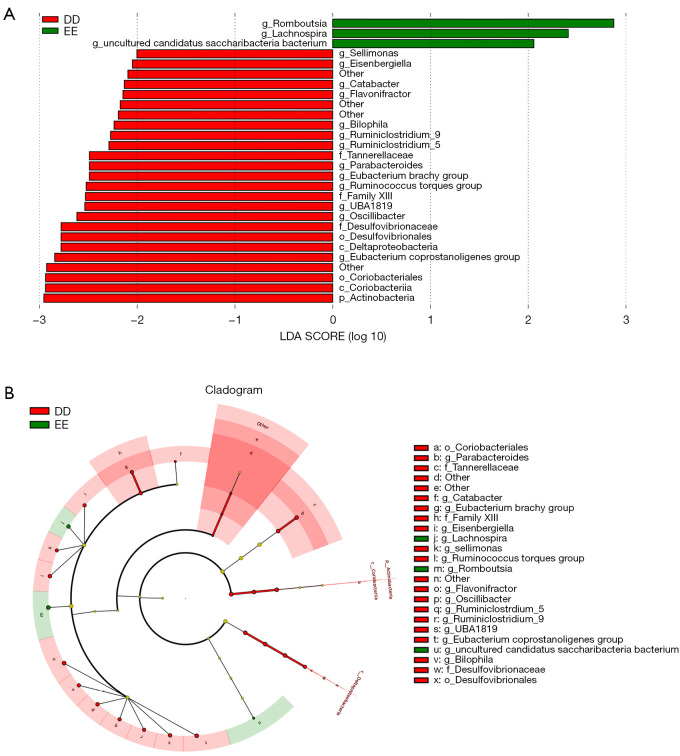
The results of our study showed that there were statistically significant differences in the richness and species of gut microbiota at the total level between DKD patients and NDKD patients. The analysis of genus level between the two groups showed significant differences in 16 bacterial genera. Among them, Oscillibacter, Bilophila, UBA1819, Ruminococcaceae UCG-004, Anaerotruncus, Ruminococcaceae, and Ruminococcaceae NK4A214 bacteria in DKD patients were higher than those in NDKD patients.
16S rDNA sequencing technology was used in this study to analyze the characteristics of intestinal flora in ESRD patients with or without diabetes. We found that there was a significant difference in the intestinal flora of ESRD patients caused by DKD and NDKD, suggesting that these may be potential causative bacteria for the development of ERSD in DKD patients.
糖尿病肾病(DKD)是终末期肾病(ESRD)最常见的病因,但DKD与ESRD之间的机制仍不清楚。一些专家提出了“以微生物为中心的ESRD发展理论”,认为肠道微生态失衡导致的细菌负荷和尿毒症毒素转移是核心致病环节。本研究的目的是分析ESRD患者,特别是DKD或非糖尿病肾病(NDKD)患者肠道微生物群的基因组特征。
在本横断面研究中,在一个社区招募ESRD患者,包括22例DKD患者和22例按性别和年龄匹配的NDKD患者。收集患者的粪便样本进行16S rDNA测序和肠道微生物群分析。通过构建物种进化树和分析α多样性、β多样性及线性判别分析效应大小(LEfSe),分析DKD患者微生物群的分布结构、多样性和丰度。
我们的研究结果表明,DKD患者和NDKD患者在肠道微生物群的丰富度和种类总体水平上存在统计学显著差异。两组属水平分析显示16个细菌属存在显著差异。其中,DKD患者中的颤杆菌属、嗜胆菌属、UBA1819、瘤胃球菌科UCG - 004、厌氧短杆菌属、瘤胃球菌科和瘤胃球菌科NK4A214细菌高于NDKD患者。
本研究采用16S rDNA测序技术分析了有或无糖尿病的ESRD患者的肠道菌群特征。我们发现,由DKD和NDKD引起的ESRD患者肠道菌群存在显著差异,提示这些可能是DKD患者发生ERSD的潜在致病菌。