School of Public Health, Tongji Medical College, Huazhong University of Science and Technology, Wuhan, China.
Lincang Second People's Hospital, Lincang, China.
Front Public Health. 2022 Jul 25;10:940619. doi: 10.3389/fpubh.2022.940619. eCollection 2022.
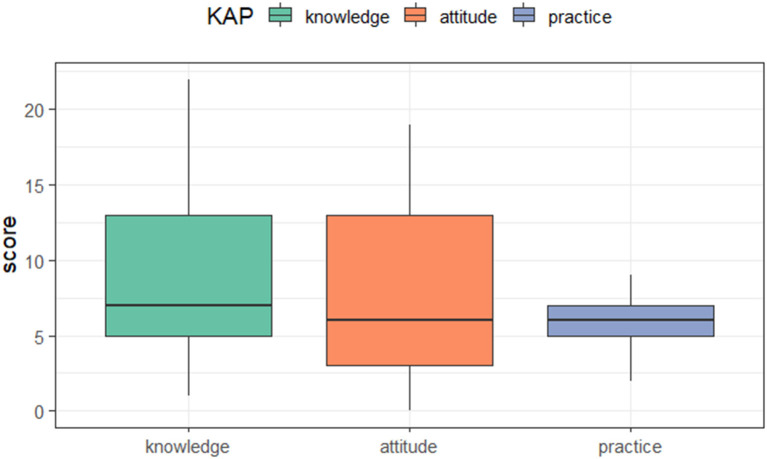
Health literacy plays an important role in preventing and managing chronic diseases, while low levels of health literacy among ethnic minorities are a major manifestation of health inequities. We believe that before effective health literacy intervention strategies, it is preferable to understand the features of health literacy among ethnic minorities. The present study firstly updated insights on health literacy among ethnic minorities by investigating the knowledge, attitude, and practice (KAP) profile of common chronic diseases in ethnic minority areas, and secondly discussed the KAP profiles in detail to inspire future health education interventions.
A cross-sectional, health-literacy-sensitive study was conducted in China's typical ethnic minority area. Participants included 801 adult residents who lived in the ethnic minority area. The primary outcome was participant scores on the KAP questionnaire of common chronic diseases, followed by latent profile analysis to identify participants with similar KAP score patterns and determine whether membership in specific groups was associated with demographic or clinical characteristics.
The participants included 496 ethnic minorities (61.9%) and 305 Han Chinese (38.1%). Three-profile solution was determined after the latent profile analysis: incomplete transfer [I.T.] ( = 215), better practice [B.P.] ( = 301), and average [A.V.] ( = 285). IT group (26.84%) was characterized by the highest level of knowledge and attitude toward common chronic diseases and below average level for practice. Participants in B.P. group performed poorly in both knowledge and attitude toward common chronic diseases but had the highest level of practice. A.V. group reflected average knowledge, attitude, and practice toward common chronic diseases among three subgroups. Ethnic minorities were the dominant population in A.V. group (68.8%). Compared with other groups, the A.V. group contained the largest proportions of married participants (84.2%), participants with no formal education (46.7%), and high annual out-of-pocket medical expense (33.3%).
A more specific and nuanced understanding of minority health literacy can enable service providers to provide more effective health education to their recipients, thereby improving health inequities.
健康素养在预防和管理慢性病方面发挥着重要作用,而少数民族的健康素养水平较低是健康不平等的一个主要表现。我们认为,在实施有效的健康素养干预策略之前,最好先了解少数民族的健康素养特征。本研究首先通过调查少数民族地区常见慢性病的知识、态度和实践(KAP)状况,更新了对少数民族健康素养的认识,其次详细讨论了 KAP 状况,以期为未来的健康教育干预提供启示。
本研究采用横断面、健康素养敏感的研究方法,在中国典型的少数民族地区进行。参与者包括 801 名居住在少数民族地区的成年居民。主要结局是参与者常见慢性病 KAP 问卷的得分,随后进行潜在剖面分析,以确定具有相似 KAP 得分模式的参与者,并确定特定群体的成员身份是否与人口统计学或临床特征相关。
参与者包括 496 名少数民族(61.9%)和 305 名汉族(38.1%)。潜在剖面分析确定了三种解决方案:不完全转移[I.T.](=215)、较好的实践[B.P.](=301)和平均[A.V.](=285)。I.T.组(26.84%)的特点是对常见慢性病的知识和态度最高,但实践水平平均。B.P.组在常见慢性病的知识和态度方面表现不佳,但实践水平最高。A.V.组反映了三个亚组中常见慢性病的平均知识、态度和实践。少数民族在 A.V.组中占主导地位(68.8%)。与其他组相比,A.V.组中已婚参与者比例最大(84.2%),无正规教育的参与者比例最高(46.7%),高年度自付医疗费用的参与者比例最高(33.3%)。
对少数民族健康素养有更具体和细致的了解,可以使服务提供者为其服务对象提供更有效的健康教育,从而改善健康不平等。