Department of Cardiology, First Affiliated Hospital of Sun Yat-Sen University, 58 Zhongshan 2nd Road, Guangzhou, 510080, China.
NHC Key Laboratory of Assisted Circulation, (Sun Yat-Sen University), Guangzhou, China.
Cardiovasc Diabetol. 2022 Aug 12;21(1):155. doi: 10.1186/s12933-022-01593-7.
This study aimed to investigate the associations between the triglyceride-glucose (TyG) index in young adulthood with incident cardiovascular disease (CVD) and mortality.
We included 4,754 participants from the Coronary Artery Risk Development in Young Adults study at baseline. The TyG index was calculated as ln (fasting TG [mg/dl] × fasting glucose [mg/dl]/2), and the TyG index trajectories were identified by using the latent class growth mixture model. We evaluated the association between the baseline and trajectories of the TyG index with incident CVD events and all-cause mortality using Cox proportional hazards regression analysis. The added value of the TyG index included in pooled cohort equations for CVD prediction was also analyzed.
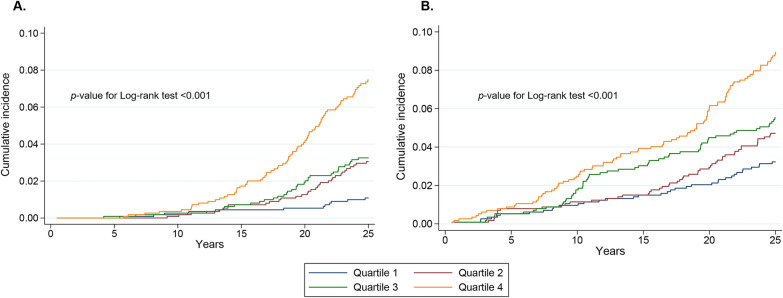
Among 4754 participants (mean age 24.72 years, 45.8% male, 51.2% black), there were 158 incident CVD events and 246 all-cause mortality during a median 25 years follow-up. After adjusting for multiple confounding variables, each one-unit increase in the TyG index was associated with a 96% higher CVD risk (hazard ratio [HR] 1.96, 95% confidence interval [CI] 1.44-2.66) and a 85% higher all-cause mortality risk (HR 1.85, 95% CI 1.45-2.36). Three distinct trajectories of the TyG index along the follow-up duration were identified: low (44.0%), moderate (45.5%), and high (10.5%). Compared with those participants in the low TyG index trajectory group, those in the high TyG index trajectory group had a greater risk of CVD events (HR 2.35, 95% CI 1.34-4.12) and all-cause mortality (HR 3.04, 95% CI 1.83-5.07). The addition of baseline TyG index to pooled cohort equations for CVD improved the C-statistics (P < 0.001), integrated discrimination improvement value (P < 0.001), and category-free net reclassification improvement value (P = 0.003).
Higher baseline TyG index levels and higher long-term trajectory of TyG index during young adulthood were significantly associated with an increased risk of incident CVD events and all-cause mortality in later life.
本研究旨在探讨年轻人的甘油三酯-葡萄糖(TyG)指数与心血管疾病(CVD)事件和死亡率的相关性。
我们纳入了基线时来自冠状动脉风险发展青年研究的 4754 名参与者。TyG 指数的计算方法为 ln(空腹甘油三酯[mg/dl]×空腹血糖[mg/dl]/2),并使用潜在类别增长混合模型确定 TyG 指数轨迹。我们使用 Cox 比例风险回归分析评估基线和 TyG 指数轨迹与 CVD 事件和全因死亡率之间的相关性。还分析了 TyG 指数纳入汇总队列方程进行 CVD 预测的附加值。
在 4754 名参与者(平均年龄 24.72 岁,45.8%为男性,51.2%为黑人)中,中位 25 年随访期间发生了 158 例 CVD 事件和 246 例全因死亡。在调整了多个混杂变量后,TyG 指数每增加一个单位,CVD 风险增加 96%(风险比[HR]1.96,95%置信区间[CI]1.44-2.66),全因死亡率风险增加 85%(HR 1.85,95% CI 1.45-2.36)。沿着随访时间确定了 TyG 指数的三个不同轨迹:低(44.0%)、中(45.5%)和高(10.5%)。与低 TyG 指数轨迹组的参与者相比,高 TyG 指数轨迹组的 CVD 事件风险更高(HR 2.35,95% CI 1.34-4.12),全因死亡率风险更高(HR 3.04,95% CI 1.83-5.07)。基线 TyG 指数添加到 CVD 的汇总队列方程中提高了 C 统计量(P<0.001)、综合判别改善值(P<0.001)和无类别净重新分类改善值(P=0.003)。
较高的基线 TyG 指数水平和年轻成年期 TyG 指数的长期轨迹与晚年 CVD 事件和全因死亡率风险的增加显著相关。