Department of Microbiology, Immunology, and Cell Biology, West Virginia Universitygrid.268154.c, Morgantown, West Virginia, USA.
Vaccine Development Center at West Virginia Universitygrid.268154.c Health Sciences Center, Morgantown, West Virginia, USA.
mSphere. 2022 Aug 31;7(4):e0024322. doi: 10.1128/msphere.00243-22. Epub 2022 Aug 15.
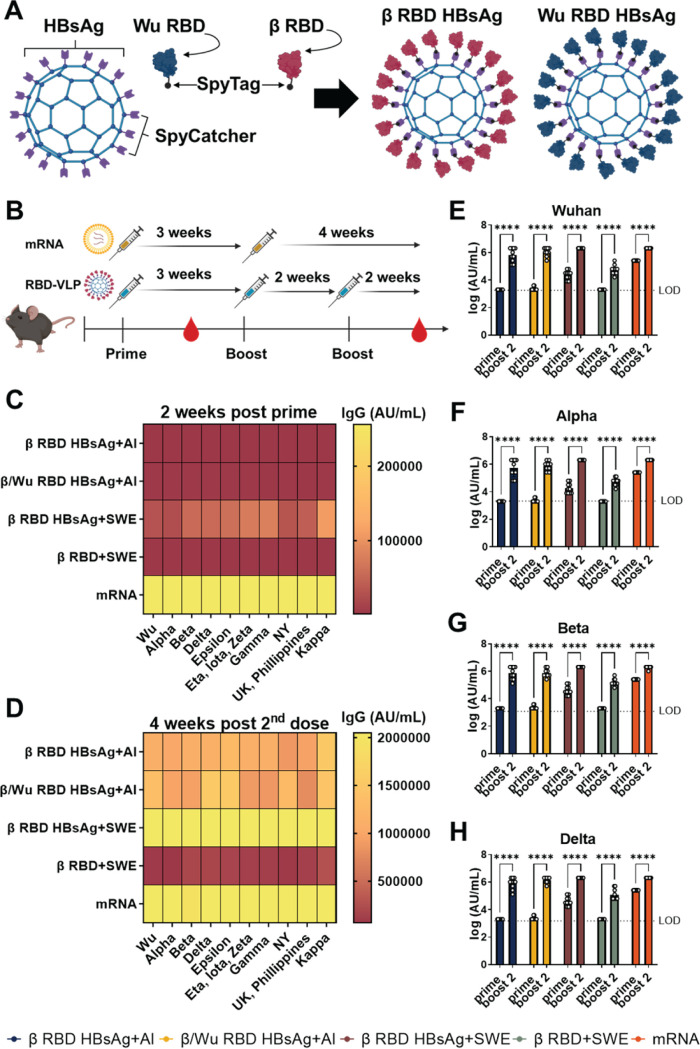
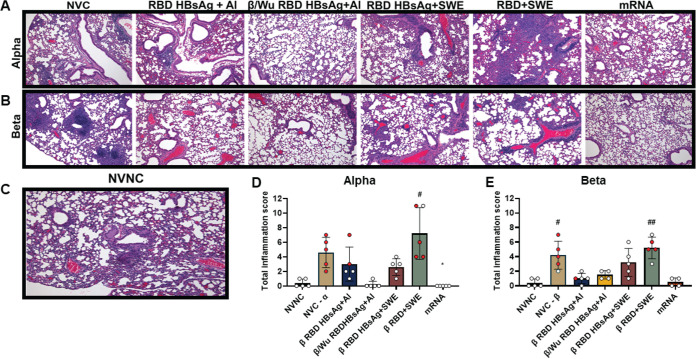
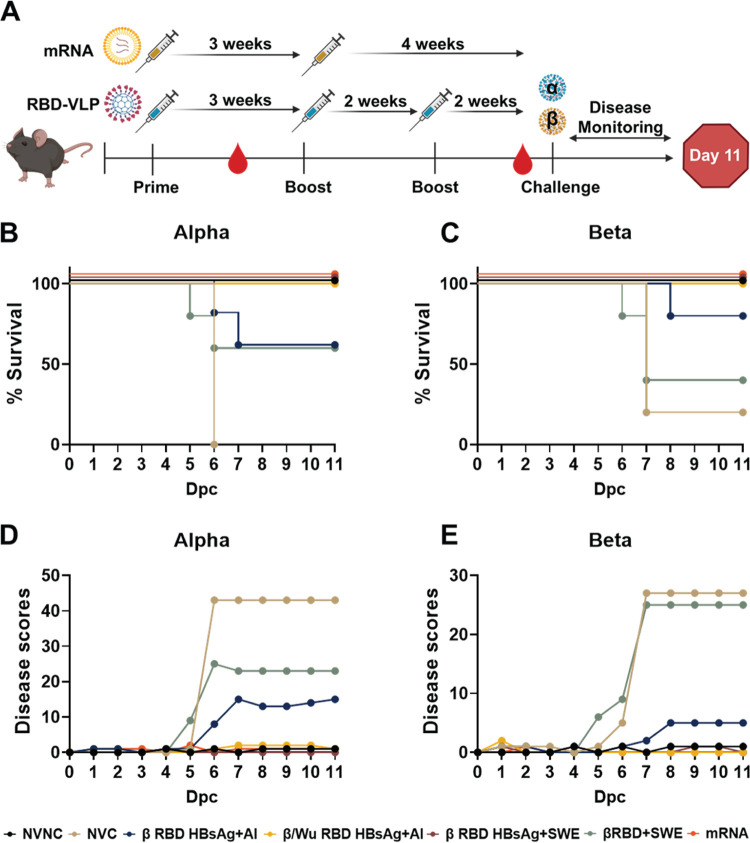
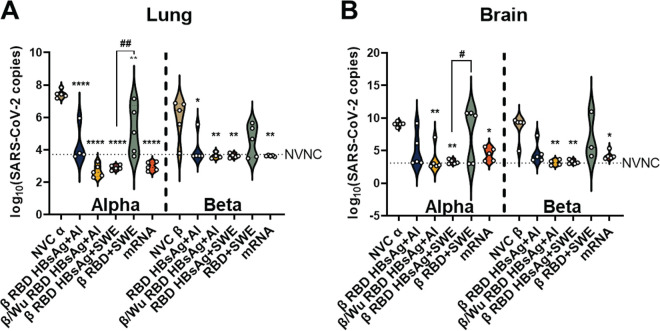
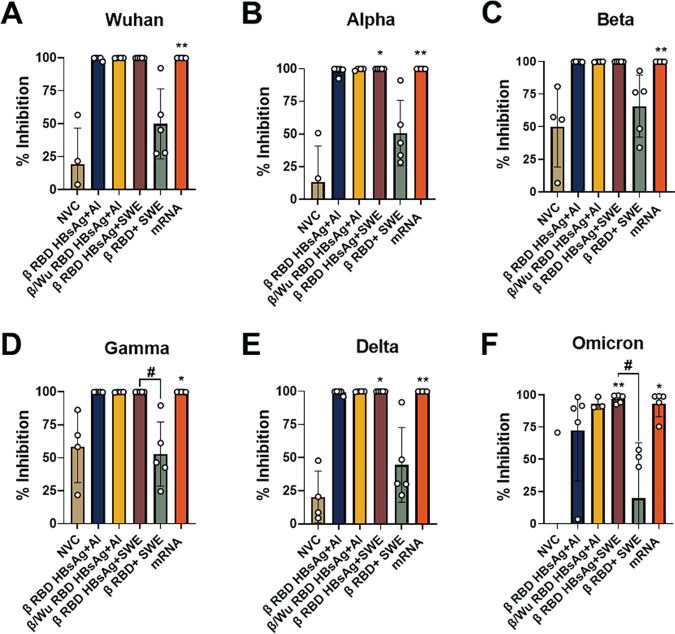
The ongoing COVID-19 pandemic has contributed largely to the global vaccine disparity. Development of protein subunit vaccines can help alleviate shortages of COVID-19 vaccines delivered to low-income countries. Here, we evaluated the efficacy of a three-dose virus-like particle (VLP) vaccine composed of hepatitis B surface antigen (HBsAg) decorated with the receptor binding domain (RBD) from the Wuhan or Beta SARS-CoV-2 strain adjuvanted with either aluminum hydroxide (alum) or squalene in water emulsion (SWE). RBD HBsAg vaccines were compared to the standard two doses of Pfizer mRNA vaccine. Alum-adjuvanted vaccines were composed of either HBsAg conjugated with Beta RBD alone (β RBD HBsAg+Al) or a combination of both Beta RBD HBsAg and Wuhan RBD HBsAg (β/Wu RBD HBsAg+Al). RBD vaccines adjuvanted with SWE were formulated with Beta RBD HBsAg (β RBD HBsAg+SWE) or without HBsAg (β RBD+SWE). Both alum-adjuvanted RBD HBsAg vaccines generated functional RBD IgG against multiple SARS-CoV-2 variants of concern (VOC), decreased viral RNA burden, and lowered inflammation in the lung against Alpha or Beta challenge in K18-hACE2 mice. However, only β/Wu RBD HBsAg+Al was able to afford 100% survival to mice challenged with Alpha or Beta VOC. Furthermore, mice immunized with β RBD HBsAg+SWE induced cross-reactive neutralizing antibodies against major VOC of SARS-CoV-2, lowered viral RNA burden in the lung and brain, and protected mice from Alpha or Beta challenge similarly to mice immunized with Pfizer mRNA. However, RBD+SWE immunization failed to protect mice from VOC challenge. Our findings demonstrate that RBD HBsAg VLP vaccines provided similar protection profiles to the approved Pfizer mRNA vaccines used worldwide and may offer protection against SARS-CoV-2 VOC. Global COVID-19 vaccine distribution to low-income countries has been a major challenge of the pandemic. To address supply chain issues, RBD virus-like particle (VLP) vaccines that are cost-effective and capable of large-scale production were developed and evaluated for efficacy in preclinical mouse studies. We demonstrated that RBD-VLP vaccines protected K18-hACE2 mice against Alpha or Beta challenge similarly to Pfizer mRNA vaccination. Our findings showed that the VLP platform can be utilized to formulate immunogenic and efficacious COVID-19 vaccines.
持续的 COVID-19 大流行在很大程度上导致了全球疫苗差距。开发蛋白质亚单位疫苗可以帮助缓解向低收入国家提供的 COVID-19 疫苗短缺的问题。在这里,我们评估了由乙型肝炎表面抗原(HBsAg)组成的三剂量病毒样颗粒(VLP)疫苗的功效,该抗原带有武汉或 Beta SARS-CoV-2 株的受体结合域(RBD),并使用氢氧化铝(明矾)或角鲨烯佐剂在水乳液(SWE)中。RBD HBsAg 疫苗与标准的辉瑞 mRNA 疫苗两剂进行了比较。明矾佐剂疫苗由单独的与 Beta RBD 缀合的 HBsAg(β RBD HBsAg+Al)或同时包含 Beta RBD HBsAg 和武汉 RBD HBsAg(β/Wu RBD HBsAg+Al)组成。用 SWE 佐剂的 RBD 疫苗由 Beta RBD HBsAg(β RBD HBsAg+SWE)或没有 HBsAg(β RBD+SWE)组成。两种明矾佐剂的 RBD HBsAg 疫苗均针对多种 SARS-CoV-2 关注变体(VOC)产生了功能性 RBD IgG,降低了 Alpha 或 Beta 挑战后 K18-hACE2 小鼠中的病毒 RNA 负担并减轻了肺部炎症。然而,只有β/Wu RBD HBsAg+Al 能够使 100%的小鼠免受 Alpha 或 Beta VOC 的挑战。此外,用β RBD HBsAg+SWE 免疫的小鼠诱导了针对 SARS-CoV-2 主要 VOC 的交叉反应性中和抗体,降低了肺部和脑部的病毒 RNA 负担,并与用 Pfizer mRNA 免疫的小鼠一样,保护小鼠免受 Alpha 或 Beta 挑战。然而,RBD+SWE 免疫不能保护小鼠免受 VOC 挑战。我们的研究结果表明,RBD HBsAg VLP 疫苗提供了与全球使用的已批准的 Pfizer mRNA 疫苗相似的保护作用,并可能提供针对 SARS-CoV-2 VOC 的保护。全球向低收入国家分配 COVID-19 疫苗一直是大流行的主要挑战。为了解决供应链问题,开发并评估了具有成本效益且能够大规模生产的 RBD 病毒样颗粒(VLP)疫苗,以评估其在临床前小鼠研究中的功效。我们证明,RBD-VLP 疫苗可保护 K18-hACE2 小鼠免受 Alpha 或 Beta 挑战,与 Pfizer mRNA 疫苗接种的效果相似。我们的研究结果表明,VLP 平台可用于制定免疫原性和有效的 COVID-19 疫苗。