Chang Huiqin, Jiang Meng, Zhu Qiying, Liu Anqi, Wu Yuyin, Li Canguo, Ji Xiangyue, Gong Li, Li Shanshan, Chen Zhiwei, Kong Ling, Han Lei
School of Agriculture Engineering and Food Science, Shandong University of Technology, Zibo 255049, PR China.
School of Life Sciences, Shandong University of Technology, Zibo 255049, PR China.
Microchem J. 2022 Nov;182:107866. doi: 10.1016/j.microc.2022.107866. Epub 2022 Aug 11.
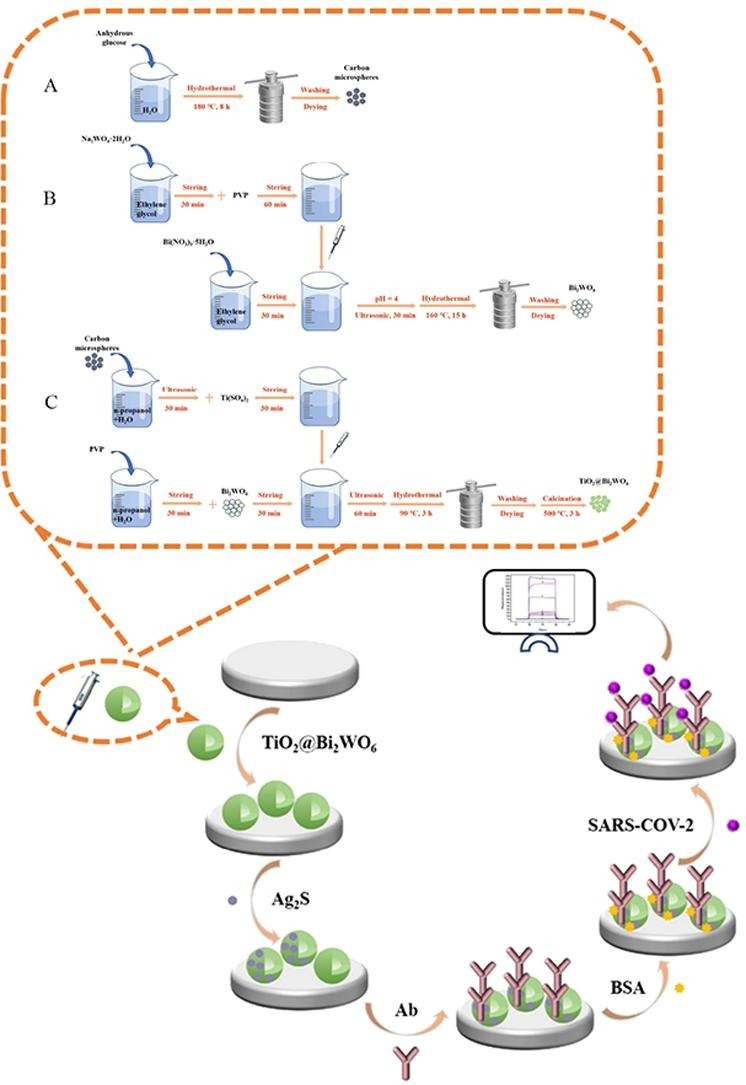
Severe Acute Respiratory Syndrome Coronavirus 2 (SARS-COV-2) is a cluster of β coronaviruses. The 2019 coronavirus disease (COVID-19) caused by SARS-COV-2 is emerging as a global pandemic. Thus, early diagnosis of SARS-COV-2 is essential to prevent severe outbreaks of the disease. In this experiment, a novel label-free photoelectrochemical (PEC) immunosensor was obtained based on silver sulfide (AgS) sensitized titanium dioxide@bismuth tungstate (TiO@BiWO) nanocomposite for quantitative detection of SARS-COV-2 nucleocapsid protein. The constructed TiO@BiWO hollow microspheres had large specific surface area and could produce high photocurrent intensity under visible light illumination. AgS was in-situ grown on the surface of thioglycolic acid (TGA) modified TiO@BiWO. In particular, TiO@BiWO and AgS formed a good energy level match, which could effectively enhance the photocurrent conversion efficiency and strength the photocurrent response. Ascorbic acid (AA) acted as an effective electron donor to effectively eliminate photogenerated holes. Under optimal experimental conditions, the constructed immunosensor presented a supersensitive response to SARS-COV-2 nucleocapsid protein, with a desirable linear relationship ranged from 0.001 to 50 ng/mL for nucleocapsid protein and a lower detection limit of 0.38 pg/mL. The fabricated sensor exhibited a wide linear range, excellent selectivity, specificity and stability, which provided a valuable referential idea for the detection of SARS-COV-2.
严重急性呼吸综合征冠状病毒2(SARS-CoV-2)是β冠状病毒的一个簇。由SARS-CoV-2引起的2019冠状病毒病(COVID-19)正在演变成一场全球大流行。因此,SARS-CoV-2的早期诊断对于预防该疾病的严重爆发至关重要。在本实验中,基于硫化银(AgS)敏化的二氧化钛@钨酸铋(TiO@BiWO)纳米复合材料获得了一种新型无标记光电化学(PEC)免疫传感器,用于定量检测SARS-CoV-2核衣壳蛋白。构建的TiO@BiWO空心微球具有较大的比表面积,在可见光照射下能产生较高的光电流强度。AgS原位生长在巯基乙酸(TGA)修饰的TiO@BiWO表面。特别是,TiO@BiWO和AgS形成了良好的能级匹配,可有效提高光电流转换效率并增强光电流响应。抗坏血酸(AA)作为有效的电子供体,可有效消除光生空穴。在最佳实验条件下,构建的免疫传感器对SARS-CoV-2核衣壳蛋白呈现超灵敏响应,核衣壳蛋白的线性关系良好,范围为0.001至50 ng/mL,检测下限为0.38 pg/mL。所制备的传感器具有宽线性范围、优异的选择性、特异性和稳定性,为SARS-CoV-2的检测提供了有价值的参考思路。