
动态催化指导下的核酸网络和 DNA 纳米结构。
Dynamic Catalysis Guided by Nucleic Acid Networks and DNA Nanostructures.
机构信息
The Institute of Chemistry, The Hebrew University of Jerusalem, Jerusalem 91904, Israel.
出版信息
Bioconjug Chem. 2023 Jan 18;34(1):51-69. doi: 10.1021/acs.bioconjchem.2c00233. Epub 2022 Aug 16.
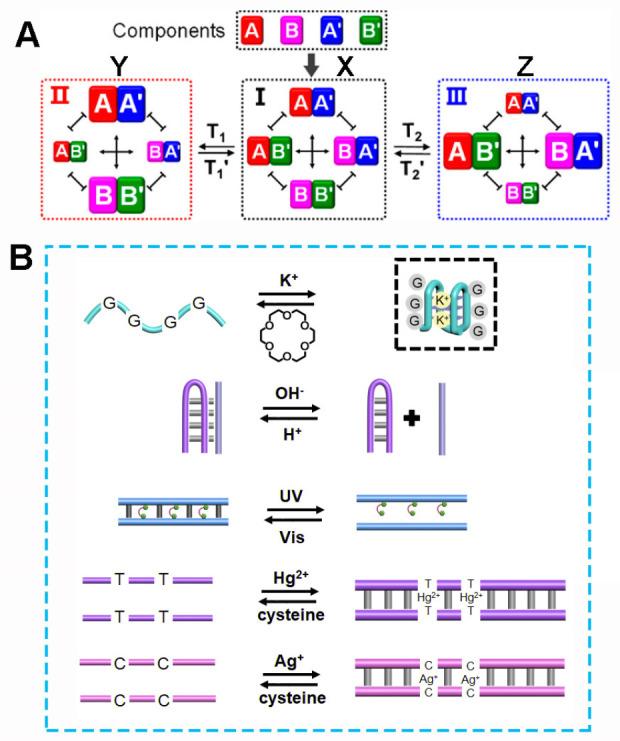
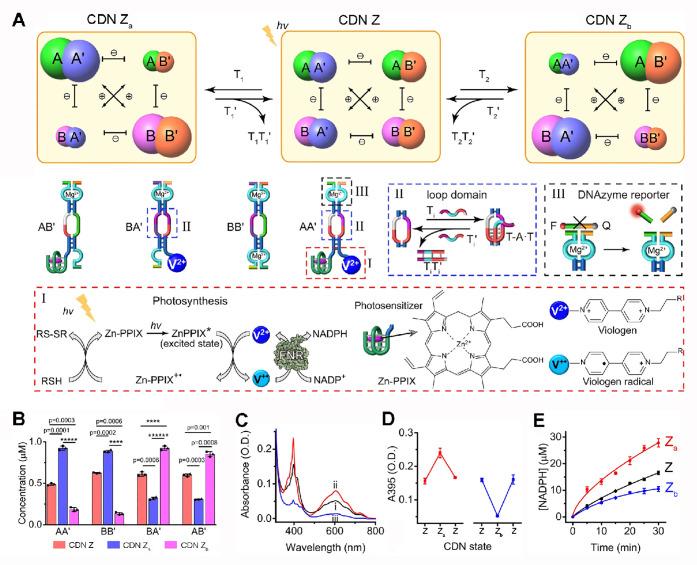
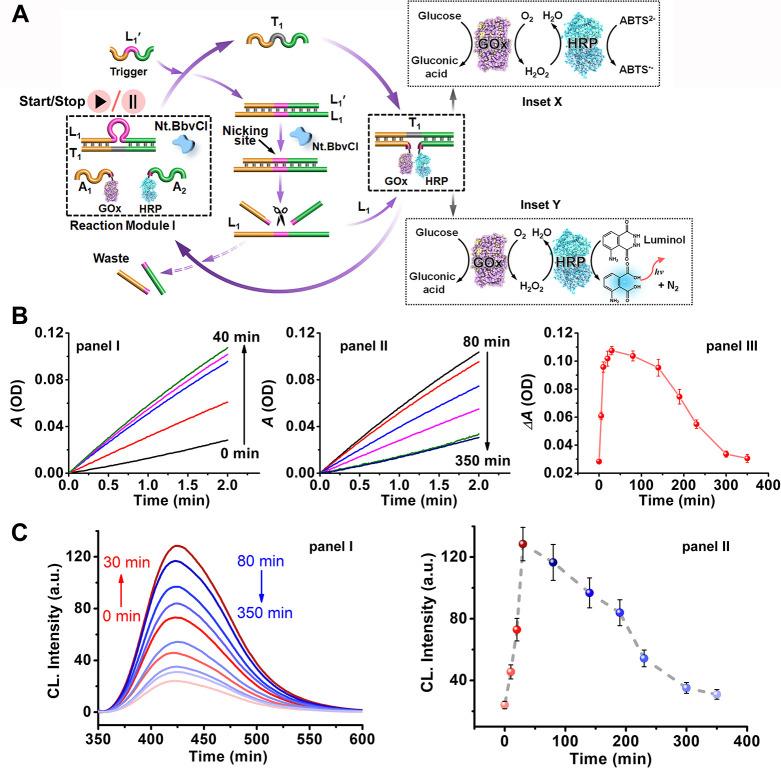
Nucleic acid networks conjugated to native enzymes and supramolecular DNA nanostructures modified with enzymes or DNAzymes act as functional reaction modules for guiding dynamic catalytic transformations. These systems are exemplified with the assembly of constitutional dynamic networks (CDNs) composed of nucleic acid-functionalized enzymes, as constituents, undergoing triggered structural reconfiguration, leading to dynamically switched biocatalytic cascades. By coupling two nucleic acid/enzyme networks, the intercommunicated feedback-driven dynamic biocatalytic operation of the system is demonstrated. In addition, the tailoring of a nucleic acid/enzyme reaction network driving a dissipative, transient, biocatalytic cascade is introduced as a model system for out-of-equilibrium dynamically modulated biocatalytic transformation in nature. Also, supramolecular nucleic acid machines or DNA nanostructures, modified with DNAzyme or enzyme constituents, act as functional reaction modules driving temporal dynamic catalysis. The design of dynamic supramolecular machines is exemplified with the introduction of an interlocked two-ring catenane device that is dynamically reversibly switched between two states operating two different DNAzymes, and with the tailoring of a DNA-tweezers device functionalized with enzyme/DNAzyme constituents that guides the dynamic ON/OFF operation of a biocatalytic cascade by opening and closing the molecular device. In addition, DNA origami nanostructures provide functional scaffolds for the programmed positioning of enzymes or DNAzyme for the switchable operation of catalytic transformations. This is introduced by the tailored functionalization of the edges of origami tiles with nucleic acids guiding the switchable formation of DNAzyme catalysts through the dimerization/separation of the tiles. In addition, the programmed deposition of two-enzyme/cofactor constituents on the origami raft allowed the dynamic photochemical activation of the cofactor-mediated biocatalytic cascade on the spatially biocatalytic assembly on the scaffold. Furthermore, photoinduced "mechanical" switchable and reversible unlocking and closing of nanoholes in the origami frameworks allow the "ON" and "OFF" operation of DNAzyme units in the nanoholes, confined environments. The future challenges and potential applications of dynamic nucleic acid/enzyme and DNAzyme conjugates are discussed in the conclusion paragraph.
核酸网络与天然酶连接,超分子 DNA 纳米结构经过酶或 DNA 酶修饰后充当指导动态催化转化的功能反应模块。这些系统的例子是由核酸功能化酶组成的组成型动态网络 (CDN) 的组装,这些酶作为组成部分经历触发的结构重排,导致动态切换的生物催化级联。通过耦合两个核酸/酶网络,证明了系统的互传反馈驱动的动态生物催化操作。此外,引入了一种核酸/酶反应网络,该网络驱动耗散、瞬态、生物催化级联,作为自然界中不平衡动态调节生物催化转化的模型系统。此外,经过 DNA 酶或酶成分修饰的超分子核酸机器或 DNA 纳米结构充当驱动时间动态催化的功能反应模块。动态超分子机器的设计通过引入一个互锁的双环套索装置为例,该装置在两种状态之间动态可逆切换,操作两种不同的 DNA 酶,并通过打开和关闭分子装置来引导生物催化级联的动态 ON/OFF 操作,设计了一种带有酶/DNA 酶成分的 DNA 镊子装置。此外,DNA 折纸纳米结构为酶或 DNA 酶的程控定位提供了功能支架,以实现催化转化的可切换操作。这是通过将折纸瓦片边缘进行核酸功能化来实现的,核酸引导 DNA 酶催化剂的可切换形成,通过瓦片的二聚化/分离。此外,在 origami 筏上程序化沉积两种酶/辅因子成分,允许在支架上的空间生物催化组装上动态光化学激活辅因子介导的生物催化级联。此外, origami 框架中的纳米孔的光诱导“机械”可切换和可逆解锁和关闭允许纳米孔中 DNA 酶单元的“ON”和“OFF”操作,处于受限环境中。在结论部分讨论了动态核酸/酶和 DNA 酶缀合物的未来挑战和潜在应用。





 Zotero 插件