Institute for Sport and Physical Activity Research, School of Sport Science and Physical Activity, University of Bedfordshire, Bedford, UK.
Health Advancement Research Team (HART), School of Sport and Exercise Science, University of Lincoln, Lincoln, UK.
J Cachexia Sarcopenia Muscle. 2022 Dec;13(6):2791-2806. doi: 10.1002/jcsm.13064. Epub 2022 Aug 17.
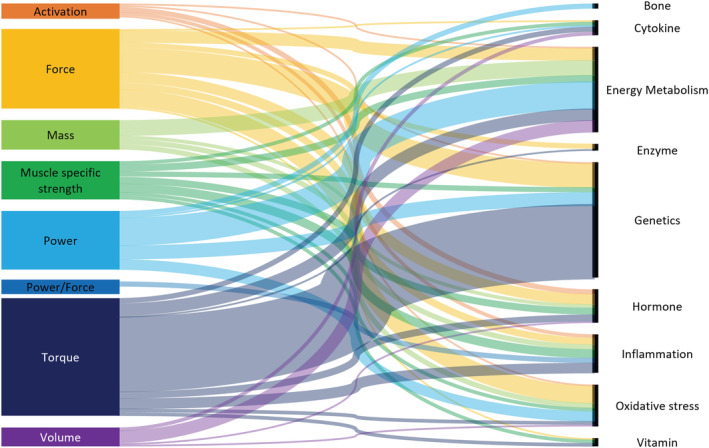
Lower limb muscle dysfunction is a key driver for impaired physical capacity and frailty status, both characteristics of sarcopenia. Sarcopenia is the key pathway between frailty and disability. Identifying biological markers for early diagnosis, treatment, and prevention may be key to early intervention and prevention of disability particularly mobility issues. To identify biological markers associated with lower limb muscle (dys)function in adults with sarcopenia, a systematic literature search was conducted in AMED, CINAHL, Cochrane Library, EMBASE, Medline, PubMed, Scopus, SPORTDiscus, and Web of Science databases from inception to 17 November 2021. Title, abstract, and full-text screening, data extraction, and methodological quality assessment were performed by two reviewers independently and verified by a third reviewer. Depending on available data, associations are reported as either Pearson's correlations, regression R or partial R , P value, and sample size (n). Twenty eligible studies including 3306 participants were included (females: 79%, males: 15%, unreported: 6%; mean age ranged from 53 to 92 years) with 36% in a distinct sarcopenic subgroup (females: 73%, males: 19%, unreported: 8%; mean age range 55-92 years). A total of 119 biomarkers were reported, categorized into: genetic and microRNAs (n = 64), oxidative stress (n = 10), energy metabolism (n = 18), inflammation (n = 7), enzyme (n = 4), hormone (n = 7), bone (n = 3), vitamin (n = 2), and cytokine (n = 4) markers) and seven lower limb muscle measures predominately focused on strength. Seven studies reported associations between lower limb muscle measures including (e.g. power, force, and torque) and biomarkers. In individuals with sarcopenia, muscle strength was positively associated with free testosterone (r = 0.40, P = 0.01; n = 46). In analysis with combined sarcopenic and non-sarcopenic individuals, muscle strength was positively associated with combined genetic and methylation score (partial R = 0.122, P = 0.03; n = 48) and negatively associated with sarcopenia-driven methylation score (partial R = 0.401, P < 0.01; n = 48). Biomarkers related to genetics (R = 0.001-0.014, partial R = 0.013-0.122, P > 0.05; n = 48), oxidative stress (r = 0.061, P > 0.05; n ≥ 77), hormone (r = 0.01, ρ = 0.052 p > 0.05, n ≥ 46) and combined protein, oxidative stress, muscle performance, and hormones (R = 22.0, P > 0.05; n ≥ 82) did not report significant associations with lower limb muscle strength. Several biomarkers demonstrated associations with lower limb muscle dysfunction. The current literature remains difficult to draw clear conclusions on the relationship between biomarkers and lower limb muscle dysfunction in adults with sarcopenia. Heterogeneity of biomarkers and lower limb muscle function precluded direct comparison. Use of international classification of sarcopenia and a set of core standardized outcome measures should be adopted to aid future investigation and recommendations to be made.
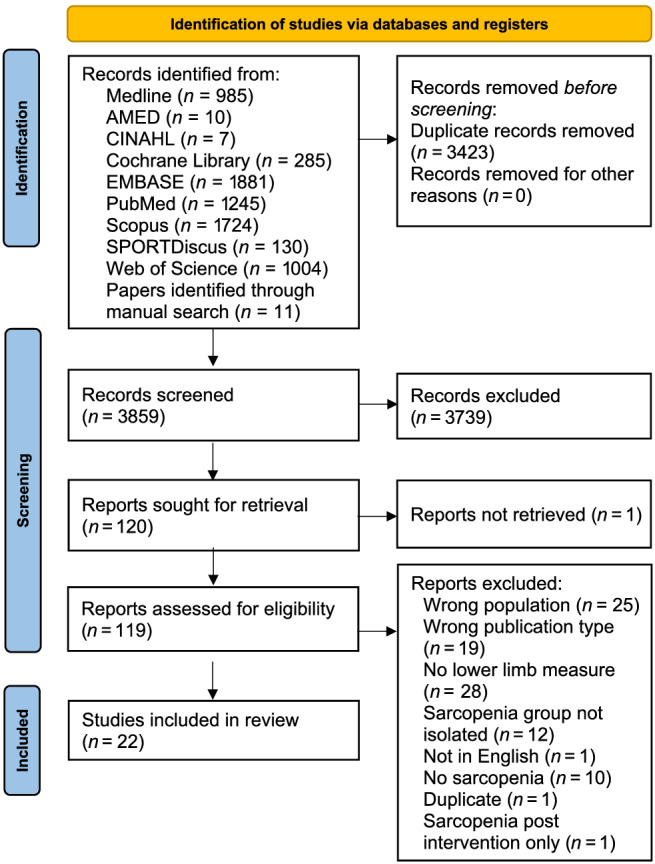
下肢肌肉功能障碍是导致体力下降和虚弱状态的关键因素,这两个特征都是肌肉减少症的表现。肌肉减少症是虚弱和残疾之间的关键途径。确定早期诊断、治疗和预防的生物标志物可能是早期干预和预防残疾特别是移动问题的关键。为了确定与肌肉减少症患者下肢肌肉(功能)障碍相关的生物标志物,对 AMED、CINAHL、Cochrane 图书馆、EMBASE、Medline、PubMed、Scopus、SPORTDiscus 和 Web of Science 数据库进行了系统的文献检索,检索时间从建立到 2021 年 11 月 17 日。标题、摘要和全文筛选、数据提取和方法学质量评估由两名评审员独立进行,并由第三名评审员进行验证。根据可用数据,关联以 Pearson 相关系数、回归 R 或偏 R 、 P 值和样本量(n)报告。纳入了 20 项符合条件的研究,包括 3306 名参与者(女性:79%,男性:15%,未报告:6%;平均年龄范围为 53-92 岁),其中 36%处于明显的肌肉减少症亚组(女性:73%,男性:19%,未报告:8%;平均年龄范围 55-92 岁)。共报告了 119 种生物标志物,分为:遗传和 microRNAs(n=64)、氧化应激(n=10)、能量代谢(n=18)、炎症(n=7)、酶(n=4)、激素(n=7)、骨(n=3)、维生素(n=2)和细胞因子(n=4)标志物)和 7 种下肢肌肉测量方法,主要集中在力量上。有 7 项研究报告了下肢肌肉测量方法(如功率、力和扭矩)与生物标志物之间的关联。在肌肉减少症患者中,肌肉力量与游离睾酮呈正相关(r=0.40,P=0.01;n=46)。在对肌肉减少症和非肌肉减少症个体进行的分析中,肌肉力量与遗传和甲基化评分相结合呈正相关(偏 R=0.122,P=0.03;n=48),与肌肉减少症驱动的甲基化评分呈负相关(偏 R=0.401,P<0.01;n=48)。与遗传相关的生物标志物(R=0.001-0.014,偏 R=0.013-0.122,P>0.05;n=48)、氧化应激(r=0.061,P>0.05;n≥77)、激素(r=0.01,ρ=0.052 p>0.05,n≥46)和综合蛋白质、氧化应激、肌肉性能和激素(R=22.0,P>0.05;n≥82)与下肢肌肉力量没有显著关联。一些生物标志物与下肢肌肉功能障碍有相关性。目前的文献仍然难以对肌肉减少症成年人中生物标志物与下肢肌肉功能障碍之间的关系得出明确的结论。生物标志物和下肢肌肉功能的异质性排除了直接比较。应采用国际肌肉减少症分类和一套核心标准化结局测量标准,以帮助未来的研究和提出建议。