Aski Muraleedhar S, Hamwieh Aladdin, Talukdar Akshay, Kumar Gupta Santosh, Sharma Brij Bihari, Joshi Rekha, Upadhyaya H D, Singh Kuldeep, Kumar Rajendra
Department of Genetics and Plant Breeding, University of Agricultural Sciences, GKVK, Bangalore, India.
Division of Genetics, Indian Agricultural Research Institute (ICAR), New Delhi, India.
Front Genet. 2022 Jul 22;13:932430. doi: 10.3389/fgene.2022.932430. eCollection 2022.
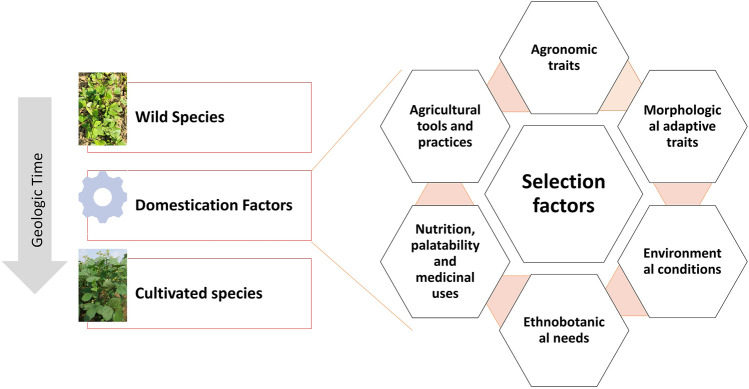
Domestication is a dynamic and ongoing process of transforming wild species into cultivated species by selecting desirable agricultural plant features to meet human needs such as taste, yield, storage, and cultivation practices. Human plant domestication began in the Fertile Crescent around 12,000 years ago and spread throughout the world, including China, Mesoamerica, the Andes and Near Oceania, Sub-Saharan Africa, and eastern North America. Indus valley civilizations have played a great role in the domestication of grain legumes. Crops, such as pigeon pea, black gram, green gram, lablab bean, moth bean, and horse gram, originated in the Indian subcontinent, and Neolithic archaeological records indicate that these crops were first domesticated by early civilizations in the region. The domestication and evolution of wild ancestors into today's elite cultivars are important contributors to global food supply and agricultural crop improvement. In addition, food legumes contribute to food security by protecting human health and minimize climate change impacts. During the domestication process, legume crop species have undergone a severe genetic diversity loss, and only a very narrow range of variability is retained in the cultivars. Further reduction in genetic diversity occurred during seed dispersal and movement across the continents. In general, only a few traits, such as shattering resistance, seed dormancy loss, stem growth behavior, flowering-maturity period, and yield traits, have prominence in the domestication process across the species. Thus, identification and knowledge of domestication responsive loci were often useful in accelerating new species' domestication. The genes and metabolic pathways responsible for the significant alterations that occurred as an outcome of domestication might aid in the quick domestication of novel crops. Further, recent advances in "omics" sciences, gene-editing technologies, and functional analysis will accelerate the domestication and crop improvement of new crop species without losing much genetic diversity. In this review, we have discussed about the origin, center of diversity, and seed movement of major food legumes, which will be useful in the exploration and utilization of genetic diversity in crop improvement. Further, we have discussed about the major genes/QTLs associated with the domestication syndrome in pulse crops and the future strategies to improve the food legume crops.
驯化是一个动态且持续的过程,通过选择理想的农作物特征来满足人类需求,如口感、产量、储存和种植方式等,从而将野生物种转变为栽培物种。人类对植物的驯化始于约12000年前的新月沃地,并传播到世界各地,包括中国、中美洲、安第斯地区和近大洋洲、撒哈拉以南非洲以及北美东部。印度河流域文明在谷物豆类的驯化中发挥了重要作用。诸如木豆、黑吉豆、绿豆、扁豆、蛾豆和黑豆等作物起源于印度次大陆,新石器时代的考古记录表明这些作物最早是由该地区的早期文明驯化的。野生祖先驯化为如今的优良品种,对全球粮食供应和农作物改良起到了重要作用。此外,食用豆类通过保护人类健康和减少气候变化影响,为粮食安全做出贡献。在驯化过程中,豆类作物物种经历了严重的遗传多样性丧失,品种中仅保留了非常狭窄的变异性范围。在种子传播和跨大陆移动过程中,遗传多样性进一步减少。一般来说,在整个物种的驯化过程中,只有少数性状,如抗脱粒性、种子休眠丧失、茎生长行为、开花成熟期和产量性状等较为突出。因此,识别和了解驯化响应位点通常有助于加速新物种的驯化。导致驯化产生显著变化的基因和代谢途径可能有助于新作物的快速驯化。此外,“组学”科学、基因编辑技术和功能分析的最新进展将加速新作物物种的驯化和作物改良,同时不会损失太多遗传多样性。在本综述中,我们讨论了主要食用豆类的起源、多样性中心和种子移动情况,这将有助于在作物改良中探索和利用遗传多样性。此外,我们还讨论了与豆类作物驯化综合征相关的主要基因/QTL以及改良食用豆类作物的未来策略。