Department of Chemistry, School of Engineering Sciences in Chemistry, Biotechnology and Health, KTH Royal Institute of Technology, Teknikringen 30, SE-100 44 Stockholm, Sweden.
Section of Neuropharmacology and Addiction Research, Department of Pharmaceutical Biosciences, Uppsala University, SE-751 05 Uppsala, Sweden.
Anal Chem. 2022 Aug 30;94(34):11856-11864. doi: 10.1021/acs.analchem.2c02317. Epub 2022 Aug 18.
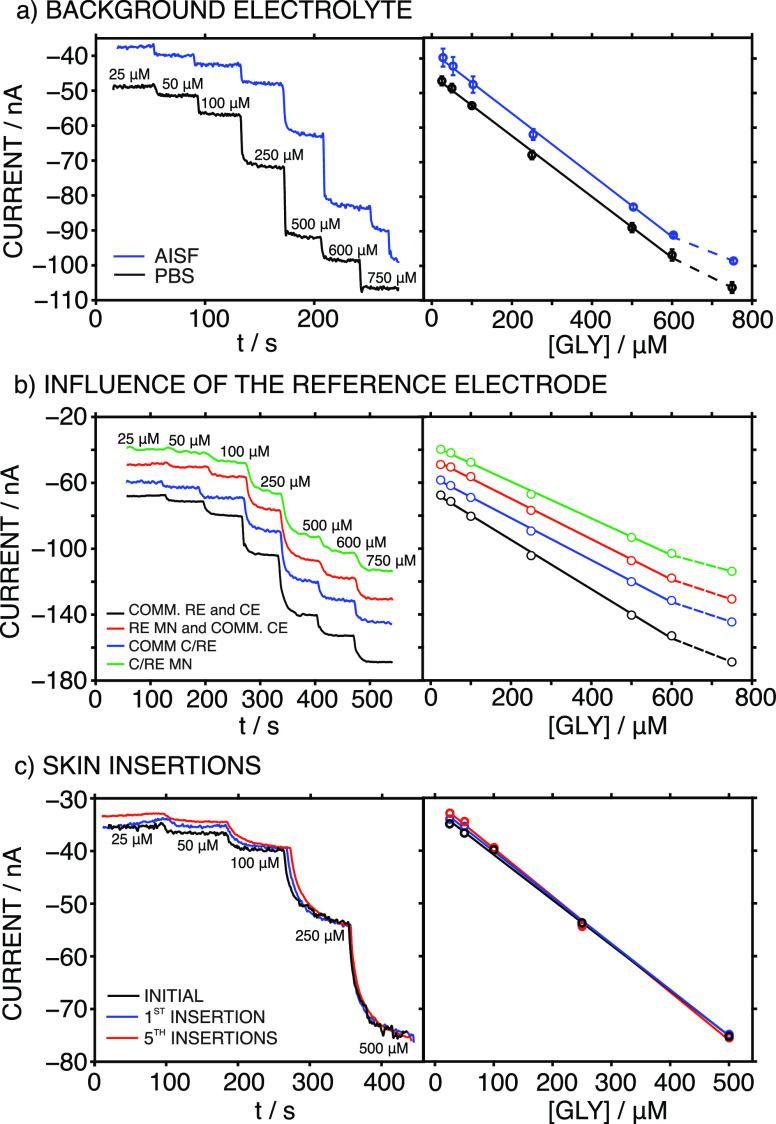
Glycine (GLY) is gaining importance in medical diagnoses due to its relationship with multiple physiological functions. Today, GLY is exclusively analyzed using instrumentation centralized in clinical labs, and a tangible point-of-care tool that gathers real-time data from the patient for effective and fast evaluations is lacking. Relevant clinical advances are expected as soon as the rapid provision of both punctual and continuous measurements is possible. In that context, this work presents a microneedle (MN)-based biosensor for intradermal GLY detection in interstitial fluid (ISF). The MN tip is externally tailored to detect GLY levels through the hydrogen peroxide formed in its reaction with a quinoprotein-based GLY oxidase enzyme. The analytical performance of the MN biosensor indicates a fast response time (<7 s); acceptable reversibility, reproducibility, and stability; as well as a wide linear range of response (25-600 μM) that covers the physiological levels of GLY in ISF. The MN biosensor conveniently exhibits high selectivity for GLY over other compounds commonly found in ISF, and the response is not influenced by temperature, pH, or skin insertions. Validated intradermal measurements of GLY were obtained at the in vitro (with pieces of rat skin), ex vivo (on-body tests of euthanized rats) and in vivo (on-body tests of anesthetized rats) levels, demonstrating its ability to produce accurate physiological data. The developed GLY MN biosensor is skin-wearable and provides reliable, real-time intradermal GLY measurements in ISF by means of a minimally invasive approach.
甘氨酸(GLY)由于与多种生理功能有关,在医学诊断中变得越来越重要。如今,GLY 仅使用集中在临床实验室的仪器进行分析,缺乏能够从患者身上实时收集数据以进行有效快速评估的便携式即时检测工具。一旦能够快速提供定时和连续测量,就有望取得相关的临床进展。在这种情况下,本工作提出了一种基于微针(MN)的生物传感器,用于检测间质液(ISF)中的皮内 GLY。MN 尖端经过外部设计,可通过与基于醌蛋白的 GLY 氧化酶反应生成的过氧化氢来检测 GLY 水平。MN 生物传感器的分析性能表明具有快速的响应时间(<7 s);良好的可重复性、重现性和稳定性;以及较宽的响应线性范围(25-600 μM),涵盖了 ISF 中 GLY 的生理水平。MN 生物传感器对 GLY 具有很高的选择性,可检测 ISF 中常见的其他化合物,且响应不受温度、pH 值或皮肤插入的影响。在体外(使用大鼠皮肤片)、离体(对安乐死大鼠进行的体上测试)和体内(对麻醉大鼠进行的体上测试)水平均获得了 GLY 的经验证的皮内测量值,证明了其产生准确生理数据的能力。所开发的 GLY MN 生物传感器可穿戴在皮肤上,通过微创方式提供可靠的、实时的 ISF 内 GLY 测量。