Epidemiology, Biostatistics and Prevention Institute (EBPI), University of Zurich (UZH), Zurich, Switzerland.
Institute for Experimental Immunology, University of Zurich (UZH), Zurich, Switzerland.
Nat Commun. 2022 Aug 18;13(1):4855. doi: 10.1038/s41467-022-32573-w.
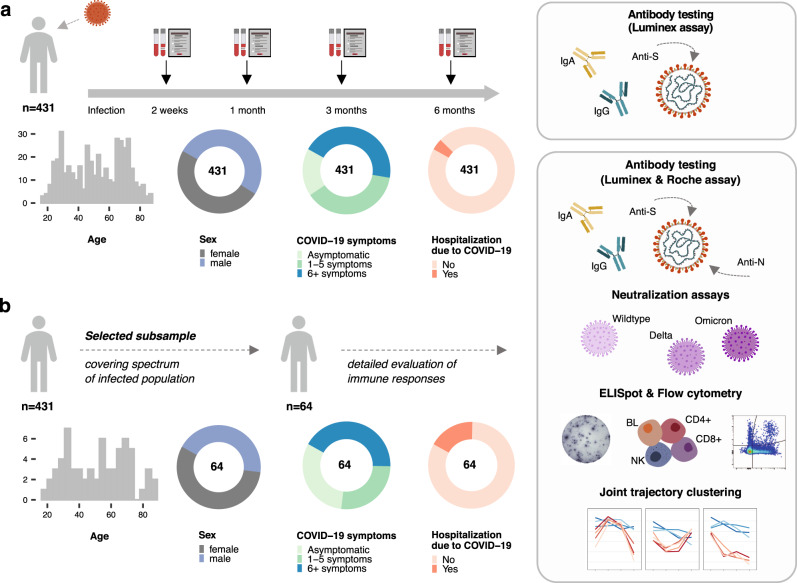
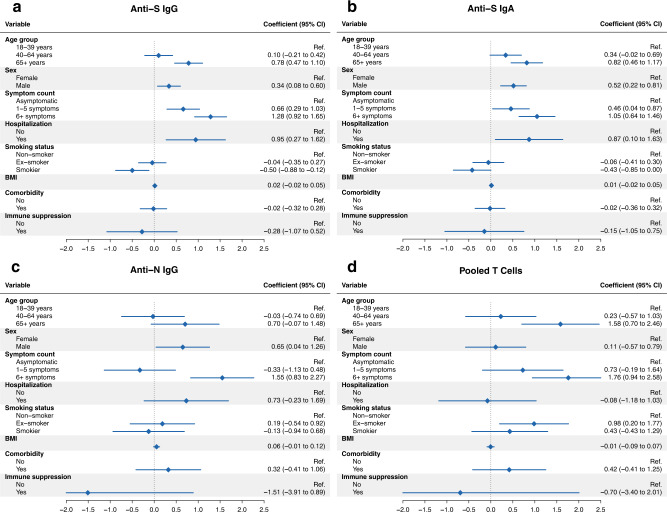
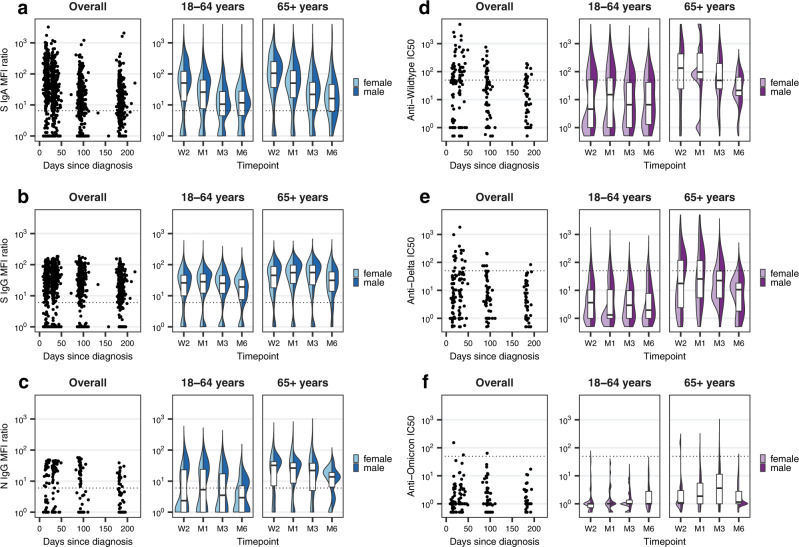
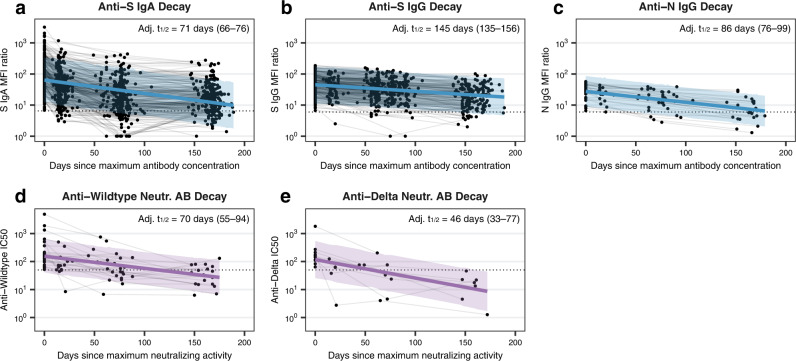
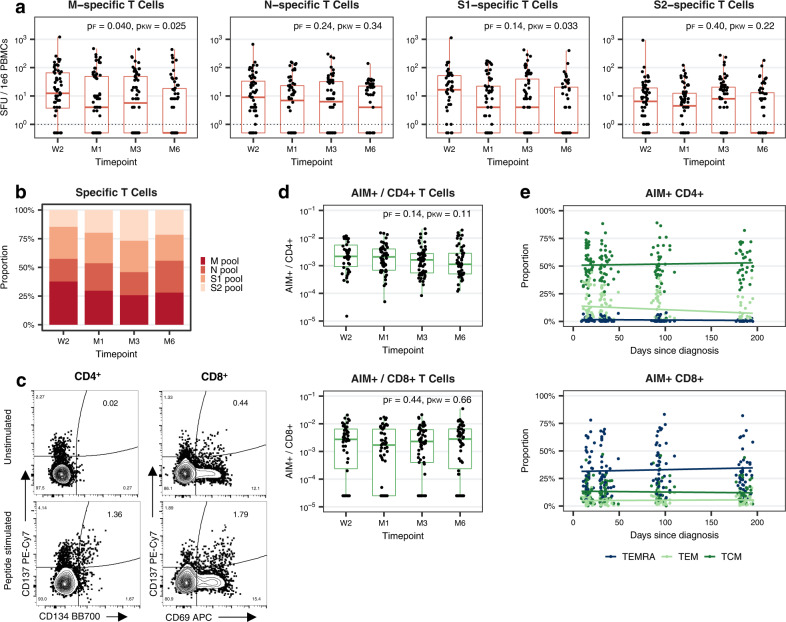
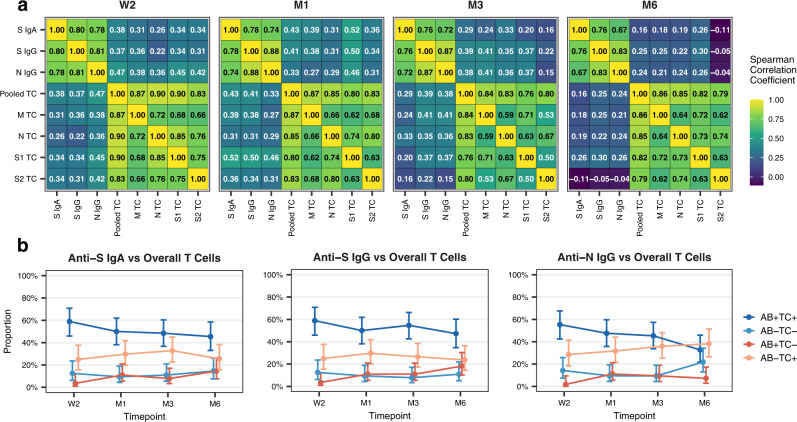
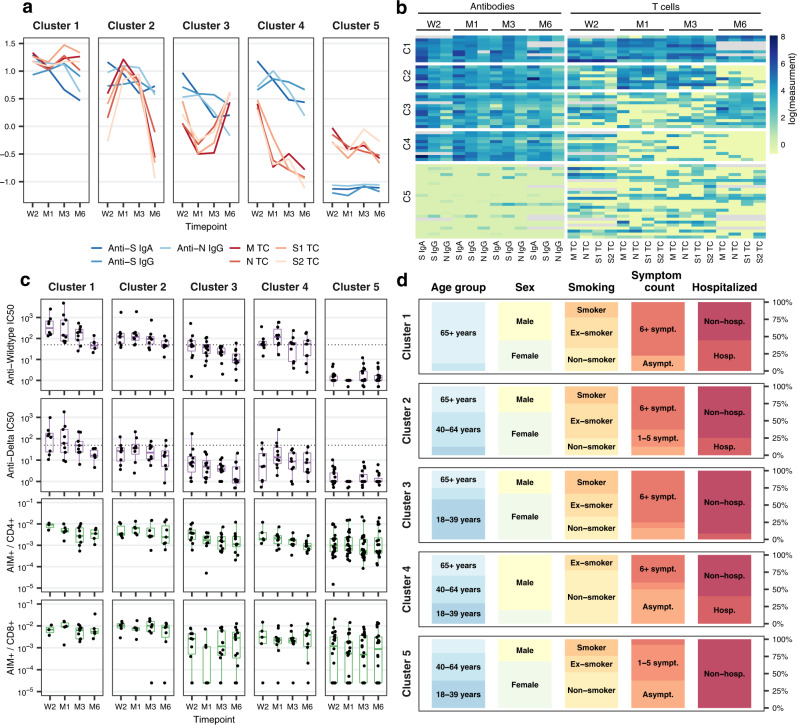
To better understand the development of SARS-CoV-2-specific immunity over time, a detailed evaluation of humoral and cellular responses is required. Here, we characterize anti-Spike (S) IgA and IgG in a representative population-based cohort of 431 SARS-CoV-2-infected individuals up to 217 days after diagnosis, demonstrating that 85% develop and maintain anti-S responses. In a subsample of 64 participants, we further assess anti-Nucleocapsid (N) IgG, neutralizing antibody activity, and T cell responses to Membrane (M), N, and S proteins. In contrast to S-specific antibody responses, anti-N IgG levels decline substantially over time and neutralizing activity toward Delta and Omicron variants is low to non-existent within just weeks of Wildtype SARS-CoV-2 infection. Virus-specific T cells are detectable in most participants, albeit more variable than antibody responses. Cluster analyses of the co-evolution of antibody and T cell responses within individuals identify five distinct trajectories characterized by specific immune patterns and clinical factors. These findings demonstrate the relevant heterogeneity in humoral and cellular immunity to SARS-CoV-2 while also identifying consistent patterns where antibody and T cell responses may work in a compensatory manner to provide protection.
为了更好地了解 SARS-CoV-2 特异性免疫随时间的发展,需要对体液和细胞反应进行详细评估。在这里,我们对 431 名 SARS-CoV-2 感染个体的代表性基于人群的队列进行了长达 217 天的随访,结果表明 85%的个体产生并维持了抗-Spike(S)IgA 和 IgG 反应。在 64 名参与者的亚样本中,我们进一步评估了抗-Nucleocapsid(N)IgG、中和抗体活性以及对膜(M)、N 和 S 蛋白的 T 细胞反应。与 S 特异性抗体反应相反,抗-N IgG 水平随时间显著下降,并且在感染野生型 SARS-CoV-2 后仅数周内,针对 Delta 和奥密克戎变异体的中和活性就很低甚至不存在。大多数参与者中均可检测到病毒特异性 T 细胞,尽管其变异性大于抗体反应。对个体内抗体和 T 细胞反应的共同进化进行聚类分析,确定了五种不同的轨迹,其特征是特定的免疫模式和临床因素。这些发现表明 SARS-CoV-2 的体液和细胞免疫存在显著异质性,同时也确定了抗体和 T 细胞反应可能以代偿方式发挥作用提供保护的一致模式。