Department of Bioengineering, School of Engineering & Applied Science, University of Pennsylvania, Philadelphia, PA 19104, USA; Center for Neuroengineering and Therapeutics, University of Pennsylvania, Philadelphia, PA 19104, USA.
Center for Neuroengineering and Therapeutics, University of Pennsylvania, Philadelphia, PA 19104, USA; Department of Computer Science, University of Pennsylvania, Philadelphia, PA 19104, USA.
Neuroimage Clin. 2022;36:103154. doi: 10.1016/j.nicl.2022.103154. Epub 2022 Aug 17.
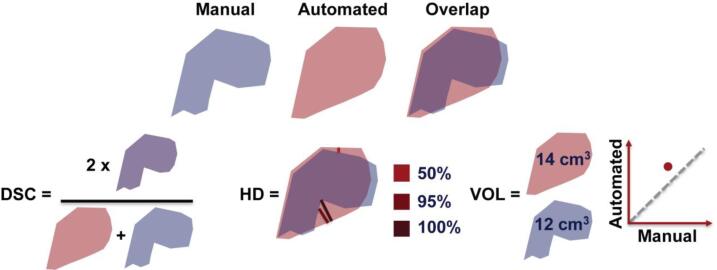
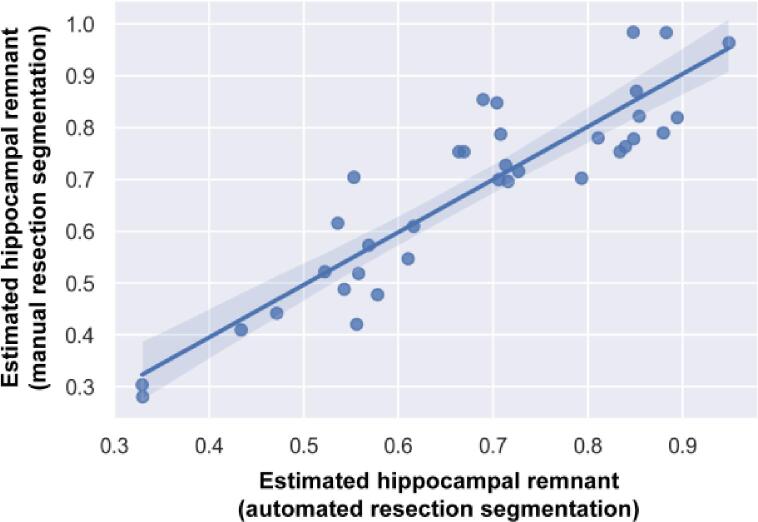
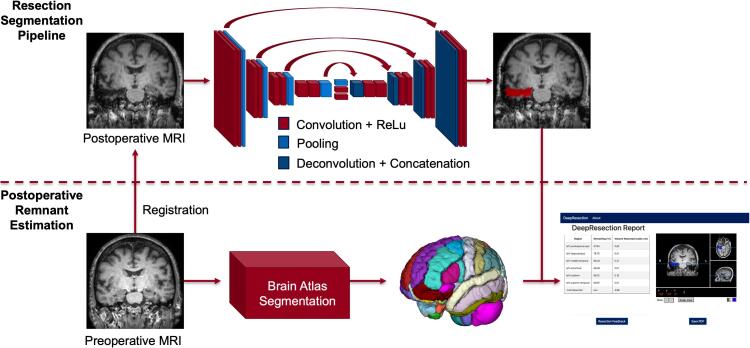
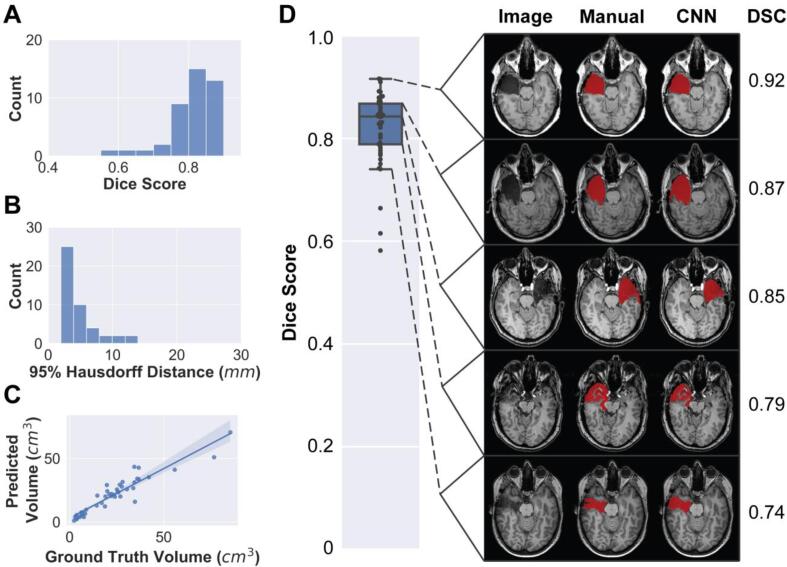
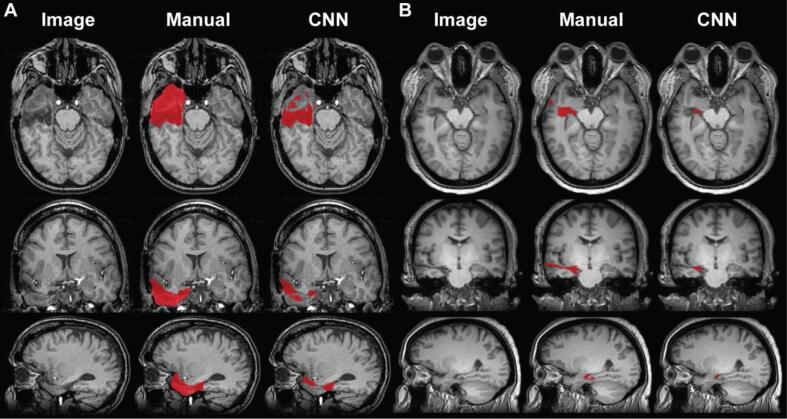
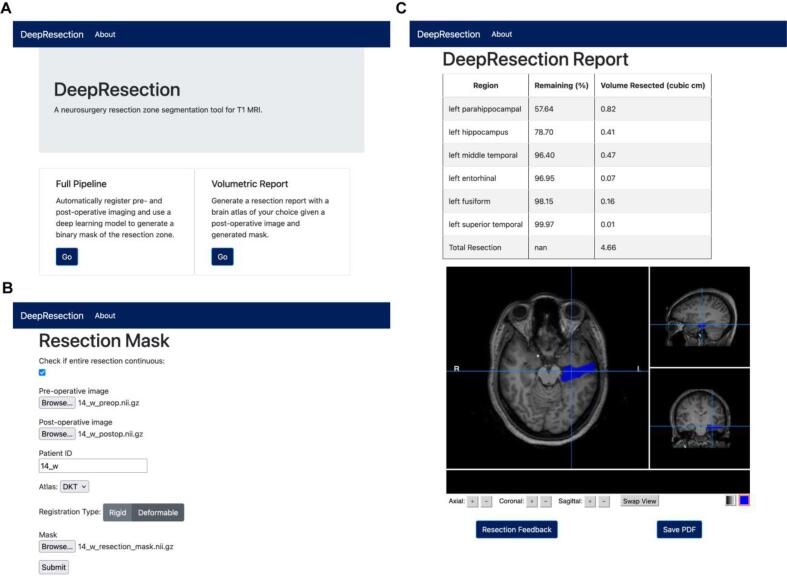
Accurate segmentation of surgical resection sites is critical for clinical assessments and neuroimaging research applications, including resection extent determination, predictive modeling of surgery outcome, and masking image processing near resection sites. In this study, an automated resection cavity segmentation algorithm is developed for analyzing postoperative MRI of epilepsy patients and deployed in an easy-to-use graphical user interface (GUI) that estimates remnant brain volumes, including postsurgical hippocampal remnant tissue. This retrospective study included postoperative T1-weighted MRI from 62 temporal lobe epilepsy (TLE) patients who underwent resective surgery. The resection site was manually segmented and reviewed by a neuroradiologist (JMS). A majority vote ensemble algorithm was used to segment surgical resections, using 3 U-Net convolutional neural networks trained on axial, coronal, and sagittal slices, respectively. The algorithm was trained using 5-fold cross validation, with data partitioned into training (N = 27) testing (N = 9), and validation (N = 9) sets, and evaluated on a separate held-out test set (N = 17). Algorithm performance was assessed using Dice-Sørensen coefficient (DSC), Hausdorff distance, and volume estimates. Additionally, we deploy a fully-automated, GUI-based pipeline that compares resection segmentations with preoperative imaging and reports estimates of resected brain structures. The cross-validation and held-out test median DSCs were 0.84 ± 0.08 and 0.74 ± 0.22 (median ± interquartile range) respectively, which approach inter-rater reliability between radiologists (0.84-0.86) as reported in the literature. Median 95 % Hausdorff distances were 3.6 mm and 4.0 mm respectively, indicating high segmentation boundary confidence. Automated and manual resection volume estimates were highly correlated for both cross-validation (r = 0.94, p < 0.0001) and held-out test subjects (r = 0.87, p < 0.0001). Automated and manual segmentations overlapped in all 62 subjects, indicating a low false negative rate. In control subjects (N = 40), the classifier segmented no voxels (N = 33), <50 voxels (N = 5), or a small volumes<0.5 cm (N = 2), indicating a low false positive rate that can be controlled via thresholding. There was strong agreement between postoperative hippocampal remnant volumes determined using automated and manual resection segmentations (r = 0.90, p < 0.0001, mean absolute error = 6.3 %), indicating that automated resection segmentations can permit quantification of postoperative brain volumes after epilepsy surgery. Applications include quantification of postoperative remnant brain volumes, correction of deformable registration, and localization of removed brain regions for network modeling.
准确的手术切除部位分割对于临床评估和神经影像学研究应用至关重要,包括切除范围的确定、手术结果的预测建模以及切除部位附近的图像处理掩模。在这项研究中,开发了一种用于分析癫痫患者术后磁共振成像的自动切除腔分割算法,并将其部署在一个易于使用的图形用户界面(GUI)中,该界面估计残余脑容量,包括术后海马残余组织。这项回顾性研究包括 62 例接受切除术的颞叶癫痫(TLE)患者的术后 T1 加权磁共振成像。切除部位由神经放射科医生(JMS)手动分割并进行评估。使用分别在轴位、冠状位和矢状位切片上训练的 3 个 U-Net 卷积神经网络,使用多数投票集成算法对手术切除部位进行分割。该算法使用 5 折交叉验证进行训练,将数据分为训练集(N=27)、测试集(N=9)和验证集(N=9),并在单独的测试集(N=17)上进行评估。使用 Dice-Sørensen 系数(DSC)、Hausdorff 距离和体积估计来评估算法性能。此外,我们还部署了一个完全自动化的基于 GUI 的管道,该管道将切除分割与术前成像进行比较,并报告切除脑结构的估计。交叉验证和测试集的中位数 DSC 分别为 0.84±0.08 和 0.74±0.22(中位数±四分位距),接近文献中报道的放射科医生之间的可靠性(0.84-0.86)。中位数 95%Hausdorff 距离分别为 3.6 毫米和 4.0 毫米,表明分割边界置信度高。交叉验证(r=0.94,p<0.0001)和测试集受试者(r=0.87,p<0.0001)的自动和手动切除体积估计高度相关。在所有 62 名受试者中,自动和手动分割都完全重叠,表明假阴性率较低。在对照组(N=40)中,分类器未分割出任何体素(N=33)、<50 个体素(N=5)或<0.5cm3 的小体积(N=2),表明假阳性率较低,可以通过阈值控制。使用自动和手动切除分割确定的术后海马残余体积之间存在很强的一致性(r=0.90,p<0.0001,平均绝对误差=6.3%),表明自动切除分割可用于量化癫痫手术后的术后残余脑容量。应用包括术后残余脑容量的量化、可变形配准的校正以及去除脑区的定位用于网络建模。