VCI Group, Neurology Department, UMC Utrecht Brain Center, UMC Utrecht, Utrecht, The Netherlands.
Image Sciences Institute, Division Imaging and Oncology, UMC Utrecht, Utrecht, The Netherlands.
Brain Struct Funct. 2022 Sep;227(7):2553-2567. doi: 10.1007/s00429-022-02546-2. Epub 2022 Aug 22.
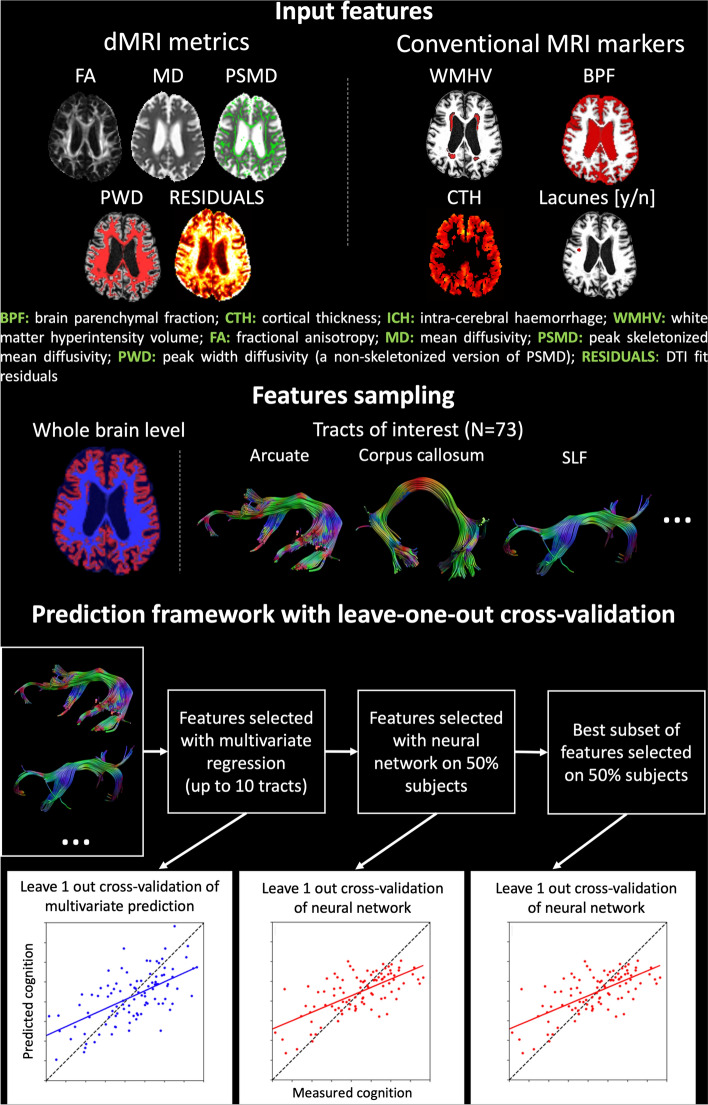
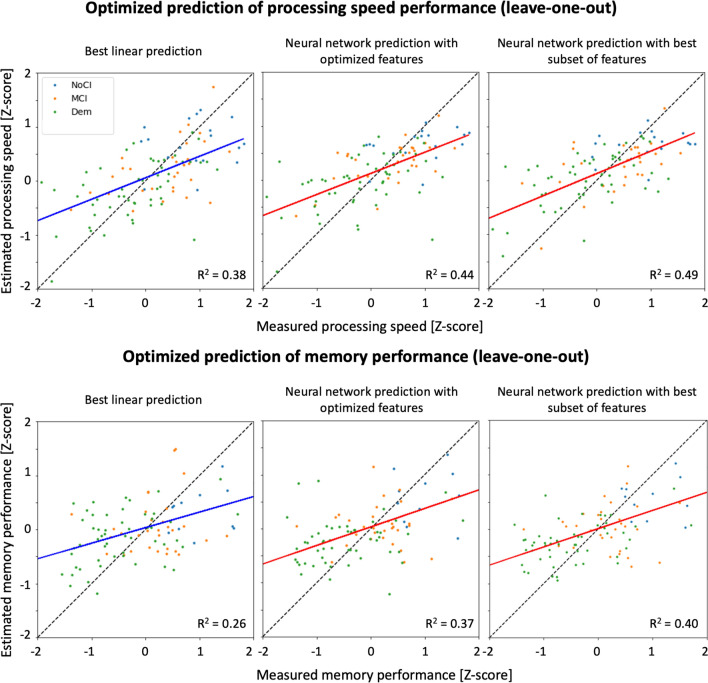
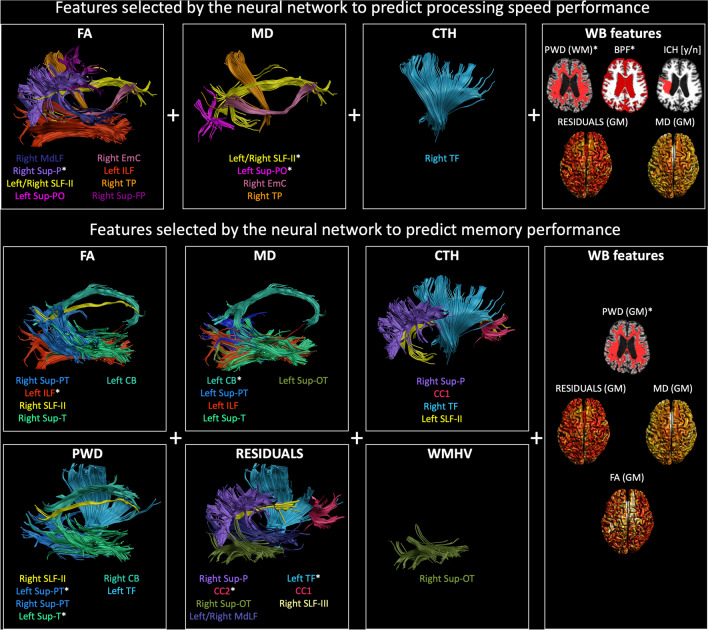
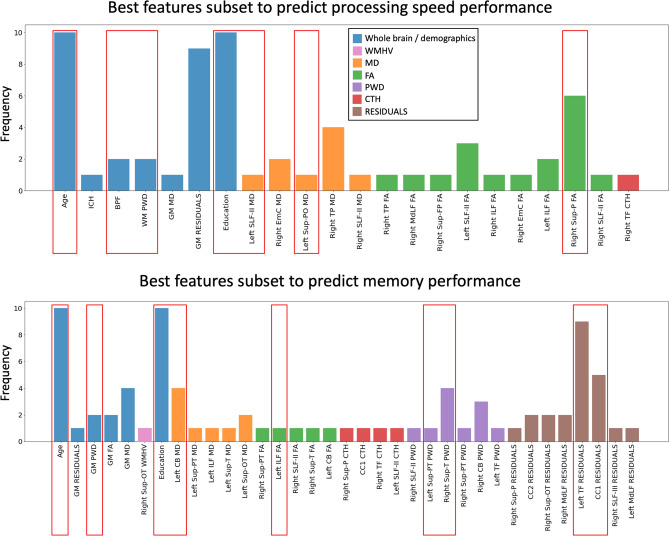
In cerebral small vessel disease (cSVD), whole brain MRI markers of cSVD-related brain injury explain limited variance to support individualized prediction. Here, we investigate whether considering abnormalities in brain tracts by integrating multimodal metrics from diffusion MRI (dMRI) and structural MRI (sMRI), can better capture cognitive performance in cSVD patients than established approaches based on whole brain markers. We selected 102 patients (73.7 ± 10.2 years old, 59 males) with MRI-visible SVD lesions and both sMRI and dMRI. Conventional linear models using demographics and established whole brain markers were used as benchmark of predicting individual cognitive scores. Multi-modal metrics of 73 major brain tracts were derived from dMRI and sMRI, and used together with established markers as input of a feed-forward artificial neural network (ANN) to predict individual cognitive scores. A feature selection strategy was implemented to reduce the risk of overfitting. Prediction was performed with leave-one-out cross-validation and evaluated with the R of the correlation between measured and predicted cognitive scores. Linear models predicted memory and processing speed with R = 0.26 and R = 0.38, respectively. With ANN, feature selection resulted in 13 tract-specific metrics and 5 whole brain markers for predicting processing speed, and 28 tract-specific metrics and 4 whole brain markers for predicting memory. Leave-one-out ANN prediction with the selected features achieved R = 0.49 and R = 0.40 for processing speed and memory, respectively. Our results show proof-of-concept that combining tract-specific multimodal MRI metrics can improve the prediction of cognitive performance in cSVD by leveraging tract-specific multi-modal metrics.
在脑小血管病 (cSVD) 中,与 cSVD 相关的脑损伤的全脑 MRI 标志物解释的差异有限,无法支持个体化预测。在这里,我们研究了通过整合扩散 MRI(dMRI)和结构 MRI(sMRI)的多模态指标来考虑脑束异常是否可以比基于全脑标志物的既定方法更好地捕捉 cSVD 患者的认知表现。我们选择了 102 名患者(73.7±10.2 岁,59 名男性),这些患者有 MRI 可见的 SVD 病变,并且有 sMRI 和 dMRI。使用人口统计学和既定的全脑标志物的常规线性模型被用作预测个体认知评分的基准。从 dMRI 和 sMRI 中得出 73 条主要脑束的多模态指标,并与既定标志物一起作为前馈人工神经网络 (ANN) 的输入,以预测个体认知评分。实施了一种特征选择策略来降低过度拟合的风险。使用留一法交叉验证进行预测,并通过测量和预测认知评分之间的相关性 R 进行评估。线性模型分别预测了记忆和处理速度,R 值分别为 0.26 和 0.38。使用 ANN,特征选择产生了 13 条束特异性指标和 5 条全脑标志物用于预测处理速度,以及 28 条束特异性指标和 4 条全脑标志物用于预测记忆。使用选定特征的留一法 ANN 预测分别获得了处理速度和记忆的 R 值为 0.49 和 0.40。我们的结果证明了概念验证,即通过利用束特异性多模态指标,结合束特异性多模态 MRI 指标可以提高 cSVD 认知表现的预测。