Laboratory of Virology, National Institute of Allergy and Infectious Diseases, National Institutes of Health, Hamilton, Montana 59840 United States.
Signify, High Tech Campus 48, 5656 AE Eindhoven, The Netherlands.
Environ Sci Technol. 2022 Sep 6;56(17):12424-12430. doi: 10.1021/acs.est.2c02822. Epub 2022 Aug 24.
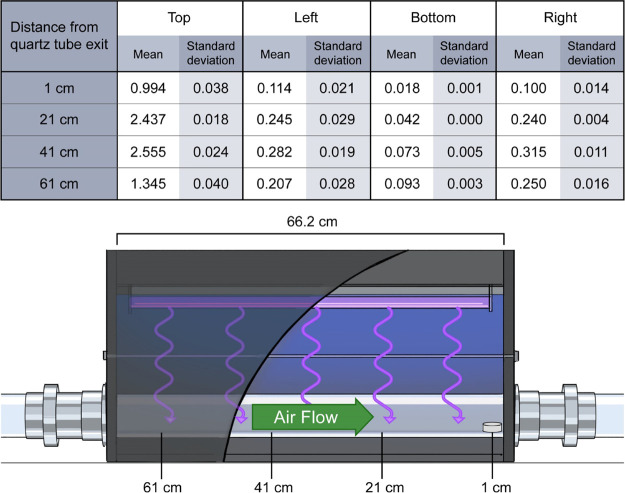
Behavioral and medical control measures have not been effective in containing the spread of SARS-CoV-2 in large part due to the unwillingness of populations to adhere to "best practices". Ultraviolet light with wavelengths of between 200 and 280 nm (UV-C) and, in particular, germicidal ultraviolet light, which refers to wavelengths around 254 nm, have the potential to unobtrusively reduce the risk of SARS-CoV-2 transmission in enclosed spaces. We investigated the effectiveness of a strategy using UV-C light to prevent airborne transmission of the virus in a hamster model. Treatment of environmental air with 254 nm UV-C light prevented transmission of SARS-CoV-2 between individuals in a model using highly susceptible Syrian golden hamsters. The prevention of transmission of SARS-CoV-2 in a natural system by treating elements of the surrounding environment is one more weapon in the arsenal to combat COVID. The results presented indicate that coupling mitigation strategies utilizing UV-C light, along with current methods to reduce transmission risk, have the potential to allow a return to normal indoor activities.
由于人们不愿意遵守“最佳实践”,行为和医学控制措施在很大程度上未能有效控制 SARS-CoV-2 的传播。波长在 200 至 280nm 之间的紫外线(UV-C),特别是杀菌紫外线,其波长在 254nm 左右,具有在封闭空间内减少 SARS-CoV-2 传播风险的潜力。我们研究了一种使用 UV-C 光来预防病毒在仓鼠模型中空气传播的策略的有效性。用 254nmUV-C 光处理环境空气可防止高度易感的叙利亚金黄仓鼠模型中个体之间 SARS-CoV-2 的传播。通过处理周围环境的元素来预防 SARS-CoV-2 在自然系统中的传播,是对抗 COVID 的又一武器。所呈现的结果表明,结合利用 UV-C 光的缓解策略,以及目前降低传播风险的方法,有可能使室内活动恢复正常。