Huang Qiqi, Chen Lishi, Liang Jianhao, Huang Qiongzhen, Sun Haitao
Clinical Biobank Center, Microbiome Medicine Center, Department of Laboratory Medicine, Zhujiang Hospital and the Second Clinical Medical College, Southern Medical University, Guangzhou 510280, China.
Neurosurgery Center, The National Key Clinical Specialty, The Engineering Technology Research Center of Education Ministry of China on Diagnosis and Treatment of Cerebrovascular Disease, Guangdong Provincial Key Laboratory on Brain Function Repair and Regeneration, The Neurosurgery Institute of Guangdong Province, Zhujiang Hospital, Southern Medical University, Guangzhou 510280, China.
Cancers (Basel). 2022 Aug 17;14(16):3970. doi: 10.3390/cancers14163970.
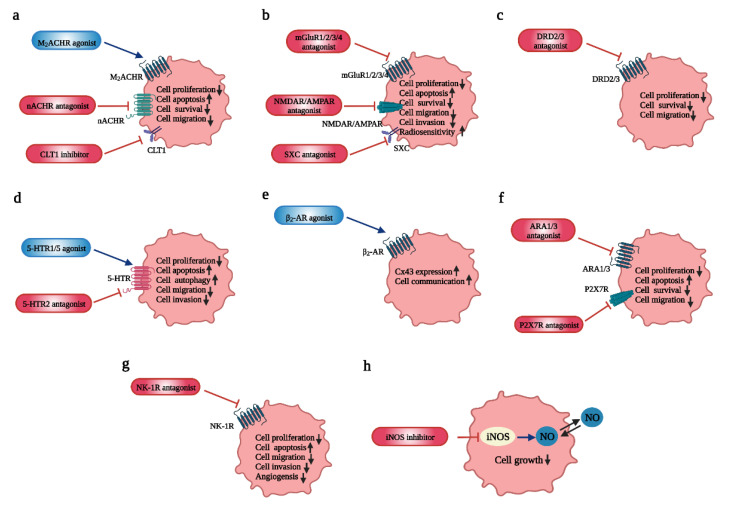
For decades, glioblastoma multiforme (GBM), a type of the most lethal brain tumor, has remained a formidable challenge in terms of its treatment. Recently, many novel discoveries have underlined the regulatory roles of neurotransmitters in the microenvironment both physiologically and pathologically. By targeting the receptors synaptically or non-synaptically, neurotransmitters activate multiple signaling pathways. Significantly, many ligands acting on neurotransmitter receptors have shown great potential for inhibiting GBM growth and development, requiring further research. Here, we provide an overview of the most novel advances concerning the role of neurotransmitters in the normal neural and the GBM microenvironments, and discuss potential targeted drugs used for GBM treatment.
几十年来,多形性胶质母细胞瘤(GBM)作为一种最致命的脑肿瘤,在其治疗方面一直是一项艰巨的挑战。最近,许多新发现强调了神经递质在生理和病理微环境中的调节作用。通过突触或非突触地靶向受体,神经递质激活多种信号通路。值得注意的是,许多作用于神经递质受体的配体已显示出抑制GBM生长和发展的巨大潜力,需要进一步研究。在此,我们概述了关于神经递质在正常神经和GBM微环境中的作用的最新进展,并讨论了用于GBM治疗的潜在靶向药物。