Department of Occupational Therapy, College of Medical Science, Soonchunhyang University, Asan 31538, Korea.
Int J Environ Res Public Health. 2022 Aug 17;19(16):10198. doi: 10.3390/ijerph191610198.
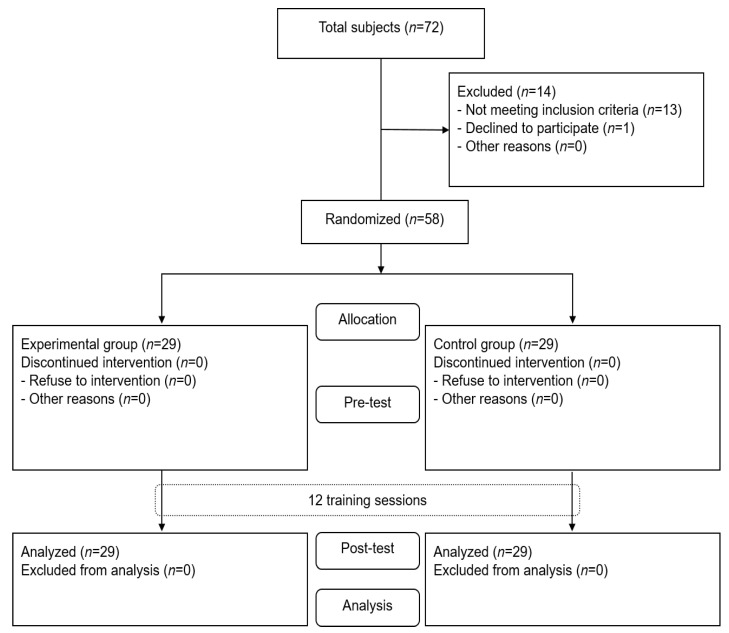
Purpose: To date, the effects of dual-task training on balance underlying cognitive function remain unclear. Therefore, this study was to verify the effects of cognitive−physical dual-task training on balance and executive function in community-dwelling older adults with a history of falls. Method: Fifty-eight participants were randomly allocated to the experimental group (EG) receiving cognitive−physical dual-task training (n = 29) or to the control group (CG) receiving functional balance training (n = 29). After 12 sessions for 6 weeks, the One Leg Standing Test (OLST), the Timed UP and Go (TUG), and part B of the Trail-Making Test (TMT-B) were implemented to examine static and dynamic balance and executive function. Results: After the 12 sessions, the EG showed a greater improvement in the OLST (p < 0.001; η2 = 0.332), the TUG (p < 0.001; η2 = 0.375), and the TMT-B (p < 0.001; η2 = 0.224) compared to the CG. Conclusion: These results indicate that dual-task training is clinically beneficial to improving static and dynamic balance as well as executive function in older adults with a history of falls. These findings shed new light on a clinical implication that executive function should be considered in balance training for older adults.
迄今为止,双重任务训练对认知基础平衡的影响尚不清楚。因此,本研究旨在验证认知-身体双重任务训练对有跌倒史的社区老年人平衡和执行功能的影响。
58 名参与者被随机分配到实验组(EG)接受认知-身体双重任务训练(n=29)或对照组(CG)接受功能性平衡训练(n=29)。经过 6 周的 12 次训练后,进行单腿站立测试(OLST)、计时起立行走测试(TUG)和连线测试 B 部分(TMT-B),以评估静态和动态平衡以及执行功能。
12 次训练后,EG 在 OLST(p<0.001;η2=0.332)、TUG(p<0.001;η2=0.375)和 TMT-B(p<0.001;η2=0.224)方面的改善明显优于 CG。
这些结果表明,双重任务训练对改善有跌倒史的老年人的静态和动态平衡以及执行功能具有临床益处。这些发现为执行功能应在老年人平衡训练中得到考虑的临床意义提供了新的启示。