de Carvalho Jamile Ambrósio, Monteiro Ruan Campos, Hagen Ferry, Camargo Zoilo Pires de, Rodrigues Anderson Messias
Laboratory of Emerging Fungal Pathogens, Department of Microbiology, Immunology, and Parasitology, Discipline of Cellular Biology, Federal University of São Paulo (UNIFESP), São Paulo 04023062, Brazil.
Department of Medical Mycology, Westerdijk Fungal Biodiversity Institute, Uppsalalaan 8, 3584 CT Utrecht, The Netherlands.
J Fungi (Basel). 2022 Jul 31;8(8):809. doi: 10.3390/jof8080809.
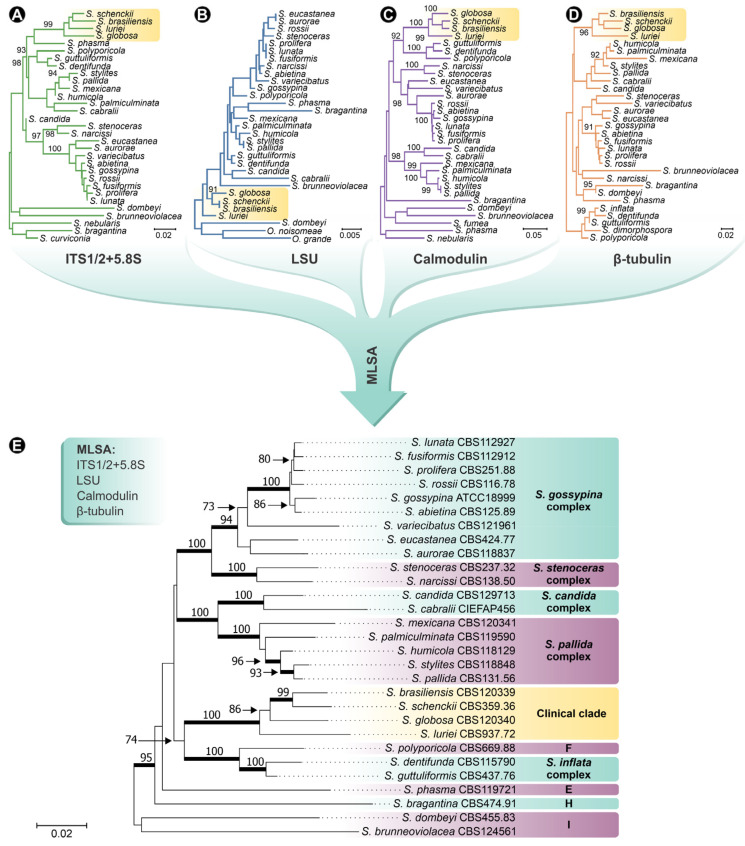
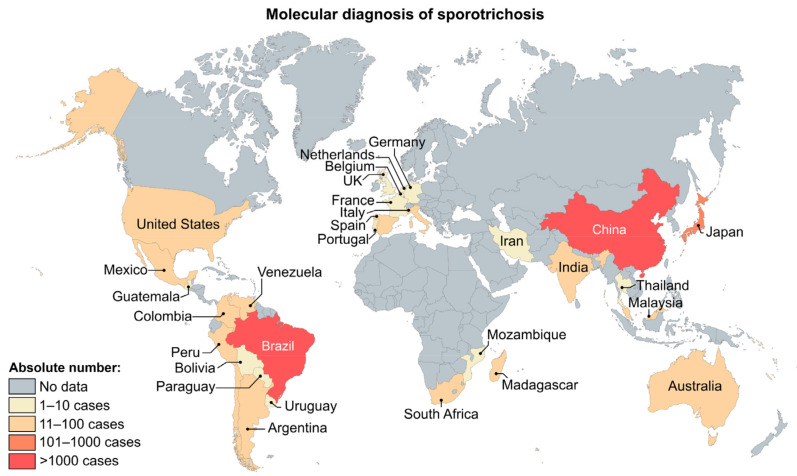
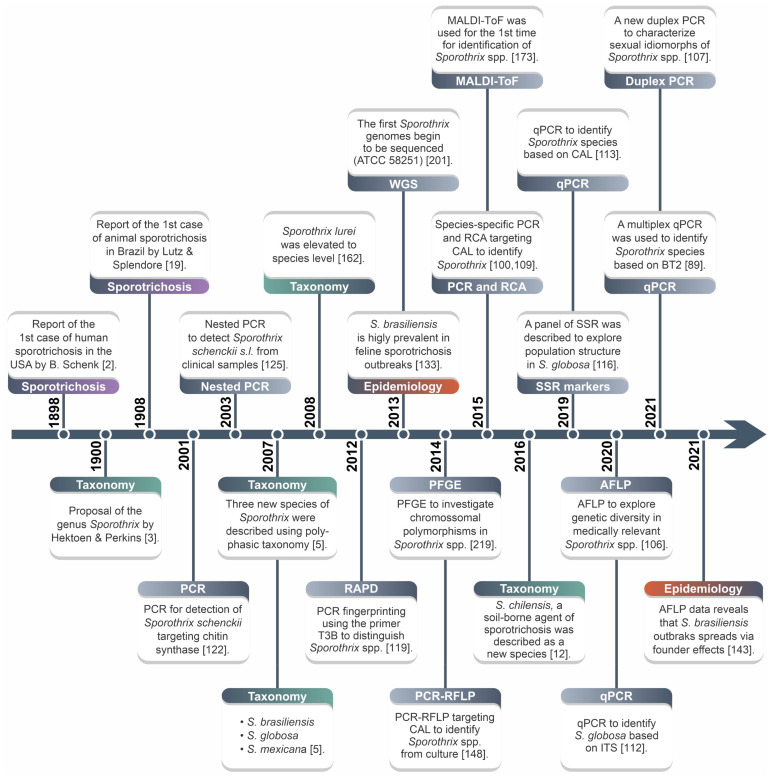
Sporotrichosis is the most important subcutaneous mycosis that affects humans and animals worldwide. The mycosis is caused after a traumatic inoculation of fungal propagules into the host and may follow an animal or environmental transmission route. The main culprits of sporotrichosis are thermodimorphic Sporothrix species embedded in a clinical clade, including S. brasiliensis, S. schenckii, S. globosa, and S. luriei. Although sporotrichosis occurs worldwide, the etiological agents are not evenly distributed, as exemplified by ongoing outbreaks in Brazil and China, caused by S. brasiliensis and S. globosa, respectively. The gold standard for diagnosing sporotrichosis has been the isolation of the fungus in vitro. However, with the advance in molecular techniques, molecular assays have complemented and gradually replaced the classical mycological tests to quickly and accurately detect and/or differentiate molecular siblings in Sporothrix. Nearly all techniques available for molecular diagnosis of sporotrichosis involve PCR amplification, which is currently moving towards detecting Sporothrix DNA directly from clinical samples in multiplex qPCR assays. From an epidemiological perspective, genotyping is key to tracing back sources of Sporothrix infections, detecting diversity in outbreak areas, and thus uncovering finer-scale epidemiological patterns. Over the past decades, molecular epidemiological studies have provided essential information to policymakers regarding outbreak management. From high-to-low throughput genotyping methods, MLSA, AFLP, SSR, RAPD, PCR-RFLP, and WGS are available to assess the transmission dynamics and sporotrichosis expansion. This review discusses the trends in the molecular diagnosis of sporotrichosis, genotyping techniques applied in molecular epidemiological studies, and perspectives for the near future.
孢子丝菌病是全球范围内影响人类和动物的最重要的皮下真菌病。这种真菌病是在真菌繁殖体经创伤接种到宿主体内后引发的,可能通过动物或环境传播途径感染。孢子丝菌病的主要病原体是临床进化枝中的嗜温双相性孢子丝菌属物种,包括巴西孢子丝菌、申克孢子丝菌、球形孢子丝菌和卢里孢子丝菌。尽管孢子丝菌病在全球范围内均有发生,但病原体分布并不均匀,例如巴西和中国分别爆发的由巴西孢子丝菌和球形孢子丝菌引起的疫情。诊断孢子丝菌病的金标准一直是体外分离真菌。然而,随着分子技术的进步,分子检测方法已对经典真菌学检测起到补充作用,并逐渐取而代之,以快速准确地检测和/或区分孢子丝菌属中的分子亲缘种。几乎所有用于孢子丝菌病分子诊断的技术都涉及聚合酶链反应(PCR)扩增,目前正朝着在多重定量PCR检测中直接从临床样本中检测孢子丝菌DNA的方向发展。从流行病学角度来看,基因分型是追溯孢子丝菌感染源、检测疫情爆发地区的多样性从而揭示更精细规模的流行病学模式的关键。在过去几十年中,分子流行病学研究为政策制定者提供了有关疫情管理的重要信息。从高通量到低通量基因分型方法,多位点序列分析(MLSA)、扩增片段长度多态性(AFLP)、简单序列重复(SSR)、随机扩增多态性DNA(RAPD)、PCR-限制性片段长度多态性(PCR-RFLP)和全基因组测序(WGS)可用于评估传播动态和孢子丝菌病的扩散情况。本文综述了孢子丝菌病分子诊断的趋势、分子流行病学研究中应用的基因分型技术以及近期展望。