De Carvalho Gomes Paulo, Hardy Mike, Tagger Yazmin, Rickard Jonathan James Stanley, Mendes Paula, Oppenheimer Pola Goldberg
School of Chemical Engineering, College of Engineering and Physical Sciences, University of Birmingham, Birmingham B15 2TT, U.K.
Department of Physics, Cavendish Laboratory, University of Cambridge, JJ Thomson Avenue, Cambridge CB3 0HE, U.K.
J Phys Chem C Nanomater Interfaces. 2022 Aug 18;126(32):13774-13784. doi: 10.1021/acs.jpcc.2c03524. Epub 2022 Aug 8.
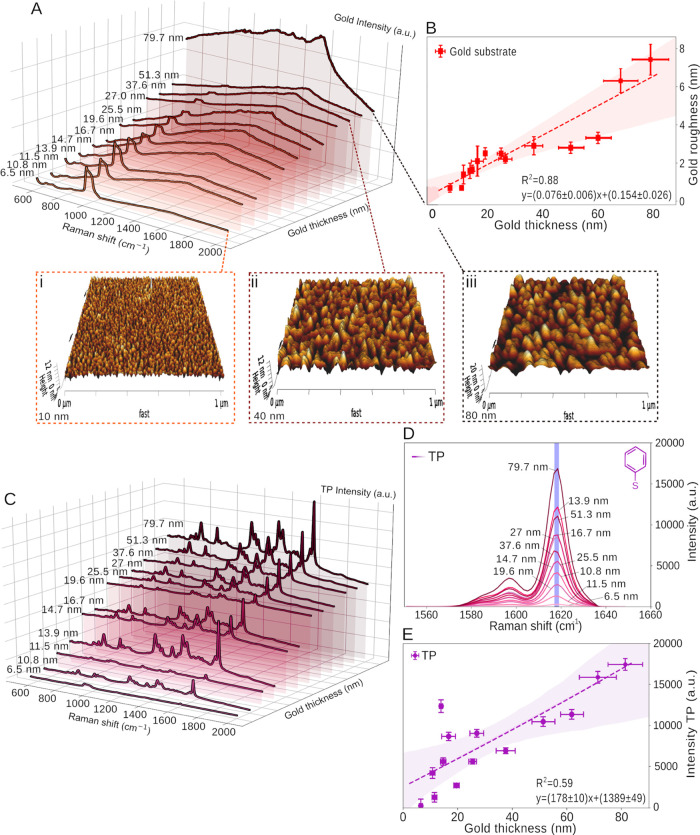
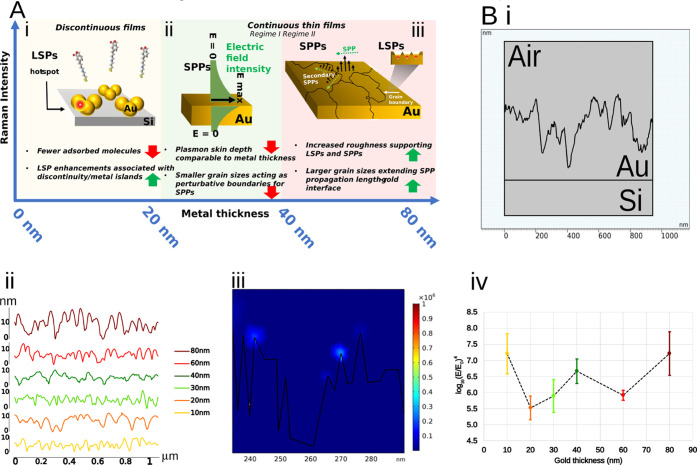
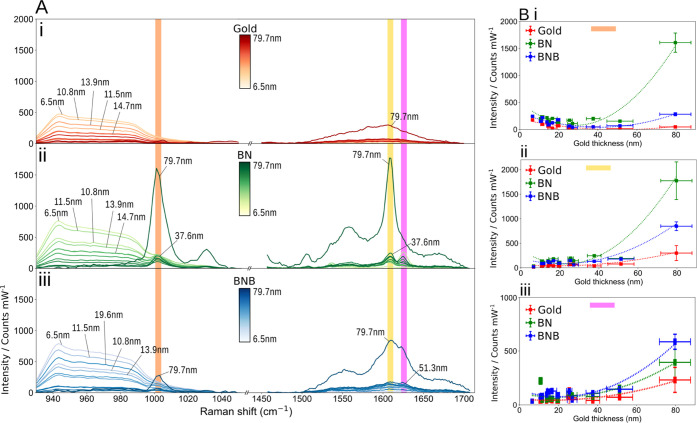
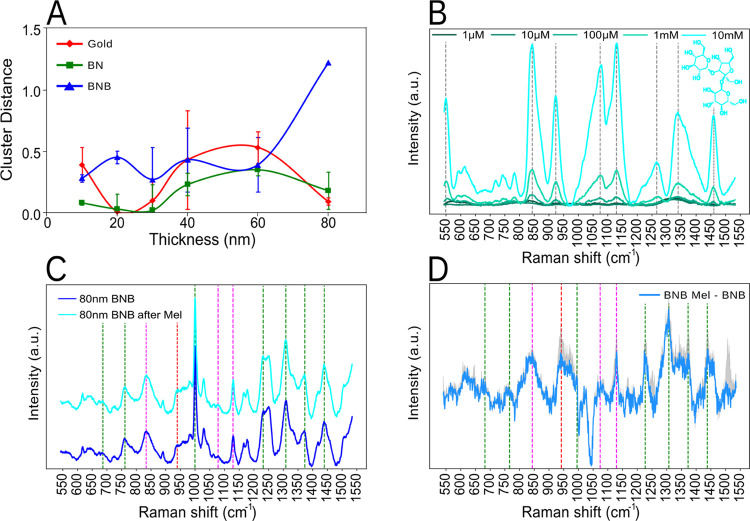
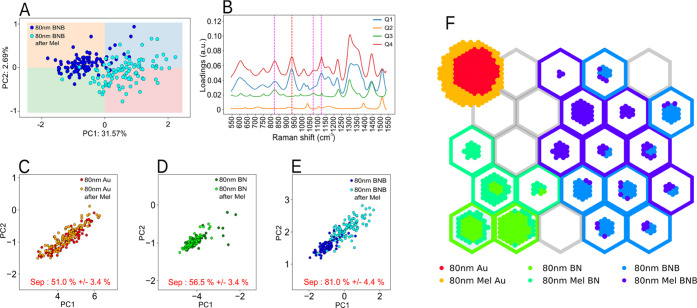
Diagnostic advancements require continuous developments of reliable analytical sensors, which can simultaneously fulfill many criteria, including high sensitivity and specificity for a broad range of target analytes. Incorporating the highly sensitive attributes of surface-enhanced Raman spectroscopy (SERS) combined with highly specific analyte recognition capabilities via molecular surface functionalization could address major challenges in molecular diagnostics and analytical spectroscopy fields. Herein, we have established a controllable molecular surface functionalization process for a series of textured gold surfaces. To create the molecularly surface-functionalized SERS platforms, self-assembled benzyl-terminated and benzoboroxole-terminated monolayers were used to compare which thicknesses and root-mean-square (RMS) roughness of planar gold produced the most sensitive and specific surfaces. Optimal functionalization was identified at 80 ± 8 nm thickness and 7.2 ± 1.0 nm RMS. These exhibited a considerably higher SERS signal (70-fold) and improved sensitivity for polysaccharides when analyzed using principal component analysis (PCA) and self-organizing maps (SOM). These findings lay the procedure for establishing the optimal substrate specifications as an essential prerequisite for future studies aiming at developing the feasibility of molecular imprinting for SERS diagnostic applications and the subsequent delivery of advanced, highly selective, and sensitive sensing devices and analytical platforms.
诊断技术的进步需要不断开发可靠的分析传感器,这些传感器要能同时满足多项标准,包括对多种目标分析物具有高灵敏度和高特异性。将表面增强拉曼光谱(SERS)的高灵敏度特性与通过分子表面功能化实现的高特异性分析物识别能力相结合,可以解决分子诊断和分析光谱领域的重大挑战。在此,我们为一系列有纹理的金表面建立了可控的分子表面功能化过程。为了创建分子表面功能化的SERS平台,使用了自组装的苄基封端和苯并硼恶唑封端的单层膜,以比较平面金的哪些厚度和均方根(RMS)粗糙度能产生最灵敏和特异的表面。在厚度为80±8nm、RMS为7.2±1.0nm时确定了最佳功能化。使用主成分分析(PCA)和自组织映射(SOM)分析时,这些表面对多糖表现出显著更高的SERS信号(70倍)和更高的灵敏度。这些发现为确定最佳底物规格奠定了程序基础,这是未来旨在开发用于SERS诊断应用的分子印迹可行性以及随后提供先进、高选择性和灵敏传感装置及分析平台的研究的必要前提。