The Second Clinical Medical College, Zhejiang Chinese Medical University, Binwen Road, 310053, Hangzhou, China.
Department of Traditional Chinese Medicine, The First Affiliated Hospital, College of Medicine, Zhejiang University, Qingchun Road, 310003, Hangzhou, China.
Comb Chem High Throughput Screen. 2023;26(6):1224-1232. doi: 10.2174/1386207325666220823144054.
Radix Paeoniae Alba is a traditional Chinese herbal medicine. It can accelerate salivary secretion and alleviate the dry mouth of patients with Sjogren's syndrome (SS). Although it is widely used in clinical treatment, its target and mechanism remain unclear.
This study aims to analyze the main components of Radix Paeoniae Alba, explore the target genes, and propose the possible mechanism for Radix Paeoniae Alba's acceleration of salivary secretion.
The main active components and potential targets of Radix Paeoniae Alba were searched through the TCMSP database. Efforts were made to search for the related genes of Sjogren's syndrome in OMIM and GeneCards databases. Cytoscape v3.8.0 software was used to link target genes of active components and key genes of the disease. The software Autodock vina1.1.2. was adopted to simulate the interaction between active components and target genes. Human submandibular gland (HSG) cells were used in vitro experiments to verify the results of our analysis.
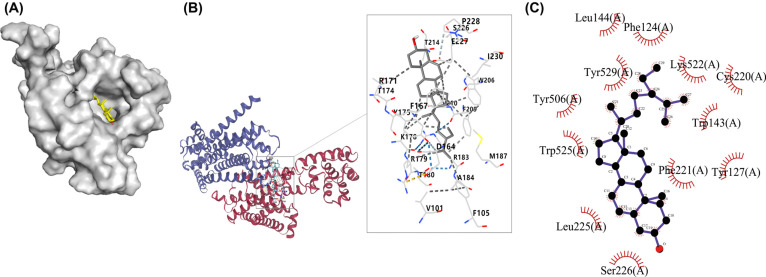
β-Sitosterol, the main component of Radix Paeoniae Alba, may intervene in the disease through CHRM3. Molecular docking shows β-Sitosterol has a high affinity with CHRM3, and the interaction between CHRM3 and β-Sitosterol is the basis of biological activity. The in vitro experiments showed that β-Sitosterol could significantly up-regulate the mRNA and protein expression levels of both CHRM3 and secretion-related genes in HSG cells.
Our study shows that the chemical components of Radix Paeoniae Alba have a positive effect on the related mechanism of salivary secretion. We found that β-Sitosterol can promote the expression of CHRM3, stimulate salivary secretion, treat Sjogren's syndrome and potentially improve its prognosis.
白芍是一种传统的中药。它可以促进唾液分泌,缓解干燥综合征(SS)患者的口干症状。尽管它在临床治疗中广泛应用,但它的靶点和机制仍不清楚。
本研究旨在分析白芍的主要成分,探讨其潜在靶点,并提出白芍促进唾液分泌的可能机制。
通过 TCMSP 数据库搜索白芍的主要活性成分和潜在靶点,在 OMIM 和 GeneCards 数据库中搜索干燥综合征相关基因。使用 Cytoscape v3.8.0 软件将活性成分的靶基因与疾病的关键基因进行关联。采用 Autodock vina1.1.2 软件模拟活性成分与靶基因的相互作用。采用体外实验验证分析结果。
白芍的主要成分β-谷甾醇可能通过 CHRM3 干预疾病。分子对接表明β-谷甾醇与 CHRM3 具有很高的亲和力,CHRM3 与β-谷甾醇的相互作用是其生物活性的基础。体外实验表明,β-谷甾醇能显著上调 HSG 细胞中 CHRM3 及其分泌相关基因的 mRNA 和蛋白表达水平。
本研究表明白芍的化学成分对唾液分泌的相关机制有积极作用。我们发现β-谷甾醇可以促进 CHRM3 的表达,刺激唾液分泌,治疗干燥综合征,并可能改善其预后。