Shenzhen Key Laboratory of Drug Addiction, Shenzhen Neher Neural Plasticity Laboratory, the Brain Cognition and Brain Disease Institute, Shenzhen Institute of Advanced Technology, Chinese Academy of Sciences; Shenzhen-Hong Kong Institute of Brain Science-Shenzhen Fundamental Research Institutions, Shenzhen, 518055, China.
University of Chinese Academy of Sciences, 100049, Beijing, China.
Mol Psychiatry. 2022 Dec;27(12):4843-4860. doi: 10.1038/s41380-022-01742-0. Epub 2022 Aug 26.
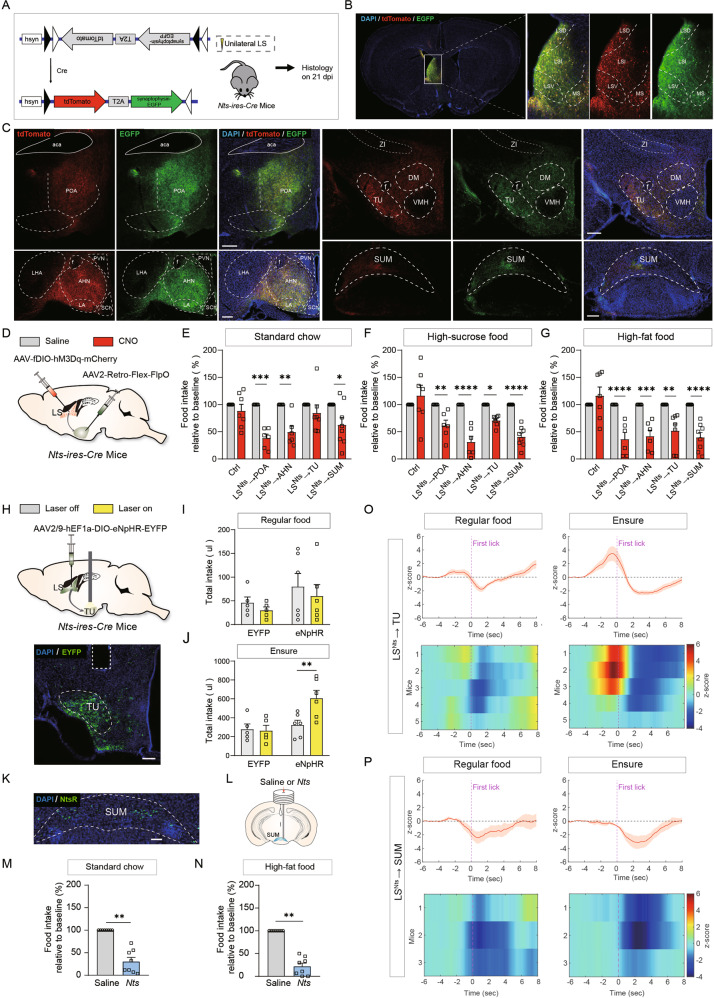
Feeding behavior is regulated by both the homeostatic needs of the body and hedonic values of the food. Easy access to palatable energy-dense foods and the consequent obesity epidemic stress the urgent need for a better understanding of neural circuits that regulate hedonic feeding. Here, we report that neurotensin-positive neurons in the lateral septum (LS) play a crucial role in regulating hedonic feeding. Silencing LS specifically promotes feeding of palatable food, whereas activation of LS suppresses overall feeding. LS neurons project to the tuberal nucleus (TU) via GABA signaling to regulate hedonic feeding, while the neurotensin signal from LS→the supramammillary nucleus (SUM) is sufficient to suppress overall feeding. In vivo calcium imaging and optogenetic manipulation reveal two populations of LS neurons that are activated and inhibited during feeding, which contribute to food seeking and consumption, respectively. Chronic activation of LS or LS→TU is sufficient to reduce high-fat diet-induced obesity. Our findings suggest that LS→TU is a key pathway in regulating hedonic feeding.
摄食行为受身体的稳态需求和食物的享乐价值调节。容易获得美味的高能量食物以及随之而来的肥胖流行,强调了急需更好地了解调节享乐性摄食的神经回路。在这里,我们报告外侧隔核(LS)中的神经降压素阳性神经元在调节享乐性摄食中起关键作用。LS 的沉默特异性促进美味食物的摄食,而 LS 的激活则抑制整体摄食。LS 神经元通过 GABA 信号投射到结节核(TU)以调节享乐性摄食,而 LS→穹隆下核(SUM)的神经降压素信号足以抑制整体摄食。体内钙成像和光遗传学操作揭示了在摄食过程中被激活和抑制的 LS 神经元的两个群体,它们分别有助于食物寻找和消耗。LS 或 LS→TU 的慢性激活足以减少高脂肪饮食诱导的肥胖。我们的发现表明 LS→TU 是调节享乐性摄食的关键途径。