Department of Public Health, Research Unit in Exercise Biology, Aarhus University, Aarhus, Denmark.
Department of Sports Science and Clinical Biomechanics, University of Southern Denmark, Odense, Denmark.
J Physiol. 2022 Nov;600(21):4713-4730. doi: 10.1113/JP283225. Epub 2022 Sep 18.
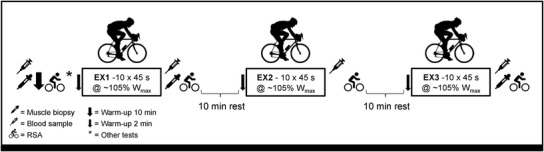
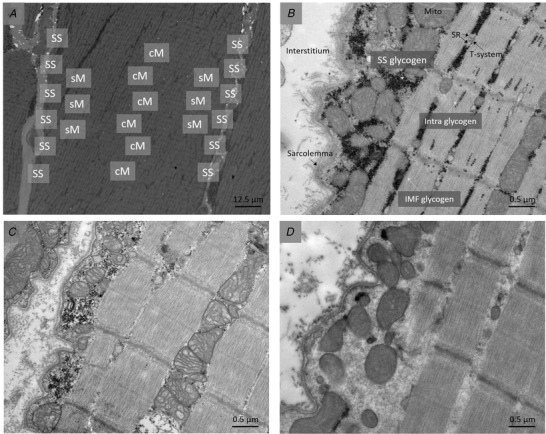
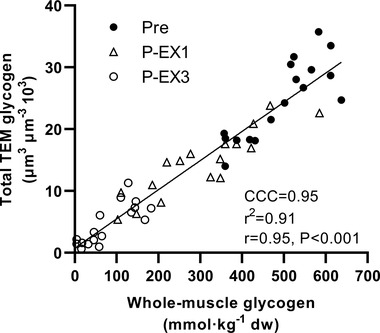
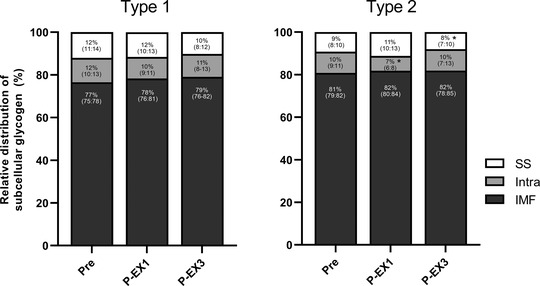
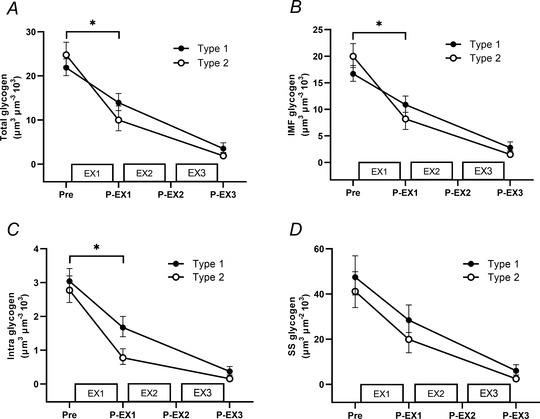
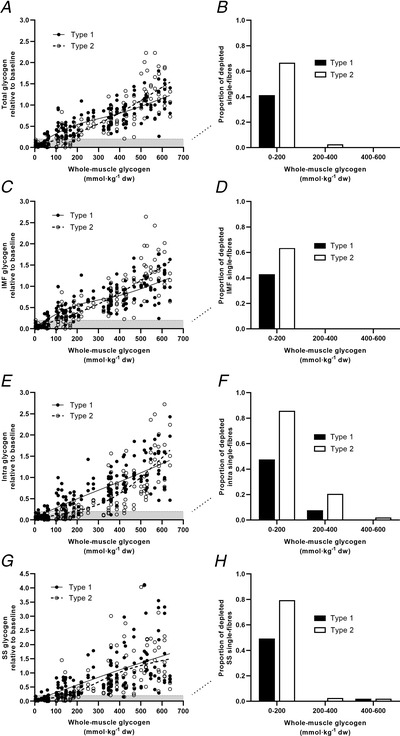
Glycogen particles are situated in key areas of the muscle cell in the vicinity of the main energy-consumption sites and may be utilised heterogeneously dependent on the nature of the metabolic demands. The present study aimed to investigate the time course of fibre type-specific utilisation of muscle glycogen in three distinct subcellular fractions (intermyofibrillar, IMF; intramyofibrillar, Intra; and subsarcolemmal, SS) during repeated high-intensity intermittent exercise. Eighteen moderately to well-trained male participants performed three periods of 10 × 45 s cycling at ∼105% watt max (EX1-EX3) coupled with 5 × 6 s maximal sprints at baseline and after each period. Muscle biopsies were sampled at baseline and after EX1 and EX3. A higher glycogen breakdown rate in type 2 compared to type 1 fibres was found during EX1 for the Intra (-72 vs. -45%) and IMF (-59 vs. -35%) glycogen fractions (P < 0.001) but with no differences for SS glycogen (-52 vs. -40%). In contrast, no fibre type differences were observed during EX2-EX3, where the utilisation of Intra and IMF glycogen in type 2 fibres was reduced, resulting in depletion of all three subcellular fractions to very low levels post-exercise within both fibre types. Importantly, large heterogeneity in single-fibre glycogen utilisation was present with an early depletion of especially Intra glycogen in individual type 2 fibres. In conclusion, there is a clear fibre type- and localisation-specific glycogen utilisation during high-intensity intermittent exercise, which varies with time course of exercise and is characterised by exacerbated pool-specific glycogen depletion at the single-fibre level. KEY POINTS: Muscle glycogen is the major fuel during high-intensity exercise and is stored in distinct subcellular areas of the muscle cell in close vicinity to the main energy consumption sites. In the present study quantitative electron microscopy imaging was used to investigate the utilisation pattern of three distinct subcellular muscle glycogen fractions during repeated high-intensity intermittent exercise. It is shown that the utilisation differs dependent on fibre type, subcellular localisation and time course of exercise and with large single-fibre heterogeneity. These findings expand on our understanding of subcellular muscle glycogen metabolism during exercise and may help us explain how reductions in muscle glycogen can attenuate muscle function even at only moderately lowered whole-muscle glycogen concentrations.
糖原颗粒位于肌肉细胞的关键区域,靠近主要的能量消耗部位,并且可能根据代谢需求的性质不均匀地被利用。本研究旨在探讨在重复高强度间歇运动过程中,三种不同的亚细胞部分(肌间、肌内和肌下)中肌肉糖原的纤维类型特异性利用的时间过程。18 名中等至高水平训练的男性参与者进行了 3 个周期的 10×45 秒自行车运动,约为 105%瓦最大值(EX1-EX3),并在基线和每个周期后进行了 5×6 秒最大冲刺。在基线和 EX1 和 EX3 后采集肌肉活检。在 EX1 期间,2 型纤维的糖原分解率高于 1 型纤维,在肌内(-72%比-45%)和肌间(-59%比-35%)糖原分数中发现(P<0.001),但在肌下糖原中没有差异(-52%比-40%)。相比之下,在 EX2-EX3 期间没有观察到纤维类型差异,在 2 型纤维中肌内和肌间糖原的利用减少,导致两种纤维类型的所有三个亚细胞部分在运动后都非常低的水平耗竭。重要的是,在单个纤维糖原利用中存在明显的纤维类型和局部特有的异质性,特别是在个体 2 型纤维中,肌内糖原的早期耗竭。总之,高强度间歇运动过程中存在明显的纤维类型和局部特有的糖原利用,这随着运动的时间过程而变化,其特征是在单个纤维水平上加剧了特定糖原池的耗竭。关键点:肌肉糖原是高强度运动的主要燃料,储存在肌肉细胞的不同亚细胞区域,靠近主要能量消耗部位。在本研究中,定量电子显微镜成像用于研究在重复高强度间歇运动过程中三种不同的亚细胞肌肉糖原分数的利用模式。结果表明,利用方式取决于纤维类型、亚细胞定位和运动的时间过程,并具有较大的单纤维异质性。这些发现扩展了我们对运动过程中亚细胞肌肉糖原代谢的理解,并有助于我们解释为什么即使在肌肉糖原浓度仅适度降低的情况下,肌肉糖原的减少也会削弱肌肉功能。