Ji Lichen, Zhang Wei, Zhong Xugang, Zhao Tingxiao, Sun Xixi, Zhu Senbo, Tong Yu, Luo Junchao, Xu Youjia, Yang Di, Kang Yao, Wang Jin, Bi Qing
Department of Orthopedics, Zhejiang Provincial People's Hospital, Hangzhou, China.
Department of Orthopedics, The Second Affiliated Hospital and Yuying Children's Hospital of Wenzhou Medical University, Wenzhou, China.
Front Oncol. 2022 Aug 12;12:973307. doi: 10.3389/fonc.2022.973307. eCollection 2022.
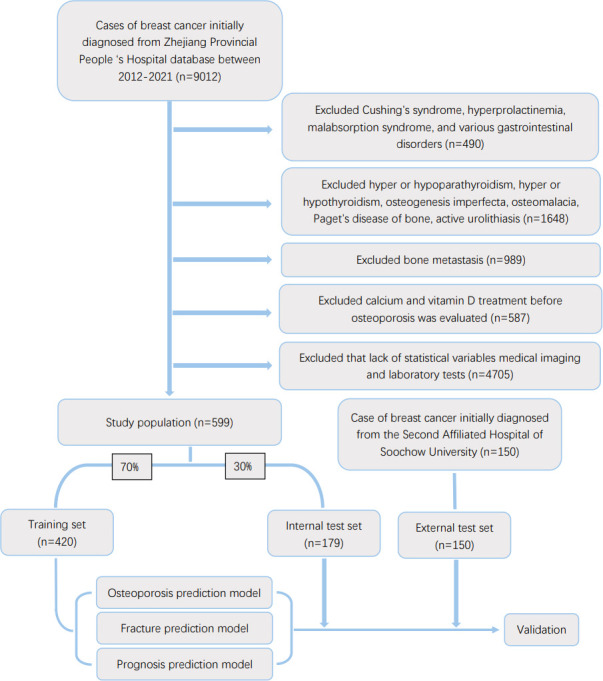
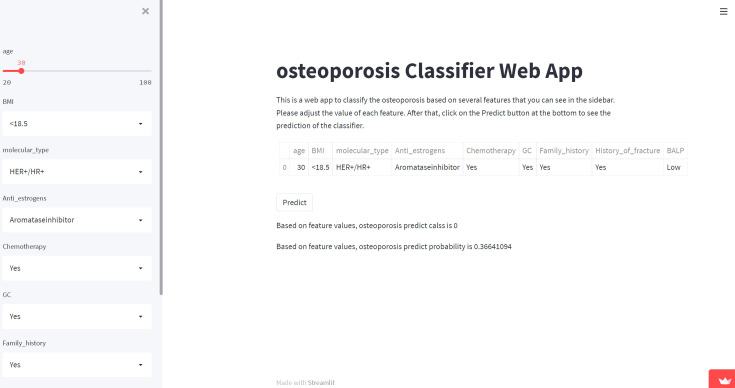
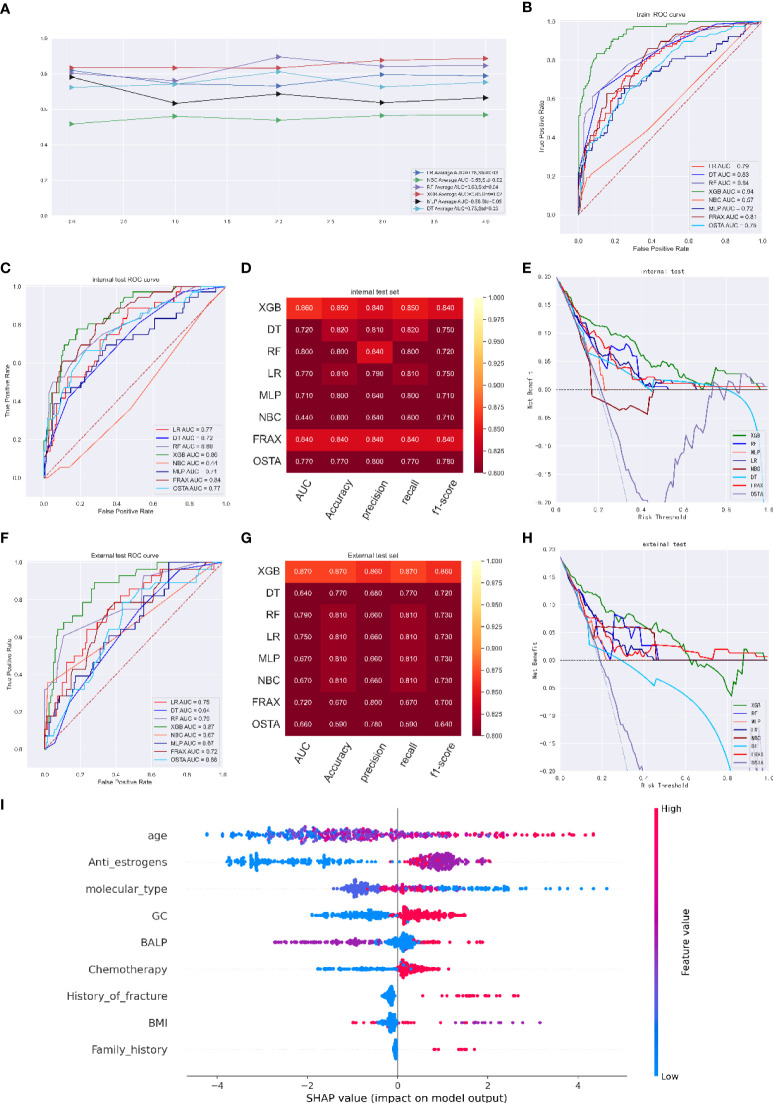
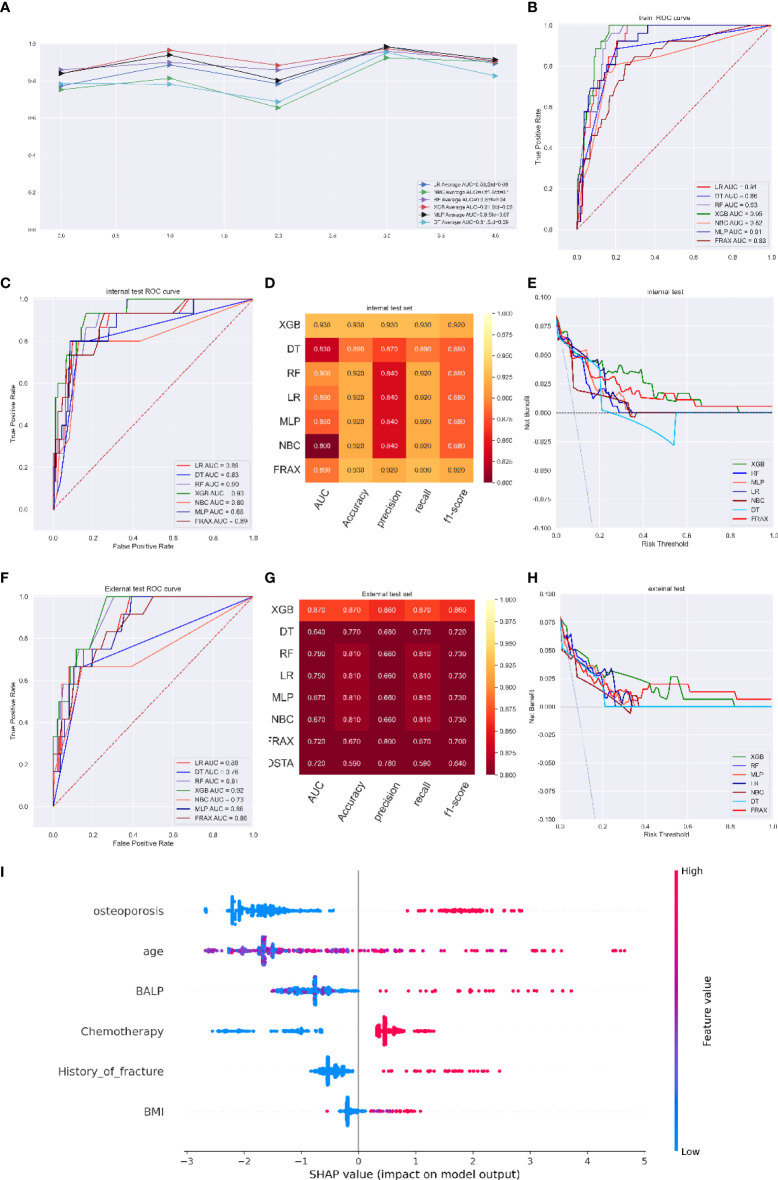
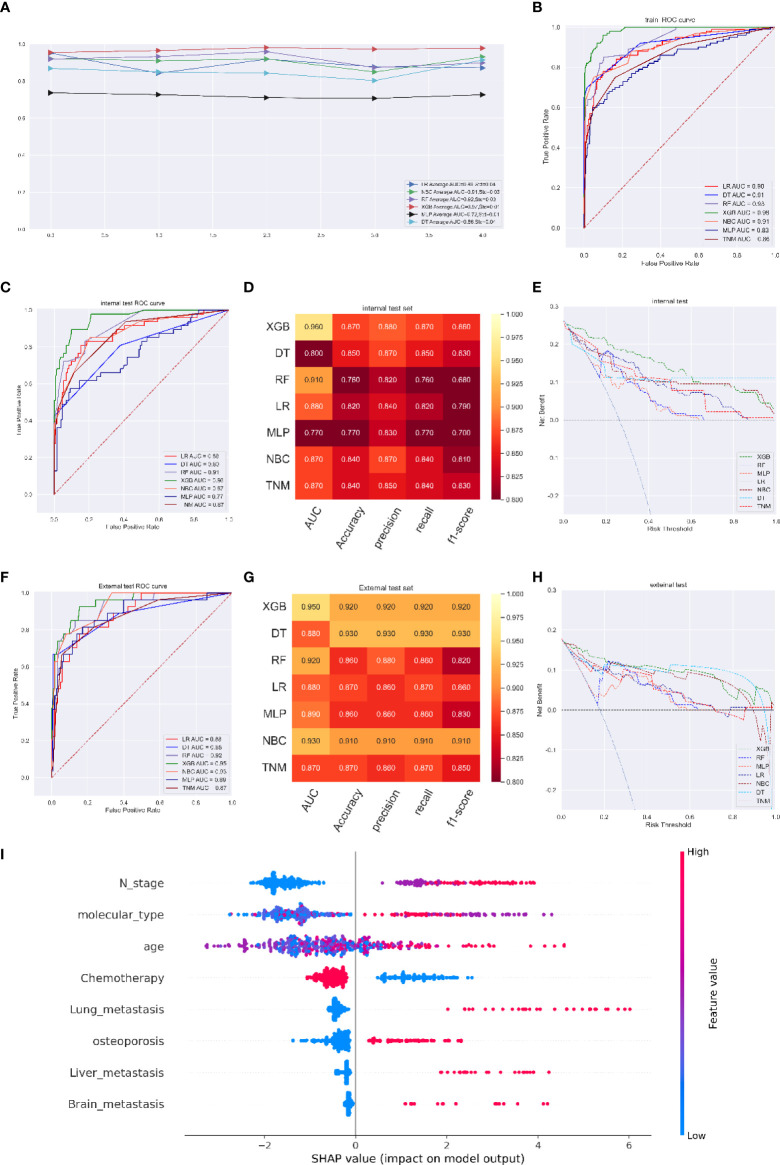
The risk of osteoporosis in breast cancer patients is higher than that in healthy populations. The fracture and death rates increase after patients are diagnosed with osteoporosis. We aimed to develop machine learning-based models to predict the risk of osteoporosis as well as the relative fracture occurrence and prognosis. We selected 749 breast cancer patients from two independent Chinese centers and applied six different methods of machine learning to develop osteoporosis, fracture and survival risk assessment models. The performance of the models was compared with that of current models, such as FRAX, OSTA and TNM, by applying ROC, DCA curve analysis, and the calculation of accuracy and sensitivity in both internal and independent external cohorts. Three models were developed. The XGB model demonstrated the best discriminatory performance among the models. Internal and external validation revealed that the AUCs of the osteoporosis model were 0.86 and 0.87, compared with the FRAX model (0.84 and 0.72)/OSTA model (0.77 and 0.66), respectively. The fracture model had high AUCs in the internal and external cohorts of 0.93 and 0.92, which were higher than those of the FRAX model (0.89 and 0.86). The survival model was also assessed and showed high reliability internal and external validation (AUC of 0.96 and 0.95), which was better than that of the TNM model (AUCs of 0.87 and 0.87). Our models offer a solid approach to help improve decision making.
乳腺癌患者患骨质疏松症的风险高于健康人群。患者被诊断为骨质疏松症后,骨折和死亡率会增加。我们旨在开发基于机器学习的模型,以预测骨质疏松症的风险以及相对骨折发生率和预后。我们从两个独立的中国中心选取了749例乳腺癌患者,并应用六种不同的机器学习方法来开发骨质疏松症、骨折和生存风险评估模型。通过应用ROC、DCA曲线分析以及计算内部和独立外部队列中的准确性和敏感性,将这些模型的性能与当前模型(如FRAX、OSTA和TNM)进行比较。开发了三个模型。XGB模型在这些模型中表现出最佳的区分性能。内部和外部验证显示,骨质疏松症模型的AUC分别为0.86和0.87,而FRAX模型为(0.84和0.72)/OSTA模型为(0.77和0.66)。骨折模型在内部和外部队列中的AUC较高,分别为0.93和0.92,高于FRAX模型(0.89和0.86)。还对生存模型进行了评估,结果显示其在内部和外部验证中具有较高的可靠性(AUC为0.96和0.95),优于TNM模型(AUC为0.87和0.87)。我们的模型提供了一种可靠的方法来帮助改善决策。