Landry Megan, Vyas Amita, Nagaraj Nitasha, Sardon Gary A, Bornstein Sydney, Latif Hannah, Kucherlapaty Padmini, McDonnell Karen, Castel Amanda, Goldman Lynn
Office of the Dean, Milken Institute School of Public Health, The George Washington University, Washington, DC, United States.
Department of Prevention and Community Health, Milken Institute School of Public Health, The George Washington University, Washington, DC, United States.
Interact J Med Res. 2022 Sep 13;11(2):e39230. doi: 10.2196/39230.
Academic institutions are central hubs for young adults, laden with academic and social interactions and communal living arrangements, heightening the risk of transmission of many communicable diseases, including COVID-19. Shortly after the start of the fall 2020 academic year, institutions of higher learning were identified as hot spots for rises in COVID-19 incidence among young adults.
This study aims to identify the characteristics of student SARS-CoV-2 cases, identify the extent to which the student population adhered to preventative strategies, and examine behaviors that would put them at higher risk of contracting or spreading COVID-19.
This observational study comprises 1175 university students at The George Washington University in Washington, DC, with a confirmed COVID-19 diagnosis between August 3, 2020, and November 30, 2021. Case investigation and contact tracing tools were developed by the Campus COVID-19 Support Team and captured in REDCap (Research Electronic Data Capture). Trained case investigators were notified of a case and attempted to contact all cases within 24 hours of the case receiving their lab result. Associations between case characteristics and number of contacts were examined using Wilcoxon rank sum tests. Knowledge of exposure, behaviors since exposure, student residence status, and fraternity and sorority life affiliation were examined using chi-square tests.
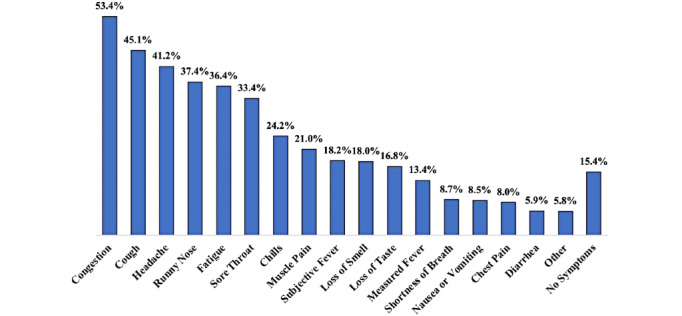
Positive student cases reported a median of 3 close contacts, and 84.6% (993/1175) reported at least one symptom with a median of 4 COVID-19 symptoms. Congestion (628/1175, 53.4%), cough (530/1175, 45.1%), and headache (484/1175, 41.2%) were the most frequently reported symptoms. Moreover, 36% (415/1160) reported that they did not know how they were exposed to the virus. Among those aware of contact with a COVID-19 confirmed case, 55.1% (109/198) reported the contact was a close friend or family member, and 25.3% (50/198) reported that it was someone with whom they lived. Athlete (vs nonathlete; P<.001), on-campus (vs off-campus; P<.001), and undergraduate (vs graduate; P=.01) students all reported a significantly higher number of contacts. Students living on campus were more likely to report attending campus events in the 2 days prior to symptom onset or positive test result (P=.004). Students with fraternity or sorority affiliation were more likely to report attending campus events in the 2 days prior to symptom onset or positive test result (P<.001).
COVID-19 cases have not yet stabilized to a predictable state, but this study provides case characteristics and insights for how academic institutions might prepare to mitigate outbreaks on their campuses as the world plans for the transition from pandemic to endemic COVID-19.
学术机构是年轻人的核心场所,充满了学术和社交互动以及集体生活安排,这增加了包括新冠病毒病(COVID-19)在内的许多传染病传播的风险。在2020年秋季学年开始后不久,高等院校就被确定为年轻人中COVID-19发病率上升的热点地区。
本研究旨在确定感染严重急性呼吸综合征冠状病毒2(SARS-CoV-2)的学生病例的特征,确定学生群体遵守预防策略的程度,并研究使他们感染或传播COVID-19风险更高的行为。
这项观察性研究纳入了华盛顿特区乔治华盛顿大学的1175名大学生,他们在2020年8月3日至2021年11月30日期间被确诊感染COVID-19。校园COVID-19支持团队开发了病例调查和接触者追踪工具,并在REDCap(研究电子数据采集)中进行记录。经过培训的病例调查员在得知病例后,会在病例收到实验室检测结果后的24小时内尝试联系所有病例。使用Wilcoxon秩和检验来检查病例特征与接触者数量之间的关联。使用卡方检验来检查暴露知识、暴露后的行为、学生居住状况以及兄弟会和姐妹会成员身份。
确诊感染的学生病例报告的密切接触者中位数为3人,84.6%(993/1175)报告至少有1种症状,COVID-19症状的中位数为4种。鼻塞(628/1175,53.4%)、咳嗽(530/1175,45.1%)和头痛(484/1175,41.2%)是报告最频繁的症状。此外,36%(415/1160)报告他们不知道自己是如何感染病毒的。在那些知道与确诊COVID-19病例有接触的人中,55.1%(109/198)报告接触者是亲密朋友或家庭成员,25.3%(50/198)报告是与他们同住的人。运动员(与非运动员相比;P<0.001)、在校(与校外相比;P<0.001)以及本科生(与研究生相比;P=0.01)报告的接触者数量均显著更多。住在校园里的学生更有可能报告在症状出现或检测呈阳性结果前2天参加了校园活动(P=0.004)。有兄弟会或姐妹会成员身份的学生更有可能报告在症状出现或检测呈阳性结果前2天参加了校园活动(P<0.001)。
COVID-19病例尚未稳定到可预测的状态,但本研究提供了病例特征,并为学术机构在全球计划从COVID-19大流行过渡到地方性流行时如何准备减轻校园疫情爆发提供了见解。